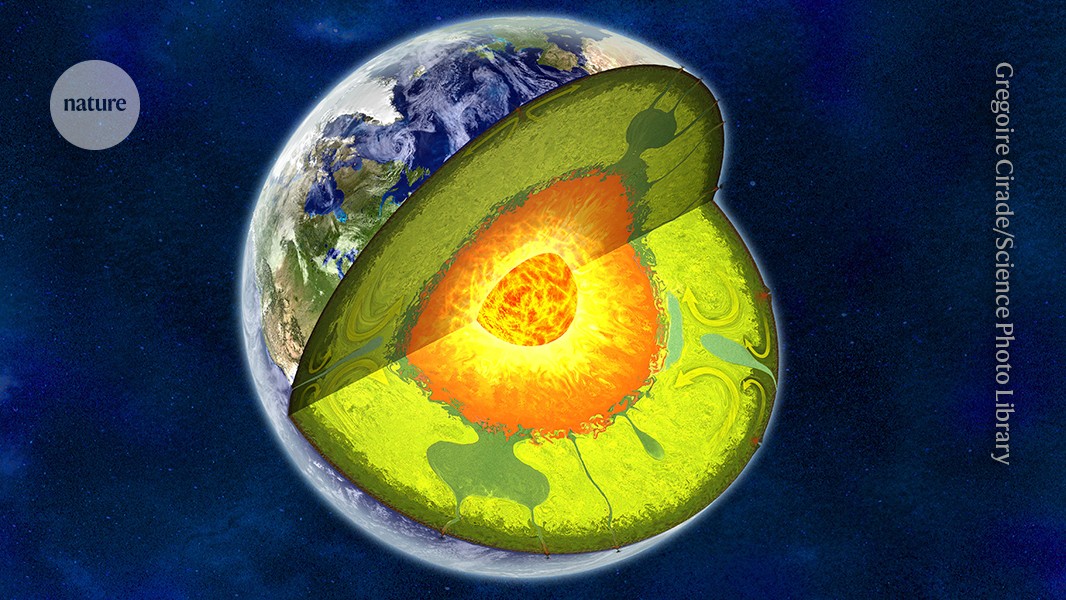
Researchers at the University of Science and Technology of China discovered that Earth’s core may be releasing hydrogen, helium, and tungsten into the mantle. The study combines machine learning with path-integral simulations to reveal deep chemical exchanges over the planet’s 4.5-billion-year history.
For decades, geophysicists operated on a neat and orderly picture of planetary formation. When Earth formed as a blazing, largely molten ball roughly 4.5 billion years ago, gravity sorted its contents by density. Heavier materials plunged inward to pool in the metallic core, while lighter materials stayed behind to form the mantle and crust. According to that classic framework, the deep interior essentially locked its doors once the sorting finished, leaving the core isolated from the layers above.
A new study published in Science Advances challenges that timeline. A team of geoscientists based in Hefei demonstrated that Earth’s core and mantle have been exchanging materials across billions of years of evolution. Rather than sitting as a stagnant time capsule, the boundary between the planet’s core and mantle acts as a leaky valve.
Path-Integral Simulations and Quantum Mechanics at the Core Boundary
To track elements moving across such extreme depths, the research team deployed computational tools tailored to the bizarre physics of the deep Earth. Hydrogen proved especially challenging because its low mass makes it subject to quantum quirks that traditional models miss. To crack the problem, the scientists relied on machine-learning-boosted path-integral simulations
to investigate the quantum action of molecules and atoms deep inside the planet.
The investigators specifically examined the ratio of deuterium to regular hydrogen. They tested whether the chemical differences seen in the deep mantle were mere leftovers from the planet’s initial crystallization from a magma ocean, or if active transport from the core was to blame. Their crystallization models revealed that isotope separation between minerals and melt should have been weak, meaning the ancient mantle should have acquired a relatively uniform hydrogen isotopic composition.
Collectively, these results indicate that magma ocean crystallization yields a primitive mantle with an essentially homogeneous hydrogen isotope composition, despite large variations in pressure, temperature, and model assumptions.
Researchers from the University of Science and Technology of China, via ScienceAlert
The calculations showed that the starting hydrogen isotope composition of the magma ocean mattered most.
Hydrogen, Helium, and Tungsten Tracing Deep Interior Upwellings
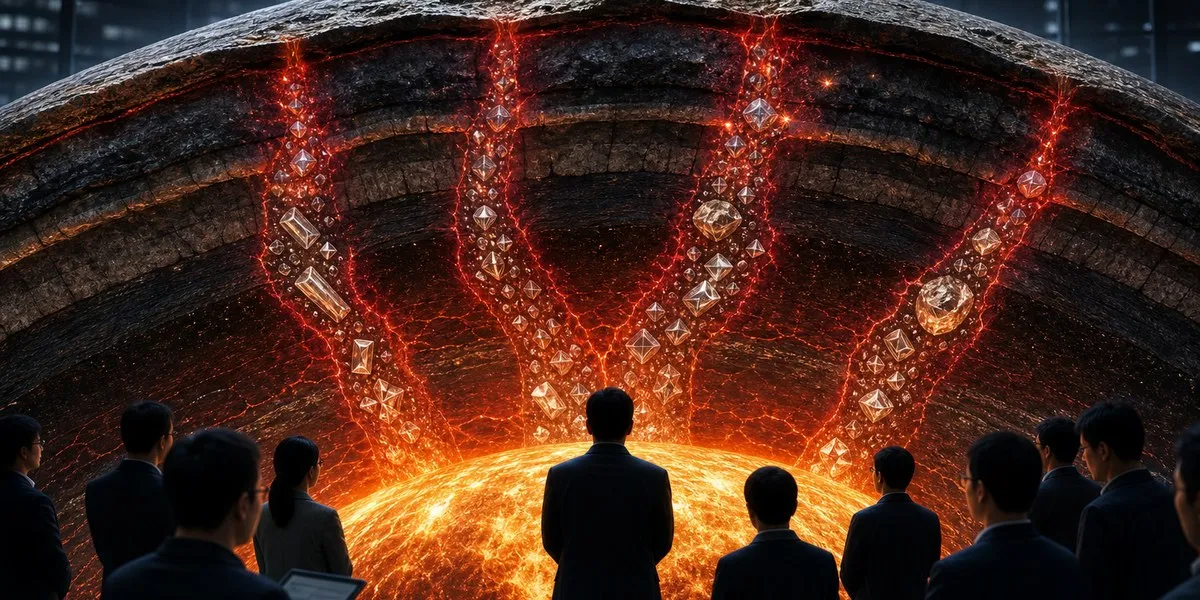
The leaking core leaves distinct chemical calling cards in volcanic rocks that erupt on the surface. Ocean island basalts form when plumes of hot material rise from near the core-mantle boundary, carrying ancient signatures upward. These specialized lavas emerge in places like Baffin Island in Nunavut, Canada, and in Iceland.
Hydrogen escaping from the core enriches the mantle above it and lowers its deuterium-to-hydrogen ratio, explaining unusual measurements found in these volcanic formations. Helium provides a second independent line of evidence. Helium-3 is a primordial isotope left over from the formation of the solar system and the Big Bang, whereas helium-4 builds up steadily through radioactive decay in the upper layers. Elevated ratios of helium-3 to helium-4 inside ocean island basalts point straight back to an influx from deep subterranean reservoirs.
Tungsten rounds out the geochemical triumvirate. Heavy tungsten sank during the planet’s initial formation to concentrate heavily in the core. Yet specific tungsten isotope signatures hitch rides on rising thermal plumes, tracing core materials as they are regurgitated upward through Earth’s interior.
Challenging Long-Held Assumptions About Deep Mantle Reservoirs
These combined isotope ratios force geophysicists to rethink what signatures in the deep lower mantle actually mean. For decades, researchers assumed that anomalous chemical pockets deep inside the planet were pristine relics untouched since early formation.
These findings suggest that even if primordial deep-mantle reservoirs once existed, the hydrogen isotope signatures in the present-day deep lower mantle are unlikely to represent simple relics of early differentiation.
The research team, via ScienceAlert
Instead of static leftovers, those deep chemical patterns reflect dynamic modification by ongoing core-mantle exchange throughout Earth’s long evolution. Separate geophysical research published in Nature during September 2026 also links core motion to small fluctuations in the length of a 24-hour day, underscoring how active the planet’s metallic center remains. While scientists must still determine the exact volume of material escaping over time, the new simulations prove that the core is far from silent.