The probe is now performing an initial survey to uncover the physical consequences of the historic kinetic impact.
The mission, which launched in 2024, is currently positioned 25 to 30 kilometers from the binary asteroid pair, moving at a relative velocity of roughly 12 centimeters per second—a pace slower than a human walking. The guidance, navigation, and control system enabling this precise formation flying was developed by GMV in Madrid, Spain.
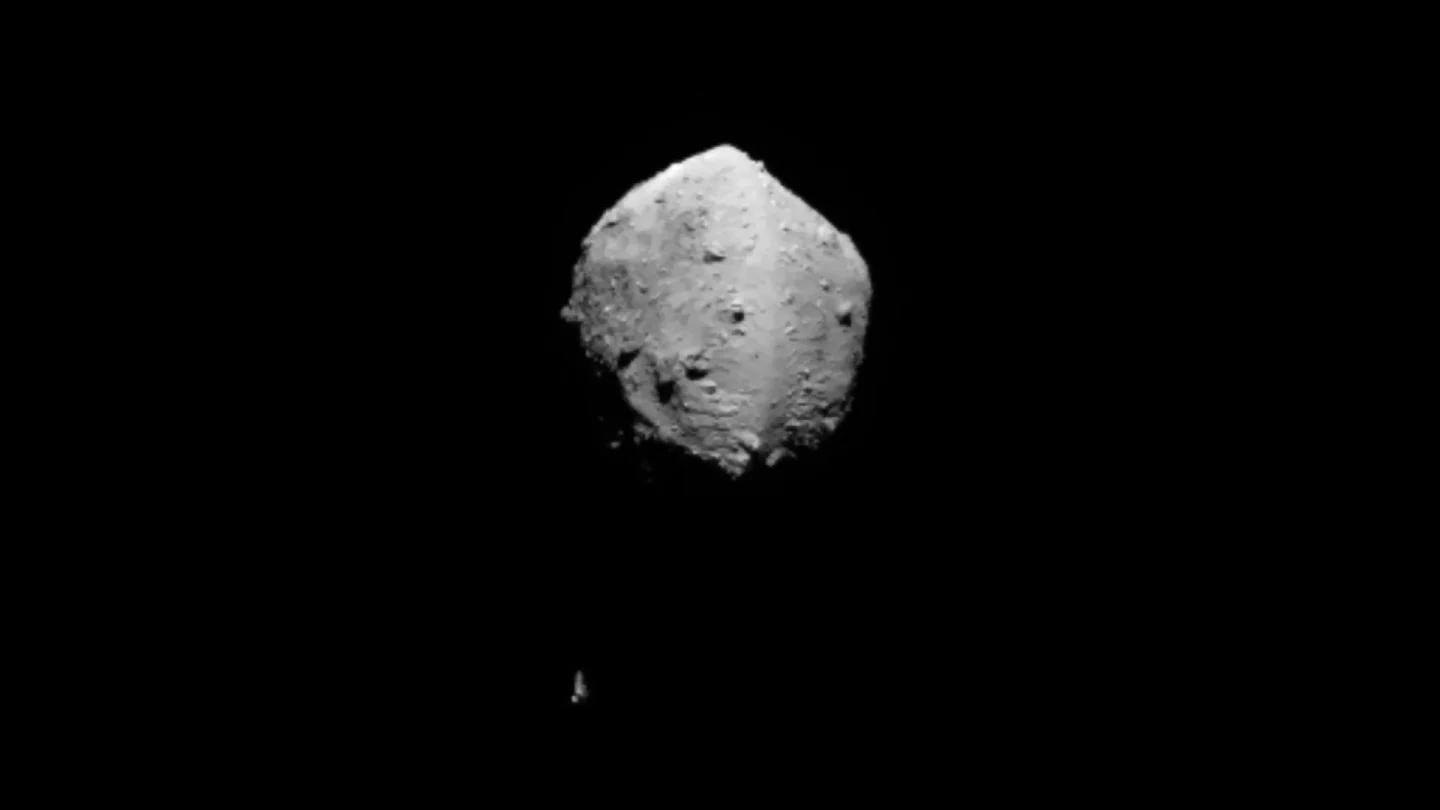
On November 5, the spacecraft’s monochromatic Asteroid Framing Camera captured an image from 60 kilometers away that provides a view of the 780-meter-wide parent asteroid, Didymos, from a side never before seen in detail. Hera had previously imaged the pair from 1,280 kilometers away on October 18, when the two bodies were first resolved as separate entities.
The first thing we said was wow! This is the other side of Didymos from the one that DART’s camera showed us shortly before impact, so this feels like looking at a whole new world. This side of Didymos has the same central ridge along its equator that we saw before, but otherwise appears very different, with multiple boulders and craters and what look like patterns of grooves or ridges.
Patrick Michel, Hera Principal Investigator and Director of Research at CNRS / Observatoire de la Côte d’Azur
According to mission scientist Michael Küppers, some of the boulders observed on the surface may be debris ejected from Dimorphos during the 2022 collision. Scientists believe this material may have traveled across the roughly 1 kilometer of space separating the two asteroids. Determining whether this transport of material contributed to the features now visible on Didymos will be a key objective for the investigation.
The DART mission deliberately struck Dimorphos on September 26, 2022, at approximately 6.6 kilometers per second. The impact shortened the moonlet’s orbit around Didymos by about 33 minutes—a result 25 times larger than the minimum threshold researchers had initially targeted. This experiment marked the first time human activity measurably altered the motion of a Solar System body.
Current estimates suggest the impact redistributed roughly 8 percent of Dimorphos’s total mass and ejected about 1 percent—nearly 15 million kilograms—into space. The impact may have also fundamentally reshaped the moonlet from an oblate spheroid into a triaxial ellipsoid.
Hera cannot maintain a traditional circular orbit. Instead, it follows a series of rectangular trajectories, performing thruster burns every few days to maintain its position. If a failure occurs during these maneuvers, the spacecraft is programmed to move away from the asteroids to avoid collision.
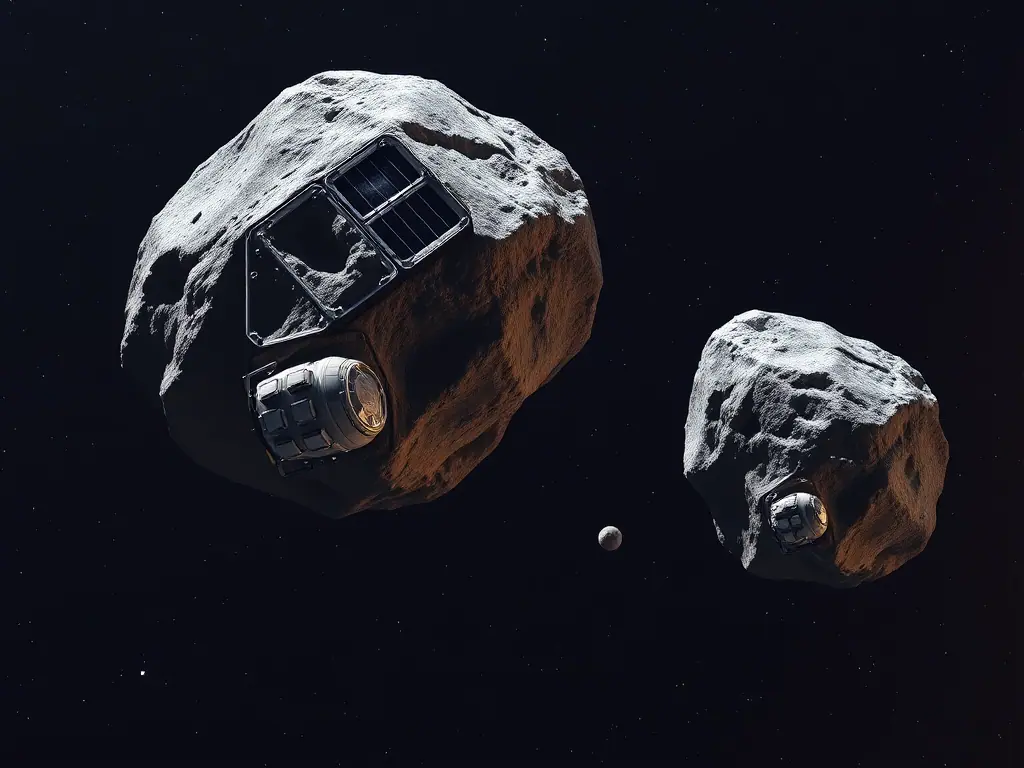
ESA has scheduled a major data release for November 25, when the first detailed images of both asteroids are expected to be unveiled. Following this, the mission enters a “Detailed Characterization Phase” in December, during which Hera will move as close as 8 to 20 kilometers to the asteroids.
Juventas carries a radar instrument with heritage from the CONSERT radar flown on the Rosetta mission, which probed the interior of comet 67P/Churyumov-Gerasimenko in 2014. These CubeSats will conduct a granular survey of the crater and the interior of the moonlet. The primary mission is currently slated to run until at least June 2027.