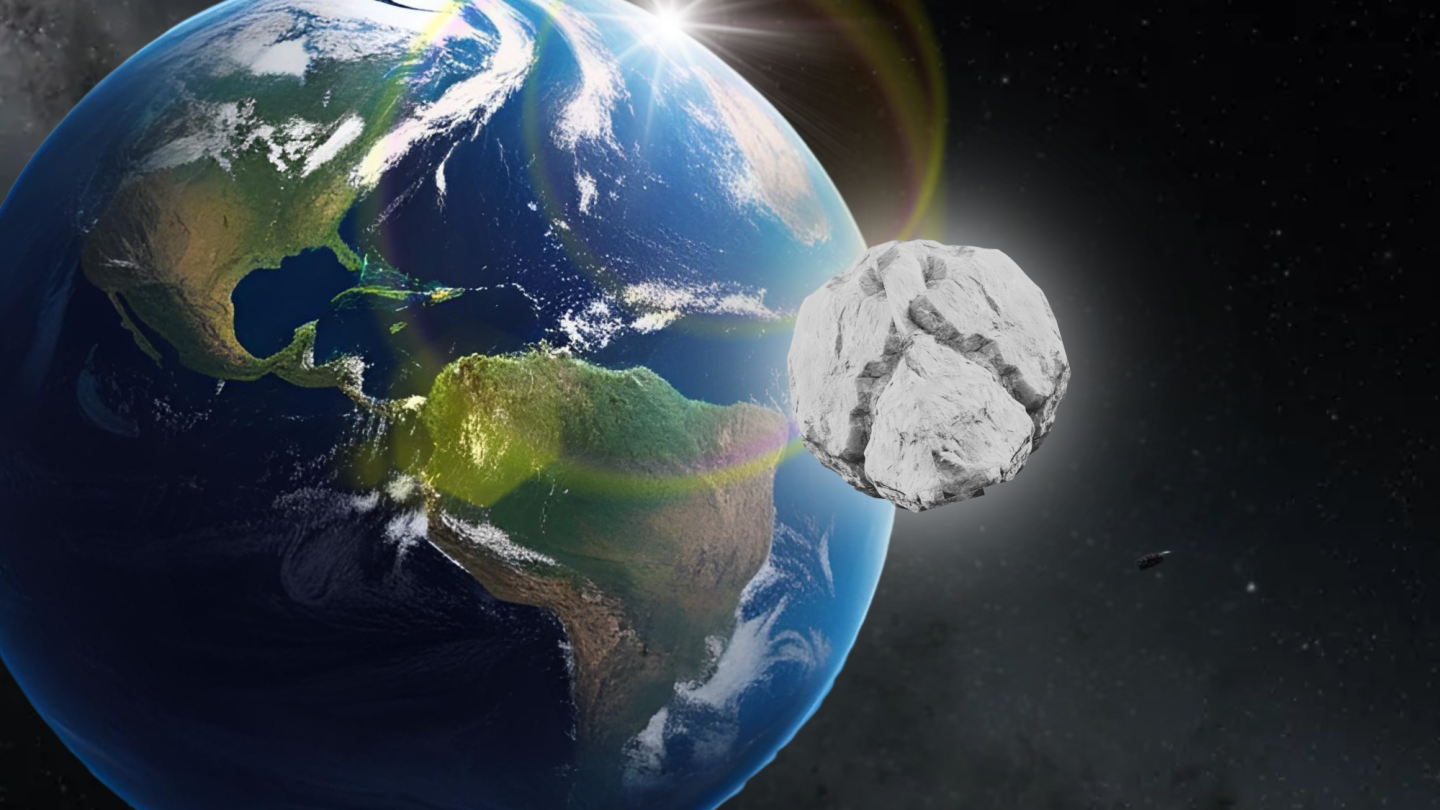
Earth has quietly acquired a temporary companion in space as a small asteroid, designated 2026 QQ8, has been pulled into orbit around our planet. Measuring roughly one to two meters across, the tiny celestial visitor arrived in late April 2026 and remained entirely unnoticed for months before its discovery was formally announced by the International Astronomical Union’s Minor Planet Center on October 29.
How Krisztián Sárneczky Spotted 2026 QQ8
The object’s journey to official recognition began on August 20, 2026, when Krisztián Sárneczky detected the rock while observing the night sky. Initial uncertainty surrounded the discovery, with researchers questioning whether the tiny body was a natural asteroid or simply discarded debris from a past space launch, such as an old rocket booster or dead satellite.
To solve the mystery, astronomers directed heavy-duty equipment toward the sky, carrying out rigorous follow-up observations using the University of Hawaii 2.2-meter telescope and the Lowell Discovery Telescope in Arizona. Data gathered from these instruments allowed experts to verify its composition. The Minor Planet Center confirmed that the body is entirely of natural origin, issuing an official statement stating that no link to a known artificial object has been found
in observations appearing in The Minor Planet Electronic Circulars.
The Mechanics of Earth’s Gravitational Capture
The rock’s temporary residency is governed by orbital mechanics and a boundary known as the Hill sphere. Outside of this specific gravitational zone, the Sun dictates how objects move, but when 2026 QQ8 crossed inside Earth’s Hill sphere in April, our planet’s gravity reeled it in. Rather than following the neat, circular path of Earth’s permanent moon, the asteroid traces an unusual, looping path around our planet.
Calculations show that the mini-moon takes approximately 359 days to complete one orbit around the Sun, a duration slightly shorter than an Earth year. While it is currently classified as a temporary satellite, it never comes exceptionally close to the surface. The minimum distance between its orbit and Earth’s is about 354,000 miles, which is roughly one and a half times the distance to our permanent moon.
Asteroid Returns Every Decade for Close Approaches
This close celestial rendezvous is not entirely unprecedented. Orbital analysis indicates that 2026 QQ8 makes a relatively close approach to Earth approximately once every decade. It passed near our planet back in 1965, though it did not come close enough at that time to be captured by gravity. Following its current departure, astronomers project that it will swing by again in 2058, though it will remain too far away to achieve mini-moon status during that encounter.
Earth frequently plays host to these short-term space rocks, with previous visitors including 2006 RH120, 2020 CD3, and 2024 PT5. Researchers suggest that Earth may actually be orbited by up to half a dozen tiny mini-moons at any given time, though most remain undetected due to their diminutive scale.

When 2026 QQ8 Will Leave Earth Orbit
The stay of 2026 QQ8 is strictly limited. Experts calculate that the object will remain under Earth’s gravitational influence through December before breaking away as solar perturbations pull it back into an independent path around the sun. By early January 2027, the tiny visitor is expected to have slipped free entirely.
There is no reason for public concern regarding safety. Beyond posing zero risk of impact, the rock’s small size means that even if its trajectory shifted directly toward us, it would be completely destroyed in our planet’s atmosphere before ever reaching the surface. Instead of presenting a threat, the fleeting visit offers researchers a valuable natural laboratory to investigate near-Earth objects up close.