Retrograde Jejunojejunal Intussusception Following Sleeve-to-RYGB Conversion
Retrograde jejunojejunal intussusception stands as a rare and late complication following Roux-en-Y gastric bypass surgery, presenting unique diagnostic hurdles when symptoms mimic common gastrointestinal distress. A case report published in Cureus details the clinical course of a 69-year-old woman who experienced this phenomenon a decade after her initial bariatric procedure, testing the limits of standard preoperative evaluation methods.
Most adult intussusceptions involve a clear anatomical lead point such as a tumor or polyp. However, bariatric revisions alter intestinal geometry entirely. In this patient’s case, approximately 90 centimeters of the common channel telescoped backward through the jejunojejunal anastomosis.
Patient Presents with Severe Abdominal Pain
The patient initially underwent a laparoscopic sleeve gastrectomy ten years prior at a body mass index of 42 kg/m², losing 20 kilograms. Reflux symptoms prompted a laparoscopic conversion to a Roux-en-Y gastric bypass roughly two years later. On the night of her acute presentation to the Emergency Department of Rambam Health Care Campus, she woke up with severe abdominal pain radiating to her back, accompanied by recent diarrhea.
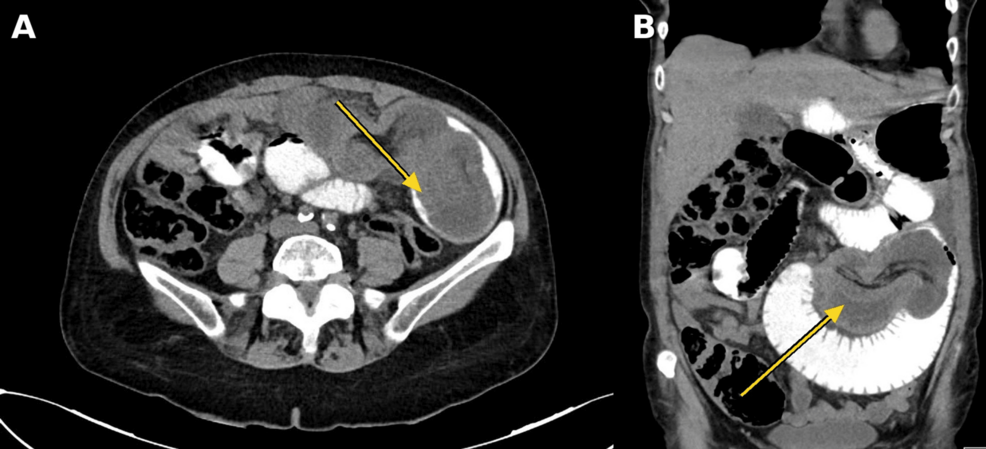
Her vital signs remained stable upon arrival, and physical examination revealed diffuse abdominal tenderness without peritoneal signs, guarding, or rigidity. Initial laboratory results showed a white blood cell count of 14.5 × 10³/µL, a normal C-reactive protein level of 0 mg/dL, and a lactate reading of 2.2 mmol/L. Abdominal radiography displayed air-fluid levels, while a computed tomography scan revealed dilated proximal small bowel loops reaching 5 cm in diameter alongside a suspected intussusception measuring about 23 cm.
Intraoperative Findings and Intervention
Initial diagnostic laparoscopy immediately revealed a 1 cm perforation in the common channel outside the intussuscepted segment, prompting conversion to an open laparotomy. Surgeons measured the bariatric anatomy precisely: the biliopancreatic limb spanned about 50 cm from the ligament of Treitz, continuing as a 30 cm blind segment attached to the liver. The alimentary limb measured approximately 80 cm.
Despite the presence of a bowel perforation, the intussuscepted loop was hyperemic and viable rather than necrotic. The surgical team reduced the intussusception manually, repaired the 1 cm perforation transversely with a 3-0 Vicryl suture, closed both the Petersen space and the jejunojejunal mesenteric defect, and fixed the common channel to the biliopancreatic limb and mesenteric root.
Patient Recovers Without Complications
The patient experienced an uneventful recovery and left the hospital on postoperative day 6. At a follow-up visit two months later, she reported no recurrent symptoms or complications.