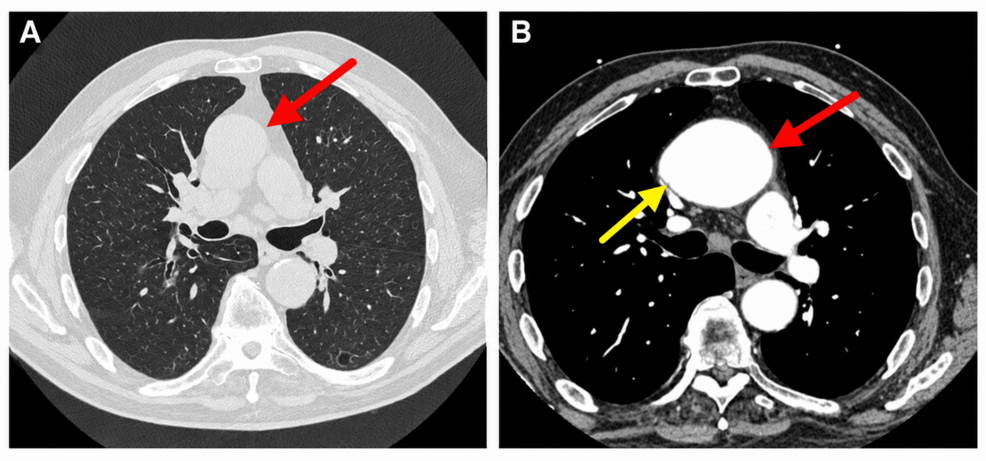
An 80-year-old man diagnosed with polymyalgia rheumatica in mid-2023 experienced an extraordinarily rapid expansion of his ascending aorta, growing from roughly 40 millimeters to nearly 78 millimeters within a single year, Cureus reported. This stark progression far outpaces the typical growth rate of nonsyndromic ascending aortic aneurysms, which historically hover around 0.2 millimeters per year. The acute presentation led to urgent surgical intervention and subsequent histological findings of lymphocytic aortitis.
Patient Develops Rapid Aortic Expansion Requiring Surgery
The patient initially sought emergency care late in 2025 due to intermittent palpitations and dizziness lasting about a week. Although he denied chest pain, back pain, or fever, cardiologic reassessment revealed breathlessness and episodic presyncope. Historical records noted a prior polymyalgia rheumatica diagnosis managed with methotrexate and glucocorticoids. A non-contrast chest scan from late 2024 had estimated his ascending aortic diameter at approximately 40 millimeters. By late 2025, an ECG-gated contrast-enhanced CT angiogram captured an expansion to 60 by 76 millimeters, with surgical records identifying a maximum diameter of roughly 78 millimeters alongside a focal ulcerated lesion of the aortic wall.
Faced with the massive aneurysm size, rapid interval change, and focal ulceration, medical teams admitted the patient for intensive blood-pressure control. Two days after the CT angiogram, surgeons performed an urgent supracoronary ascending aortic replacement via median sternotomy. Operating under normothermic cardiopulmonary bypass, the surgical team encountered a moderate serosanguineous pericardial effusion and technically challenging dissection planes driven by surrounding inflammatory changes. They resected the diseased segment and implanted a 32-millimeter Dacron graft, reinforcing the proximal and distal anastomoses with felt strips and surgical sealant. The cardiopulmonary bypass lasted 162 minutes, with an aortic cross-clamp time of 123 minutes.
Postoperative Complications and Histopathology
The immediate recovery period brought significant clinical hurdles. On postoperative day one, the patient experienced hemorrhagic shock with chest drainage reaching approximately 1,520 milliliters over six hours, necessitating surgical re-exploration that controlled diffuse venous bleeding in the periaortic and retrosternal tissues. He also developed postoperative atrial fibrillation, which converted to sinus rhythm following intravenous and oral amiodarone administration. He was discharged home seven days after his primary operation.
The formal pathology report diagnosed lymphocytic arteritis, advising clinical and biological correlation to rule out Horton’s disease. Because original slides were unavailable for review and specific markers like multinucleated giant cells or elastic stains were absent from the final report, the specimen confirmed lymphocytic aortitis without providing definitive histological classification for giant cell arteritis. A follow-up FDG-PET/CT scan performed 47 days post-surgery showed no metabolic evidence of active large-vessel vasculitis, though moderate tracer uptake remained present around the ascending aorta.