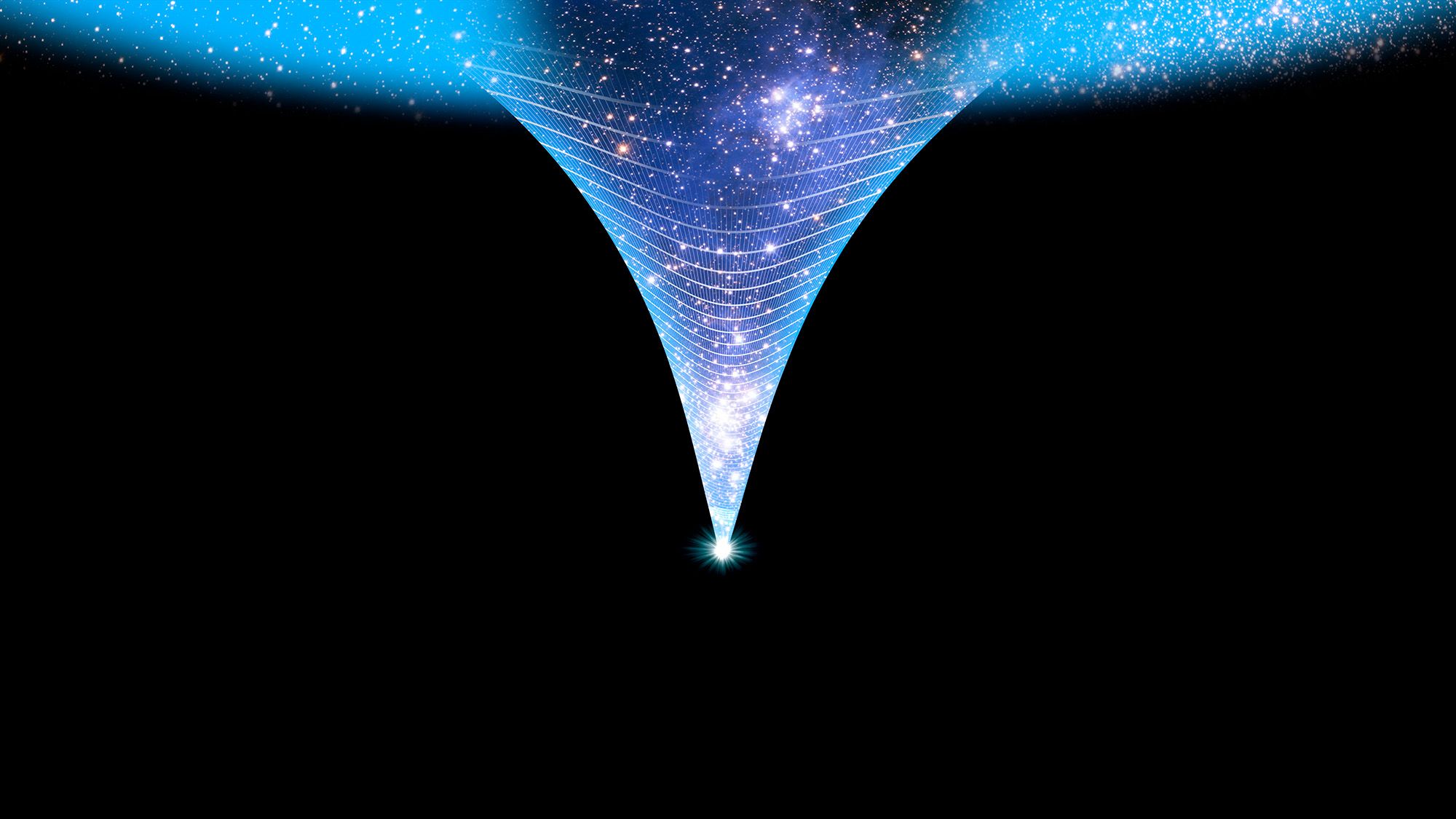
A forgotten heavy particle from the dawn of time could explain why matter survived the Big Bang, according to a study published Sept. 8 in Physical Review Letters by researchers at the University of Southampton and the Indian Institute of Technology Kanpur.
Physics operates on a premise of balance that should have doomed the universe before it began. When the cosmos burst into existence, the Big Bang ought to have generated equal measures of matter and antimatter. Those opposing forces should have met, annihilated each other, and left behind nothing but an empty expanse of radiation and space.
Instead, an infinitesimal imbalance tilted the scales in favor of matter, leaving the surplus that eventually formed stars, planets, and human beings. Physicists have long debated what triggered that asymmetry. A new theoretical model points to an overlooked ghost particle that briefly dominated the infant cosmos and altered how it expanded.
The Decoupled Heavy Neutrino and Early Cosmic Dominance
The newly highlighted entity is a right-handed neutrino, a theoretical heavy relative of the standard neutrinos that pass through ordinary matter by the trillions every second without leaving a trace. While standard left-handed neutrinos interact via the weak nuclear force and are firmly established in the Standard Model of particle physics, their hypothetical right-handed counterparts possess no electric charge and do not feel the weak force at all.
Researchers Rishav Roshan from the University of Southampton in the U.K. and Sudipta Show from the Indian Institute of Technology Kanpur investigated the behavior of a specific sterile neutrino that theorists often ignore because it interacts too weakly with other particles to matter. In their calculations, this particle weighed roughly 100 trillion times as much as a proton. Because it decays with extreme slowness, it survived long enough to change the thermodynamics of the early universe.
This decoupled heavy neutrino has long been dismissed as an irrelevant background detail in particle physics.
Rishav Roshan
As the universe cooled after the Big Bang, the energy of this heavy particle became locked into its mass rather than spreading out as radiation. According to the team’s computations, that process allowed the particle to temporarily take over the total energy density of the universe, driving a distinct phase of early matter domination before it finally decayed.
Shifting Temperatures and the Seesaw Mechanism
This period of heavy particle dominance altered the timing of fundamental interactions involving the Standard Model Higgs boson. In standard particle physics, the Higgs field gives mass to elementary particles through Yukawa couplings, functioning much like a crowded room where famous guests get slowed down by admirers.
The standard neutrinos known to physics are exceptionally lightweight—at least a million times lighter than an electron—a tiny scale that physicists attempt to explain using the seesaw mechanism. In this theoretical framework, ordinary neutrinos carry a faint trace of heavy right-handed partners, balancing out so that a heavier partner yields a lighter ordinary neutrino.
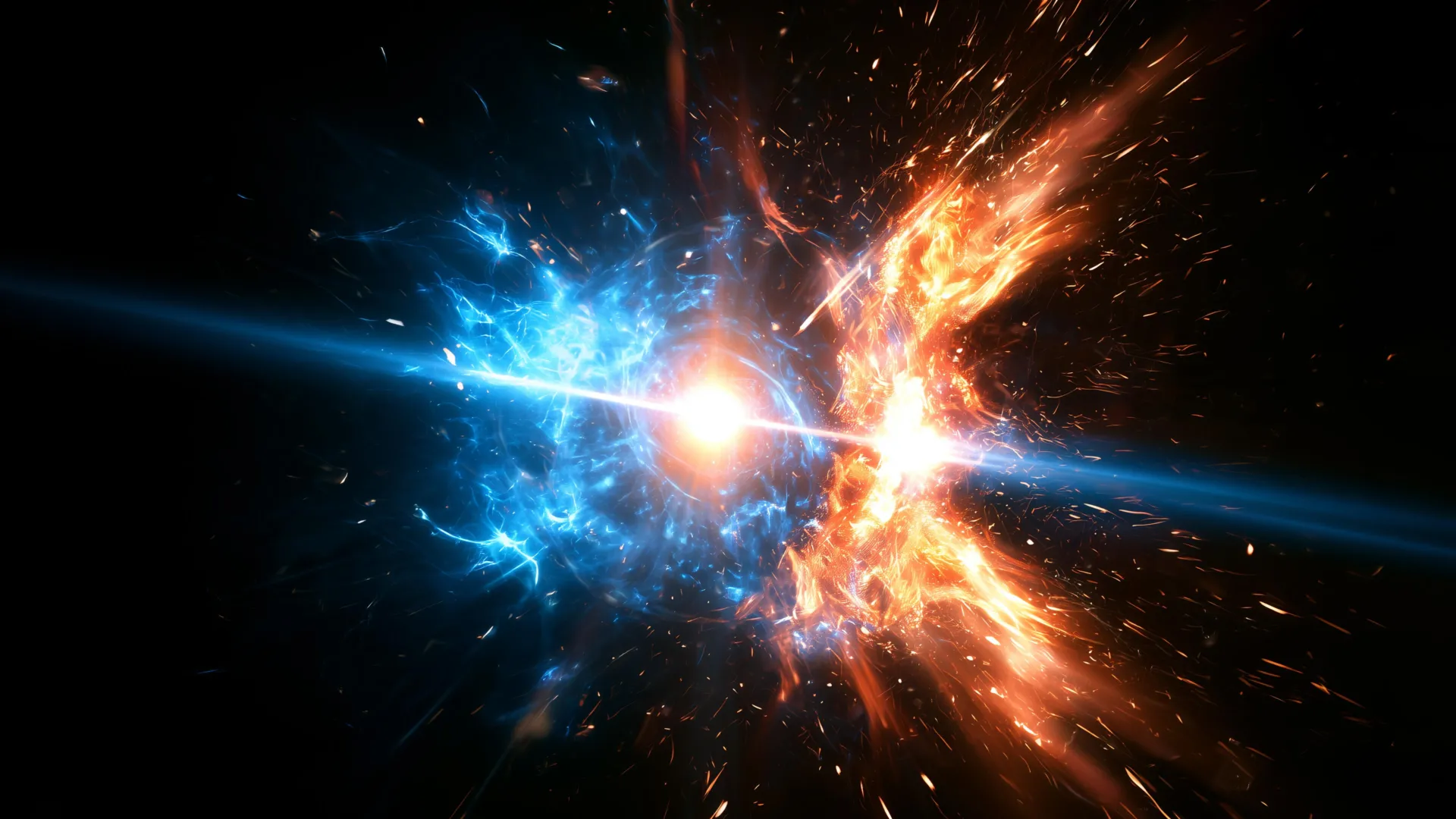
The study proposes that the third, overlooked right-handed neutrino played a different role by shifting the thermal conditions of the cooling cosmos. Because a universe dominated by the heavy particle expanded faster, fundamental particle interactions had to wait for cooler temperatures.
That temperature shift served as a switch that governed how the matter-antimatter imbalance developed. The decaying heavy neutrinos left behind a surplus of leptons—the family of particles that includes electrons—which later converted into the quarks that built today’s protons and neutrons.
Gravitational Waves as an Indirect Test
Because the heavy neutrino described in the study is too massive to create inside any modern particle accelerator, researchers must look for indirect proof. The team suggests that an era of early matter domination driven by such a heavy particle would have left a distinct physical imprint on primordial gravitational waves—ancient ripples in the fabric of space and time generated during the earliest stages of the universe.
These gravitational wave signatures open up new avenues for us to unravel the evolution of the early universe after the Big Bang.
Detecting those subtle signatures will require next-generation observatories. Researchers point to forthcoming facilities such as the European Space Agency’s Laser Interferometer Space Antenna (LISA), a space-based mission scheduled to launch around 2035, and the Square Kilometer Array Observatory (SKAO), a radio telescope project spanning Australia and South Africa that could detect background waves by timing distant pulsars.