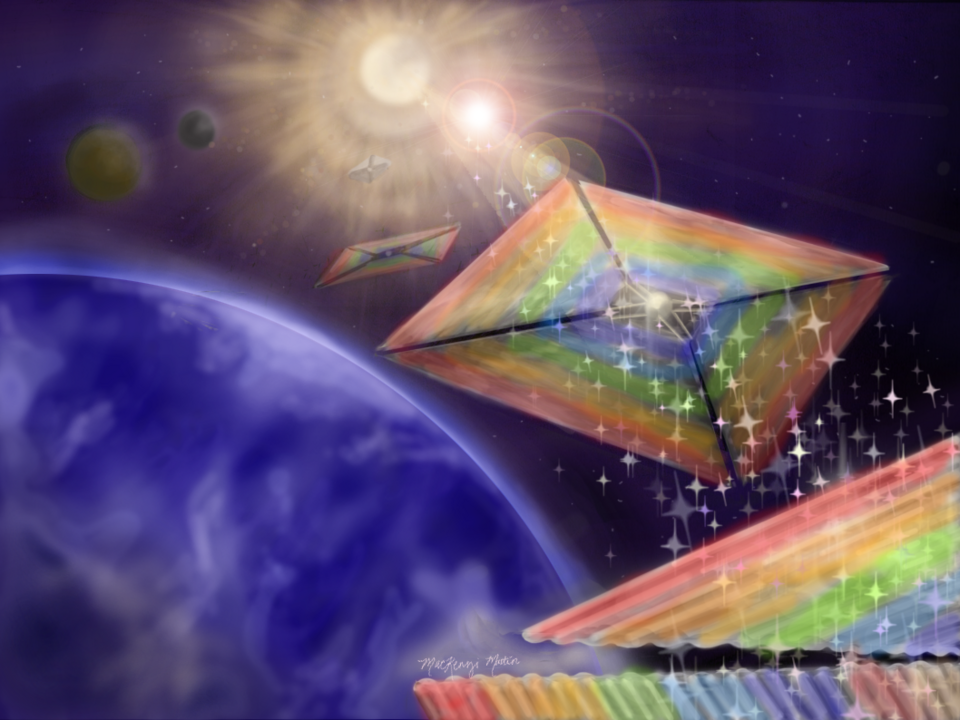
Researchers at the Rochester Institute of Technology designed an ultrathin liquid-crystal solar sail that alters incoming light through diffraction to steer spacecraft sideways without tilting away from the Sun, according to a preprint published on arXiv on Tuesday.
The concept applies liquid-crystal technology found in flat-screen displays to space propulsion. Traditional solar sails must tilt relative to the Sun to generate a sideways push. This tilt reduces the surface area catching light and complicates flight control. By using microscopic optical patterns that scatter incoming photons at steep angles, the proposed sail receives an equal and opposite push. A spacecraft changes direction simply by rolling around its Sun-facing axis.
Liquid Crystals Twist Light via Pancharatnam Phase
To achieve directional control without mechanical tilting, the RIT team used liquid crystals that contain rod-shaped molecules twisting into microscopic spirals, creating layers of differing refractive indices. This structure bends light via the Pancharatnam phase by twisting the direction of its waves.
Earlier diffractive sail prototypes relied on patterns etched into metal-coated films. Those designs struggled with manufacturing scale and rolling into compact rocket fairings. A single liquid crystal layer interacts with only a narrow wavelength of light.
The researchers used computer simulations and an optimization algorithm to design a three-layer sandwich. The top layer captures blue and visible light, the middle layer handles infrared rays, and the bottom layer interacts with longer infrared rays.
Three-Layer Film Enables Sunshade at L1
The combined three-layer film measures 5.5 micrometers thick, which is roughly one-tenth the width of a human hair. Researchers predict this arrangement could convert 51.2% of the incoming sunlight’s momentum into sideways thrust.
This configuration opens up an application as a planetary sunshade parked at the Sun-Earth L1 Lagrange point, located about 1.5 million kilometers from Earth. Traditional sunshade designs require tilting to maintain position and consequently shrink their shadow.
A diffractive sail holds its position without losing effective shading area. Engineers can also tune or remove individual layers to let specific wavelengths pass through, such as the near-infrared light used by solar panels or the red light required for plant photosynthesis.
Earlier Interplanetary Sail Missions
The new design builds on a succession of earlier flight demonstrations and NASA-supported research into solar sailing.
| Year | Mission or Study | Milestone |
|---|---|---|
| 2010 | IKA’ROS | Demonstrated interplanetary solar sailing for the first time by Japan’s spacecraft. |
| 2019 | LightSail 2 | Changed its orbit around Earth using sunlight alone. |
| 2024 | NASA Advanced Composite Solar Sail System | Unfurled an 80-square-meter solar sail using a new lightweight deployment system. |
| 2025 | Precursor Sunshade Study | Outlined a mission concept using a 400-square-meter solar sail. |
Professor Pioneered Diffractive Sails a Decade Ago
An RIT professor and co-author figured out ten years ago that microscopic optical structures capable of reflecting light sideways could substitute for mechanical tilting in solar sails. He received backing from NASA’s Innovative Advanced Concepts program and laid out the groundwork for diffractive solar sails.

When illumination strikes a diffraction grating—the technical designation for the microscopic patterns integrated into the sail akin to the etchings on a compact disc—it rebounds at steep, reliable angles even when the surface directly confronts the Sun.
Researchers dropped a sample from a 100-meter tall tower in Bremen, Germany, to test whether materials could work under vacuum and in microgravity. Once the sail was in free-fall, shining a 1 watt laser made the sail accelerate by up to 1 meter per second squared, similar to the acceleration of an office lift. Acceleration continues as long as sunlight keeps hitting the sails, taking spacecraft to higher speeds.
Rochester Institute of Technology’s space photonics work traces back a decade when an RIT professor and co-author of the new study pioneered diffractive solar sails under NASA’s Innovative Advanced Concepts program, establishing the groundwork for using microscopic optical structures to replace mechanical tilting.
The concept builds on earlier research supported by NASA’s Innovative Advanced Concepts program, which explored diffractive sails for sending spacecraft into high-altitude orbits above the solar poles. Whether the 51.2% thrust projection holds up outside computer models remains to be tested, as the design exists purely as a theoretical preprint on arXiv.