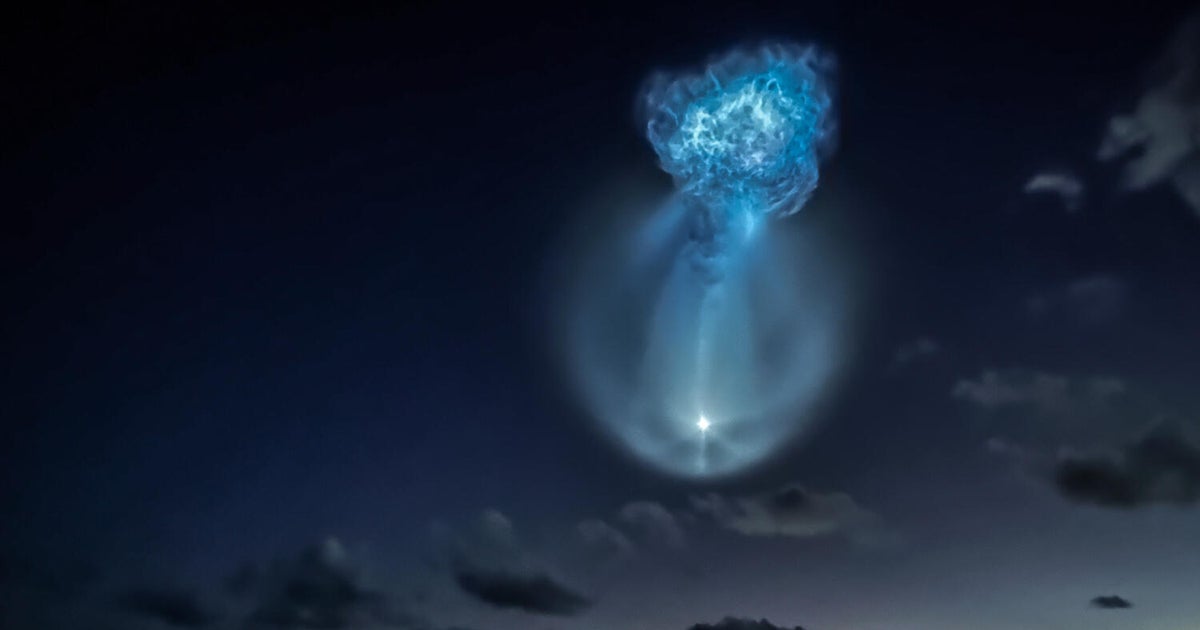
SpaceX successfully launched its Bandwagon-5 rideshare mission from Cape Canaveral early Tuesday, sending 32 payloads into orbit and offering coastal observers a brief repeat of the glowing exhaust plume known as a space jellyfish.
Space Launch Complex 40 Liftoff and Mission Manifest
SpaceX pushed its predawn Falcon 9 flight from an initial Monday target following unfavorable booster recovery weather, successfully executing the liftoff during a one-hour window opening at 6:30 a.m. EDT on Tuesday, October 20, 2026. Operating from Space Launch Complex 40 at the Cape Canaveral Space Force Station, the rocket carried 32 diverse payloads including CubeSats, microsatellites, and specialized reentry vehicles into mid-inclination orbits.
Among the manifested hardware was SpaceX’s Starfall capsule. The Federal Aviation Administration noted in an environmental assessment that the vehicle stands about 0.75 meters tall with a diameter of 3.1 meters and a mass of roughly 2,100 kilograms. Alongside Starfall, multinational mission management company Exolaunch handled deployment manifests for 20 payloads, including four radio-frequency monitoring satellites for Virginia-based HawkEye 360, four communications satellites for Finnish microsatellite company Iceye, and six navigation satellites for California-based Xona Space Systems.
The Falcon booster’s nine first-stage engines thundered to life at 6:33 a.m. EDT, as power increased and the vehicle was driven away from Pad 40 at the Cape Canaveral Space Force Station driven by 1.7 million pounds of thrust. The Falcon 9’s launch was timed to ensure the rocket climbed away into the identical orbital plane required for rendezvous missions. SpaceX updated the T-0 launch time after scrubbing the launch attempt on Monday, Oct. 19, due to poor weather in the booster recovery zone. On board this mission are 32 payloads including cubesats, microsatellites, and reentry vehicles, with twenty of the remaining 31 payloads to be deployed manifested by multinational mission management company Exolaunch.
Falcon 9 Booster Targets Droneship Recovery
The mission marked the 19th flight for the Falcon 9 first-stage booster supporting the launch, using the Falcon 9 first stage booster with the tail number B1085. Following stage separation, the booster targeted a landing downrange on the autonomous droneship A Shortfall of Gravitas stationed in the Atlantic Ocean. This endeavor is anticipated to become the 167th successful recovery on this specific platform and the 672nd overall touchdown for a Falcon booster, provided operations proceed without issue.
🛰️ https://t.co/5bTFIX1Sxh FOSSA’s FOSSASAT-2E27, carrying SEALSQ VaultIC security, targets SpaceX Bandwagon-5 on Oct 19, 2026.Launch window opens 06:30 EDT / 12:30 CEST.Advancing our post-quantum roadmap.https://t.co/BKLxsk1T36$SAIQ $LAES pic.twitter.com/HGu6imQrUb
Engineering teams treat recovery forecasts as a critical go or no-go gate because booster reuse underpins the economic model for SpaceX rideshare pricing. The cadence of these flights also drives the frequency of atmospheric light shows that captivate ground observers along the coast.
Atmospheric Optics and the Second Space Jellyfish Appearance
Tuesday morning’s flight produced a smaller, shorter-lived version of the atmospheric phenomenon that captivated sky-watchers the previous week. The glowing, bulb-shaped cloud occurs when sunlight illuminates a rocket’s rapidly expanding exhaust plume high in the upper atmosphere while observers on the ground remain in twilight darkness.
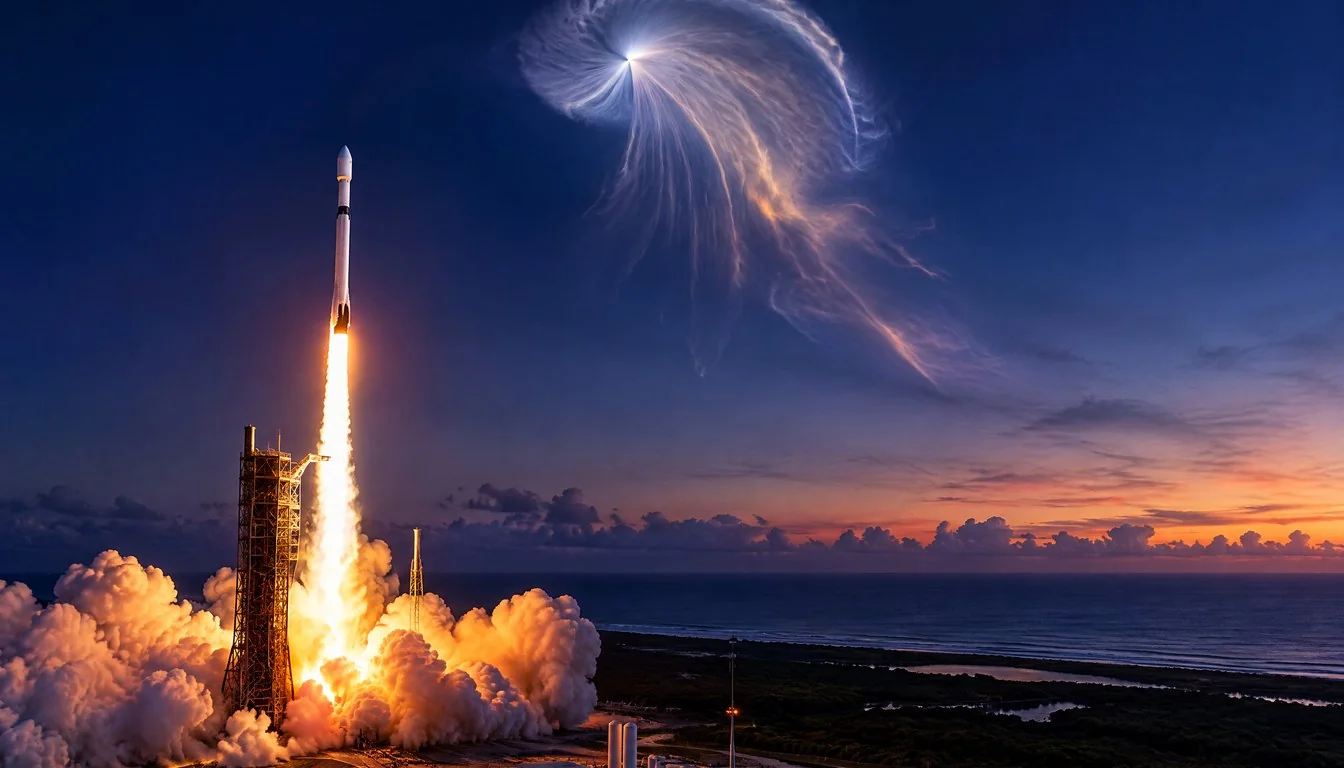
The earlier widely photographed display followed NASA’s SpaceX CRS-35 mission, which lifted off at 6:33 a.m. EDT on Tuesday, October 13, 2026, carrying more than 6,300 pounds of supplies, research gear, and the final two rollout solar array blankets for the International Space Station. While last week’s cargo resupply followed a northeast trajectory that offered wide side-on visibility across the U.S. East Coast, Tuesday’s Bandwagon-5 rideshare followed a southeasterly path that positioned the plume farther away from northern viewing locations like Georgia, moderating visual expectations for distant spectators. Flight records referenced by NBC 6 South Florida indicate that the inaugural space jellyfish originated from the NASA SpaceX CRS-35 departure, which launched at 6:33 a.m. EDT on Tuesday, October 13, 2026, out of Space Launch Complex 40 with a cargo exceeding 6,300 pounds comprised of scientific hardware, supplies, and research investigations. Also on board are two new rollout solar array blankets, the final sets in, with each IROSA blanket generating 20 kilowatts of power and, acting in concert with the original arrays, boosting power output back to factory-fresh levels, according to Dana Weigel, director of low-Earth orbit operations at the Johnson Space Center.
Payload Deployment Timeline and Backup Windows
Following second-stage separation, the mission’s extensive catalog of smallsats and experimental capsules began systematic deployment across multiple orbits. Varda Space Industries flew its W-series 7 reentry capsule to perform an experiment on the cancer drug Protac, while Portal demonstrated its orbital maneuvering spacecraft, Starburst, ahead of commercial customer flights advertised to start in 2027. If today’s launch attempt had encountered last-minute scrubs, SpaceX held a backup opportunity on Wednesday, October 21, with a window opening at 6:30 a.m. EDT. Prepared for an experiment evaluating the Protac cancer medication, Varda Space Industries’ W-7 reentry capsule appears within a cleanroom environment ahead of liftoff on the SpaceX Bandwagon-5 mission, with commercial service offerings promoted to begin in 2027.
Falcon 9’s first stage has landed on the A Shortfall of Gravitas droneship pic.twitter.com/2sNXK5qRQZ
More on Bandwagon
Starfall enables affordable, routine access to a microgravity environment, providing unique opportunities for on-orbit manufacturing, scientific research, and testing pic.twitter.com/y8kJg3QDor
The launch is now postponed Oct 20 🛰️ https://t.co/dGEiAsBLvF hardened FOSSA’s FOSSASAT-2E27 satellite carrying SEALSQ VaultIC semiconductor and security, targets SpaceX Bandwagon-5 on Oct 20, 2026 with launch window opens 06:30 EDT / 12:30 CEST.Advancing our post-quantum…