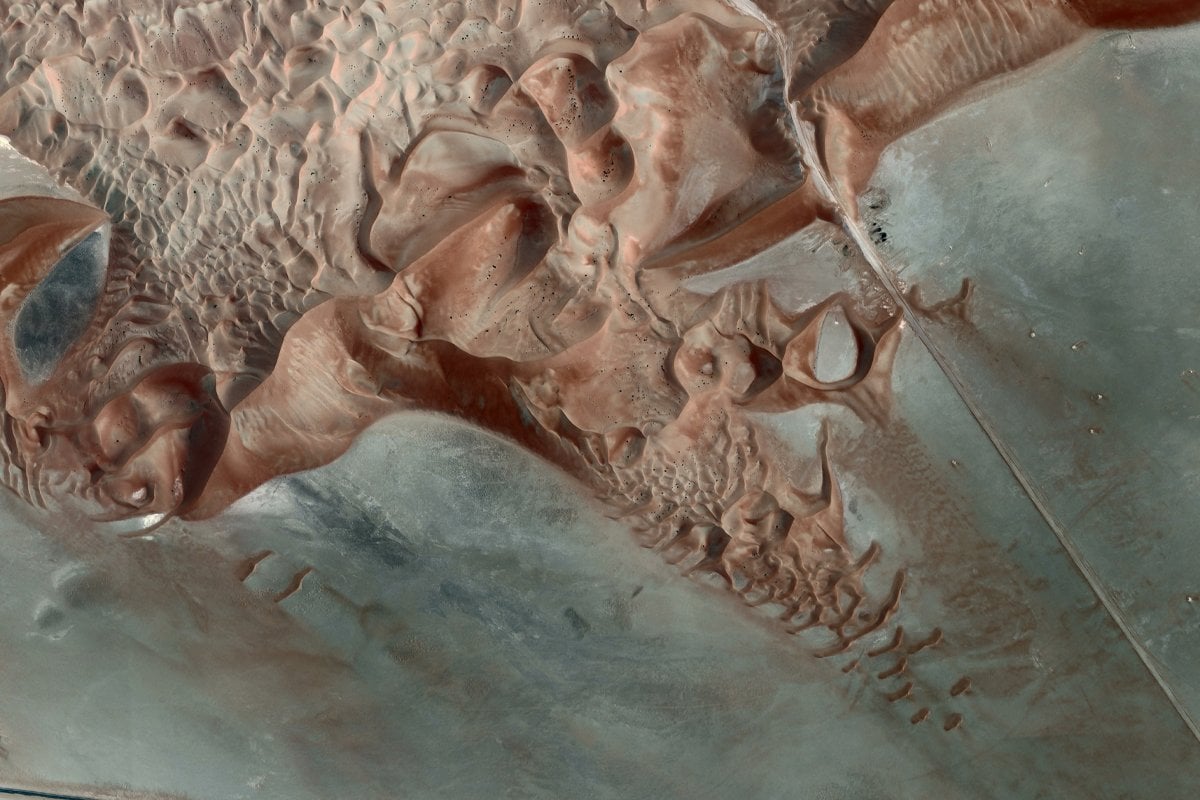
Prehistoric humans crossing the world’s largest sand sea left behind traces of freshwater lakes but no tools, according to a study published in Nature. Researchers found that access to suitable stone for tool production was just as critical for permanent desert habitation as freshwater during the Pleistocene wetter phases known as Green Arabia, according to HeritageDaily.
Rub’ al Khali Expedition Reveals Lakes Without Tools
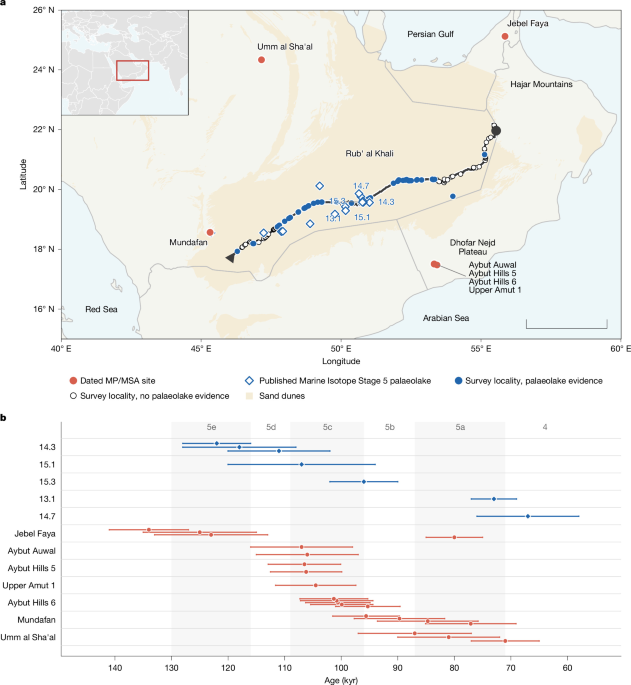
In late 2023, an eight-person team traveling in three vehicles drove about 1,500 kilometers across the Rub’ al Khali desert in southern Arabia. Over a 35-day journey, they inspected 125 locations for evidence of ancient lakes that formed between roughly 122,000 and 67,000 years ago, when monsoon rains filled the basin.
The expedition discovered ancient lake deposits at 55 of the survey spots. These included freshwater snail shells, clam shells, ostrich eggshell fragments, and traces of burrowing animals that once lived in muddy lake beds. The team found no stone tools or raw material suitable for manufacturing them at any of the lake sites. Suitable stone appeared in only small amounts at 10 locations near the desert edges.
We stood on the shore of one ancient lake after another, yet found nothing made by human hands. Water without stone was a dead end.
Rudolf Dellmour, University of Vienna
The desert interior’s surface consists solely of carbonate and evaporite rock, which fails to break into sharp edges. Because the ancient lakes were fed by groundwater rather than rivers, no currents carried useful stone inward from distant outcrops. Across roughly 800 kilometers of the basin, knappable stone was entirely absent.
Computer Modeling and Fieldwork in Oman
To test whether the stone deficit governed settlement patterns on a wider scale, the researchers built a computer model for the entire Arabian Peninsula that coupled distance to water with the geological distribution of flaking rock. Relying on water availability alone predicted site locations with a score of 0.695 on a standard accuracy scale, but adding stone raised it to 0.768. The analysis revealed that 57 percent of the land near water sat directly on rock devoid of knappable material.
Researchers also incorporated archaeological data from the Czech ARDUQ expedition, which conducted fieldwork in Oman between 2022 and 2025 under the auspices of the Institute of Archaeology of the CAS, Prague. Observations of raw material distribution matched against prehistoric sites confirmed the hypothesis.
When we carry that knowledge over into the sand desert, the model predicts an empty interior – and that is precisely what our fieldwork confirmed.
Jeffrey Rose, University of Algarve
Other prehistoric groups did occupy the margins of the desert during the same eras. Inhabitants could not simply import material from afar. Studies show that most tool raw material originates within about 5 kilometers, and sources beyond 20 to 30 kilometers normally supply only 1 to 2 percent of an assemblage. With the nearest stone lying over 200 kilometers from the surveyed lakes, carried pieces could support brief visits but not daily tool production for a resident group over generations.

Open-Source Modeling for Global Arid Lands
The authors describe the wet periods of Green Arabia as a lithic archipelago
where human movement was bounded by geology just as much as by climate. They argue that prior models built exclusively on climate and water can substantially overestimate how much of the desert prehistoric people were able to inhabit,
Similar settlement patterns appear in other dry regions globally. In Libya’s Messak Plateau, 91 percent of Middle Stone Age finds rest near a single rock outcrop despite water across nearby lowlands, and Egypt’s Eastern Desert and Tibet show comparable ties to stone sources. Central Oman provides the inverse scenario, featuring abundant chert but very little water and sparse archaeological sites.
The research team has released their predictive model as an open-source tool, making the underlying data and code publicly accessible via the OSF and Zenodo repositories so that archaeologists can apply the system to other arid regions worldwide.