Astronomers have directly observed a giant star swallowing its companion for the first time, confirming a decades-old theory about how tight binary systems form.
The event, designated AT 2025abao, unfolded in the Andromeda galaxy. A red giant nicknamed Big Bao — seven times the Sun’s mass, 350 times its radius, and 18,000 times brighter — engulfed a smaller companion, Little Bao, roughly 70 percent the Sun’s mass.
The merger produced a violent eruption on October 17, 2025, ejecting about 0.1 to 0.2 solar masses of material. NASA’s James Webb Space Telescope observed the aftermath just 47 days later, providing the decisive evidence that the two stars had merged.
“[This] marks the first time a giant star was 'caught in the act' of engulfing its companion,” Viraj Karambelkar said.
“Stars engulfing their companions have been theorized for many decades, and this event provides the first observations of this theoretical prediction,” Karambelkar said.
Seven Years of Brightening Before the Blast
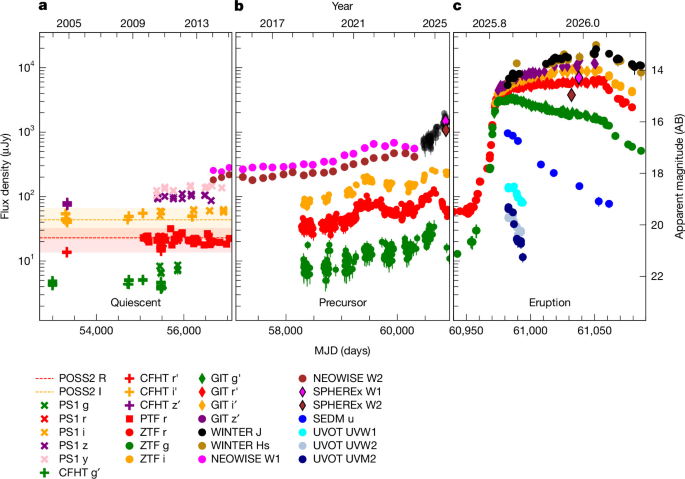
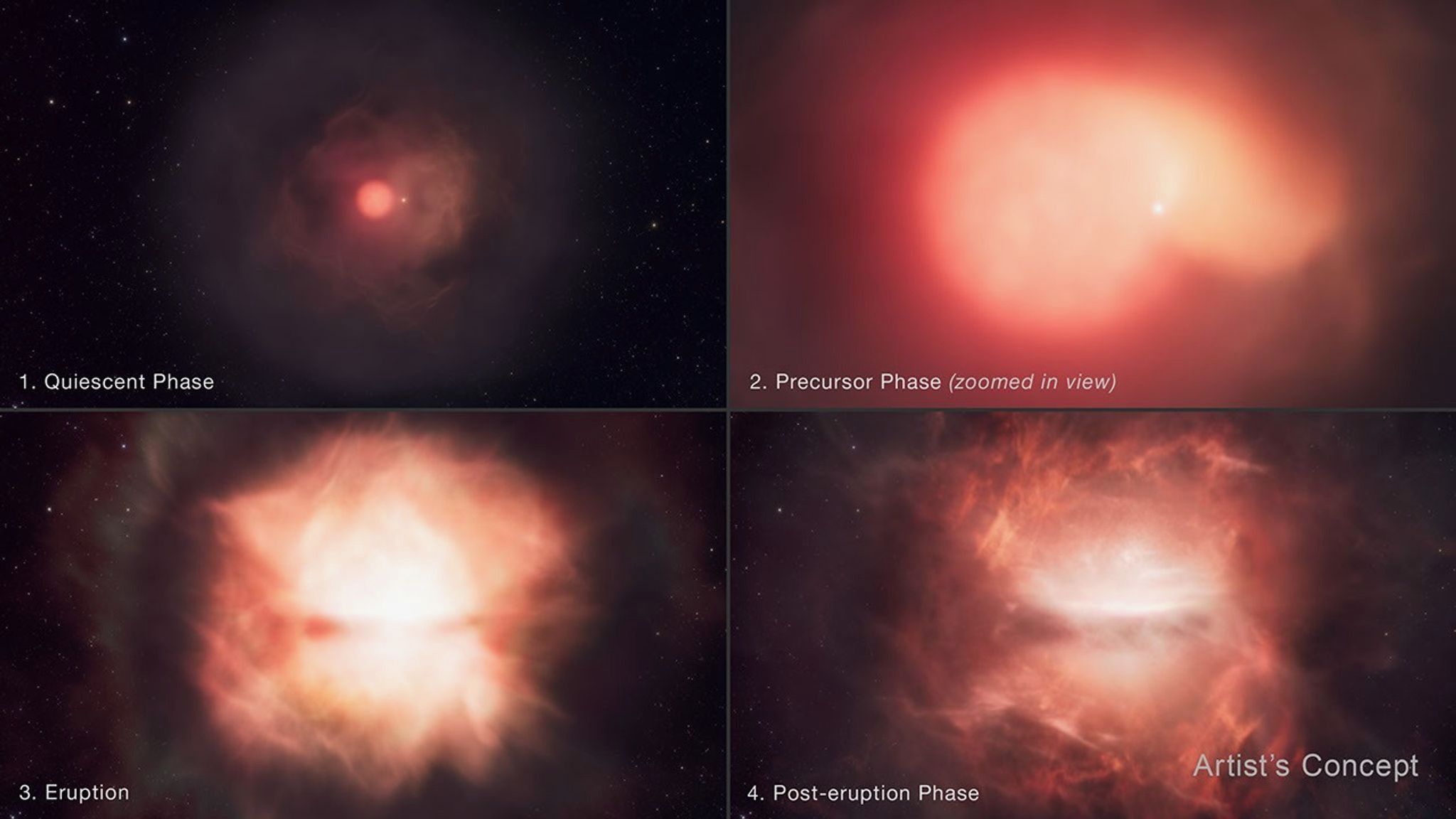
The system hid in plain sight. Archival optical data from 2003 to 2015 showed Big Bao shining steadily with irregular variations of less than 0.3 magnitudes. By 2018, it began a slow, steady brightening. A study published in the Astrophysical Journal on October 28, 2025, used this quiet period to estimate the progenitor was an early asymptotic giant branch star.
In February 2023, NASA’s retired NEOWISE mission caught the star acting strangely. In September 2024, another telescope saw it puffing out dust. By July 2025, NASA’s SPHEREx telescope recorded it fading in visible light while brightening in infrared — a signature of dust formation.
Researchers led by Karambelkar concluded the brightening came from Little Bao spiraling inside Big Bao’s outer layers. As the companion orbited, drag from the giant’s gas robbed it of orbital energy, forcing it deeper.
That transferred energy heated the envelope, making Big Bao shine brighter. The process, known as common envelope evolution, had never been caught in real time. A research group that includes Kyoto University operates the Seimei Telescope, which recognized the object’s nature early on.
“This process lasts only for a few years, which is a blip on the cosmic scale as stars take millions of years to evolve. This makes it very challenging to catch stars going through this phase in real time,” Viraj Karambelkar said.
A Week From Rise to Peak
The final act moved with speed. The Zwicky Transient Facility in California spotted the eruption on October 17, 2025. The star brightened by about five magnitudes in roughly one week — far faster than the years-long outburst the team had expected. “One day, its brightness started rising and within a week, it peaked!” said Nadia Blagorodnova, an associate professor at the University of Barcelona in Spain.
Follow-up observations came fast. The Neil Gehrels Swift Observatory and Gemini North telescope in Hawaii observed in November. Webb’s Director’s Discretionary Time observations on December 24, 2025, captured the system just 47 days after peak brightness — the earliest follow-up ever for such an event.
RIT Prediction Validated
The observation vindicated a 2019 hypothesis by Jason Nordhaus, professor of physics at Rochester Institute of Technology’s National Technical Institute for the Deaf. Nordhaus predicted that when a giant star swells to hundreds of times its original size, a nearby companion can be engulfed and spiral inward, producing a slow brightening before a final eruption. His work, funded by a National Science Foundation grant, was cited in the Nature paper published November 18, 2026.
Jason Nordhaus said that the way this came about is going to shock a lot of people because it is so rare, adding that it has never been seen before. He added that he was proud his team remained committed and pursued the work despite skepticism from many in the field, a lesson he said is vital to pass along to students.
What Remains Uncertain
Thick dust still shrouds the remnant, now simply called Bao. Researchers cannot yet see whether the merger produced a single rejuvenated star or if both stars survived in a drastically tighter orbit.
A successful stellar merger 🤝 Scientists recently spotted a star slightly less massive than the Sun merging into a puffy supergiant star in the outskirts of the Andromeda galaxy. This hard-to-observe event resulted in a new star nicknamed "Bao." https://t.co/uTdG5rW4w2 pic.twitter.com/1KLHknv4r2
Karambelkar’s team estimates Little Bao reached Big Bao’s core, but an alternative analysis by Zhuo Chen and colleagues, published in the Astrophysical Journal Letters on October 23, 2026, models a more massive companion (1.4 solar masses) that survives the encounter. The merged central region has not been directly imaged by a telescope, and the central remnant is still shrouded in thick dust.
Future observations will settle the question. The Vera Rubin Observatory and NASA’s Nancy Grace Roman Space Telescope, designed to scan huge sky areas repeatedly, should discover hundreds of similar events in nearby galaxies. “There's going to be a large influx of similar discoveries just ahead,” Karambelkar said.

These new facilities will ultimately determine which model accurately describes the system’s evolution.
RIT Alumni Join Research on Stellar Evolution
RIT astrophysical sciences and technology Ph.D. graduates Emily Wilson and Nikki Noughani were part of the research team, along with collaborators from the University of Toronto, Boston University, and the University of California San Diego, who devised a plan to use newly identified systems to determine how stars change before and after the common envelope phase.
Among RIT alumni connected to the work, Emily Wilson (class of 2022) is now an assistant professor of astronomy at Lycoming College, and Nikki Noughani (class of 2025) is a Canadian Rubin Postdoctoral Fellow at the University of Toronto.
Earlier coverage: Astronomers Watch Star Devour Companion in Andromeda