Google Quantum AI researchers demonstrated measurement contextuality on Thursday using superconducting processors with up to 105 qubits, turning a long-debated quantum property into a practical benchmark for hardware quality.
Willow Processor Wins Magic Square Game
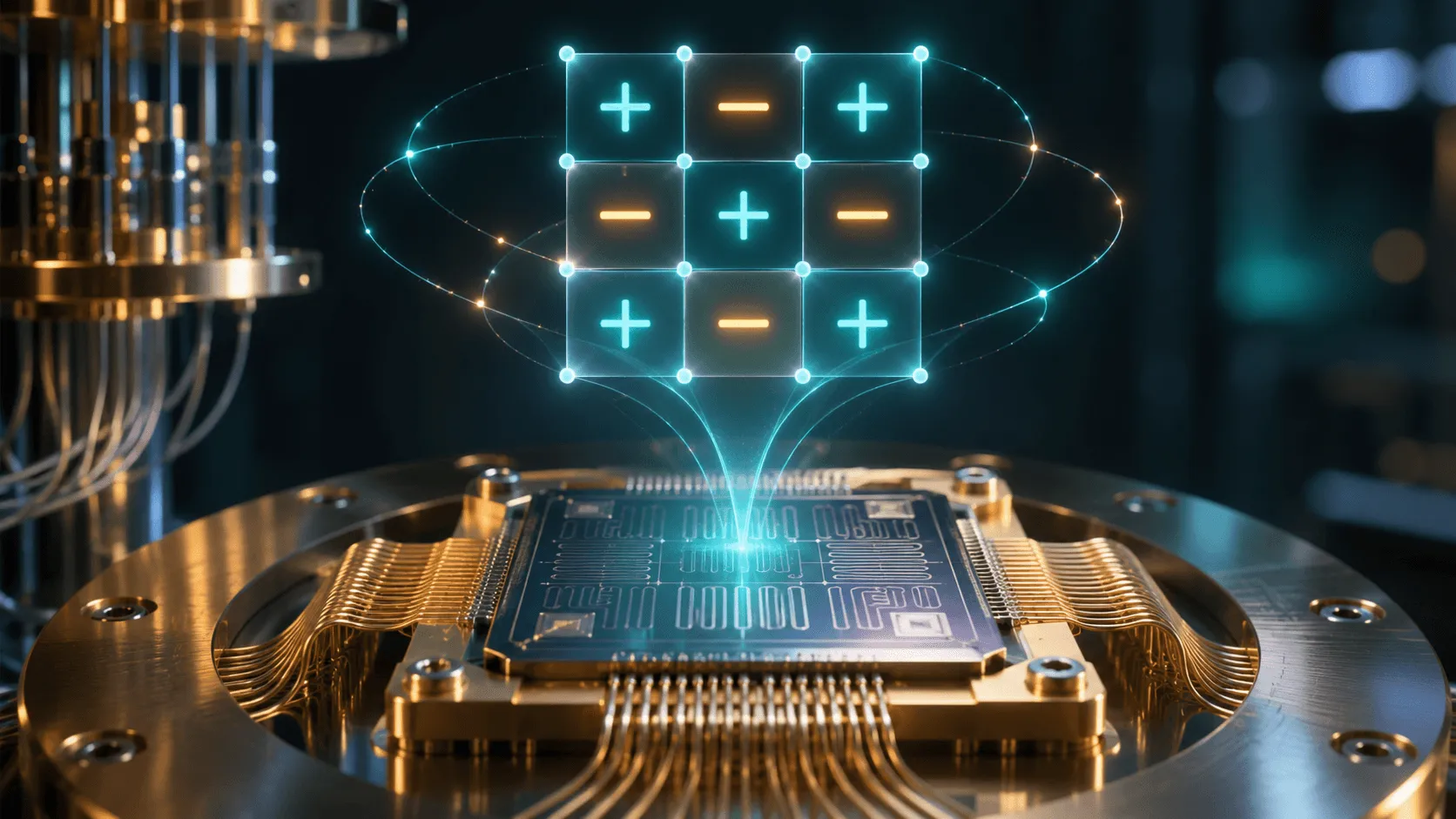
The study, published on the cover of Science (Vol. 394), shows that the Willow processor won a cooperative test known as the Mermin-Peres magic square game 98.3% of the time.
This performance clears the hard classical ceiling of 88.89%, which limits performance because no fixed grid of numbers can satisfy the requirement that row products equal +1 while column products equal -1. The experiment was submitted to the journal on September 16, 2025, and accepted on September 4, 2026, before its publication in November.
According to Google Quantum AI, the team executed the magic square game 900,000 times to verify these results. The researchers attribute the remaining 1.7% of losses to residual hardware noise rather than flaws in the underlying quantum strategy. “Their answers are not looked up in a hidden table written in advance; the table does not exist,” explain Shashwat Kumar and Rodrigo Cortiñas, Research Scientists at Google Quantum AI, Google Research.
Kochen-Specker-Bell Inequality Quantifies Contextuality
Beyond the game’s win rate, the team tested the Kochen-Specker-Bell (KSB) inequality to quantify the level of contextuality. Using a resettable ancilla qubit and 540 sequential quantum nondemolition measurements, the processor achieved χ = 5.618 ± 0.005. This value is comfortably above the classical limit of 4 and approaches the theoretical maximum of 6, demonstrating that the system’s properties are not fixed in advance but depend on the measurements chosen.
To examine whether this property persists in larger systems, the team implemented an N-player GHZ parity game. In this setup, the processor beat classical strategies across all tested sizes up to 71 qubits. The researchers encoded a 2D hidden linear function (HLF) problem on the processor grid, utilizing up to 105 qubits. In these tests, the chip returned valid answers more than half the time, exceeding the 0.5 classical bound.
Catching Hardware Errors That Random Circuits Miss
Researchers view these tasks as a sensitive new method to identify hardware errors. Because structured parity and hidden-function tests require exact multi-qubit phase agreement, they expose small coherent over-rotations that random-circuit sampling tends to average out.
Today, we’re announcing a major breakthrough that marks a significant step forward in the world of quantum computing. For the first time in history, our teams at @GoogleQuantumAI demonstrated that a quantum computer can successfully run a verifiable algorithm, 13,000x faster than…
— Post by @GoogleAI on X
This provides a fixed physical ceiling against which future processors can be calibrated. While the experiments did not perform practical molecular simulations, the diagnostic capability broadens the options for developers working on fault-tolerant quantum computing.
Google Quantum AI traces its origins to 2012, when the division was launched to accelerate machine learning through quantum technologies. Based in the Santa Barbara area since 2013, the organization has consistently aimed to build large-scale, error-corrected quantum computers capable of surpassing classical limits.
This mission reached a significant milestone in 2019, when the team reported achieving quantum supremacy with the 53-qubit Sycamore processor, followed by a 2023 breakthrough that demonstrated the first successful prototype of a logical qubit to suppress computational errors.
The Willow chip, which debuted in December 2024, has previously demonstrated quantum advantage in other contexts, including a random circuit sampling benchmark and the Quantum Echoes algorithm. However, the current study emphasizes that these contextuality-based games provide a clean, provable test of whether a machine is performing tasks that classical computers cannot replicate.
As engineers work to drive down residual hardware noise, these benchmarks serve as a marker of progress toward machines capable of solving real-world problems in chemistry and materials science.