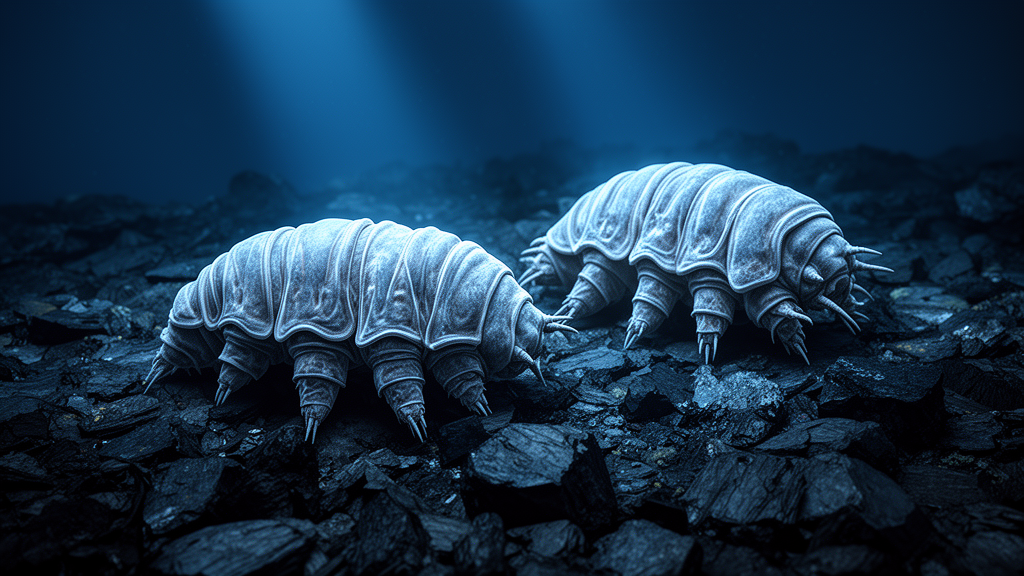
Marine scientists found two new armored tardigrade species and 18 other taxa in sediment from Senghor Seamount on October 27, 2026.
Researchers reported in ZooKeys. The animals belong to the family Stygarctidae.
“We detected the two new species—Megastygarctides hekatae sp. nov. and Parastygarctus potercha sp. nov.—in sediment samples collected during an expedition aboard the research vessel Meteor at Senghor Seamount,” lead author Roman Ruslanovych Trokhymchuk said.
An international team from the Netherlands, Germany, Denmark, and Ukraine discovered the species. The material was gathered in September 2009 during cruise M79/3 of the research vessel Meteor using a multiple corer on the flat summit plateau.
The study was authored by Roman Ruslanovych Trokhymchuk, Jesper Guldberg Hansen, Uliana Pysarenko, Kseniia Subota, and Alexander Kieneke. Participating institutions include the Naturalis Biodiversity Center in Leiden, Netherlands; the German Centre for Marine Biodiversity Research, Senckenberg am Meer in Wilhelmshaven, Germany; the Natural History Museum of Denmark at the University of Copenhagen; and V.N. Karazin Kharkiv National University in Kharkiv, Ukraine.
Seamount Diversity
The Senghor Seamount rises in the eastern tropical Atlantic off the Cape Verde Islands. Its summit sits between 100 and 130 meters below the ocean surface. The surrounding seafloor drops several thousand meters.

The summit sediment consists primarily of coarse, calcareous material of biological origin. Fragments of corals, sea urchins, bryozoans, bivalves, and snails make up the material. Samples from the deep-sea floor consist of fine, mudlike sediment.
The research team examined 219 individual tardigrades from the 2009 expedition. Of those specimens, 212 came from the summit plateau. Only seven specimens turned up at a deep-sea reference site about 100 kilometers further north.
The marked difference in the number and diversity of tardigrades we found on the plateau and on the deep-sea floor is further evidence that seamounts can be veritable oases of biodiversity—even for organisms that are barely visible to the naked eye.
Alexander Kieneke, marine scientist at Senckenberg am Meer
New Tardigrade Traits
Both newly described species belong to the armored tardigrades and exhibit distinct external features. Lead author Roman Ruslanovych Trokhymchuk of the Naturalis Biodiversity Center and Senckenberg am Meer said that Megastygarctides hekatae features genital spines, which are short, hollow projections with small hooks connected to internal reproductive organs.
The species was found at a depth of about 100 meters. That is the deepest discovery to date for that genus. The specific epithet honors Hekate, a Greek goddess whose name stems from hekaton, meaning one hundred, referencing the type locality depth.
Megastygarctides hekatae sp. nov. possesses so-called genital spines—a feature that is extremely rare in tardigrades. These are short, hollow projections with small hooks that are connected to the internal reproductive organs.
Roman Ruslanovych Trokhymchuk, lead author
The holotype female of Parastygarctus potercha measures 69.0 micrometres long. It is 21.0 micrometres wide.
With these additions, the genus Megastygarctides now comprises seven known species. Parastygarctus comprises eight.
The published study supplies updated identification keys for both genera to assist researchers in distinguishing physical characteristics.
| Site | Specimens Examined | Taxa Count |
|---|---|---|
| Senghor Seamount Summit Plateau | 212 | 20 |
| Deep-Sea Reference Site | 7 | 2 |
Atlantic Seamount Comparisons
A total of 20 taxa were recovered from the summit plateau: three fully identified species (Chrysoarctus briandi, Quisarctus armatus, Raiarctus colurus), the pair of newly described species, and 15 additional taxonomic categories (Angursa sp., Batillipes sp., Halechiniscidae sp., Halechiniscidae gen. A sp. A, Chrysoarctus sp., Dipodarctus aff. subterraneus, Dipodarctus sp., Florarctinae sp., Halechiniscus cf. perfectus, Halechiniscus sp., Styraconyxidae sp., Raiarctus aff. variabilis, Raiarctus sp., Tanarctus sp., Tholoarctus cf. natans).
The deep-sea reference station yielded only two taxa. They were represented by Angursa abyssalis and Angursa sp.
Naturalis Biodiversity Center in Leiden traces its origins to the Rijksmuseum van Natuurlijke Historie, founded by royal decree on 9 August 1820. Its collections merged with the Zoological Museum Amsterdam and the National Herbaria in 2010–2012, creating a combined holding of approximately 42 million specimens, one of the largest natural history collections in the world.
Researchers said that other Atlantic plateaus have also shown high tardigrade counts. The Faroe Bank harbors 35 recorded species. Investigations on other Atlantic elevations like Condor Seamount, Great Meteor Seamount, and Princess Alice Bank have likewise produced multiple species records and newly described forms.