“I carry the name of Pakistan on my shoulders, the hopes of 250 million Pakistanis,” said Muhammad Zeeshan Ali, the 40-year-old air force pilot who will become his country’s first astronaut to reach orbit on Wednesday aboard China’s Shenzhou-24 mission.
The spacecraft is scheduled to lift off at 8:18 a.m. Beijing time (00:18 GMT) on November 25 from the Jiuquan Satellite Launch Center in northwest China, carrying Ali alongside Chinese commander Tang Hongbo, 51, and flight engineer Wu Yi, 39. The mission marks the first time China has flown a foreign national to its Tiangong space station.
Bilateral Agreement Powers Joint Training
The flight stems from a February 2025 agreement between China and Pakistan on astronaut selection, training, and mission participation. Pakistan’s Space and Upper Atmosphere Research Commission (SUPARCO) shortlisted two pilots — Ali and Khurram Daud — from more than 300 experiment proposals. Both traveled to the Astronaut Center of China in Beijing for training.
Ali will serve as a payload specialist for a short-duration stay of roughly one week, returning to Earth aboard the Shenzhou-23 spacecraft that has been docked at Tiangong since May. Tang and Wu will remain for the standard six-month rotation. Tang, a veteran of Shenzhou-12 and Shenzhou-17, will become the first astronaut to visit Tiangong three times.
چین کے جیوچوان خلائی مرکز میں پاکستان کے پہلے خلا نورد محمد ذیشان علی کے ساتھ یہ لمحہ میرے لیے اور پوری پاکستانی قوم کے لیے باعثِ فخر ہے۔ مشن پہ روانگی سے پہلے پاکستانی وفد سے ان کی خصوصی ملاقات کروائی گئی۔ ان کے ہمراہ دوسرے خلانورد خرم داؤد بھی تھے جنہوں نے کامیابی سے ٹریننگ… pic.twitter.com/CY5QT0nk5P
Language, Culture Challenge Crew Integration
Tang told reporters that differences in language, culture, and psychology made joint training more challenging. “The labels and operating instructions aboard the spacecraft and space station are all in Chinese, and the Pakistani astronaut began training with virtually no foundation of the language,” he said, adding that he and Wu also stepped up their English studies.
Science Payload Carries Diplomatic Weight
Ali will oversee four joint experiments in biotechnology and materials, including an in-orbit test on photosynthetic microorganisms, according to CMSA spokesperson Zhang Jingbo. The mission also carries diplomatic weight: Zhang described Pakistan as China’s “all-weather strategic cooperative partner,” while Pakistani officials framed the flight as a milestone in the 75th anniversary of bilateral relations.
Pakistani Leadership Celebrates Historic Flight
President Asif Ali Zardari congratulated the nation on what he called a “historic” and “landmark achievement,” saying the milestone should inspire young Pakistanis to pursue scientific discovery, according to a statement from his office.
Deputy Prime Minister Ishaq Dar posted on X that the mission opens new horizons for Pakistan’s space programme and paid tribute to Khurram Daud, who trained alongside Ali, Dawn.com reported. Planning Minister Ahsan Iqbal, who is in China, referred to Ali on X as “Pakistan's first astronaut,” according to Dawn.com.
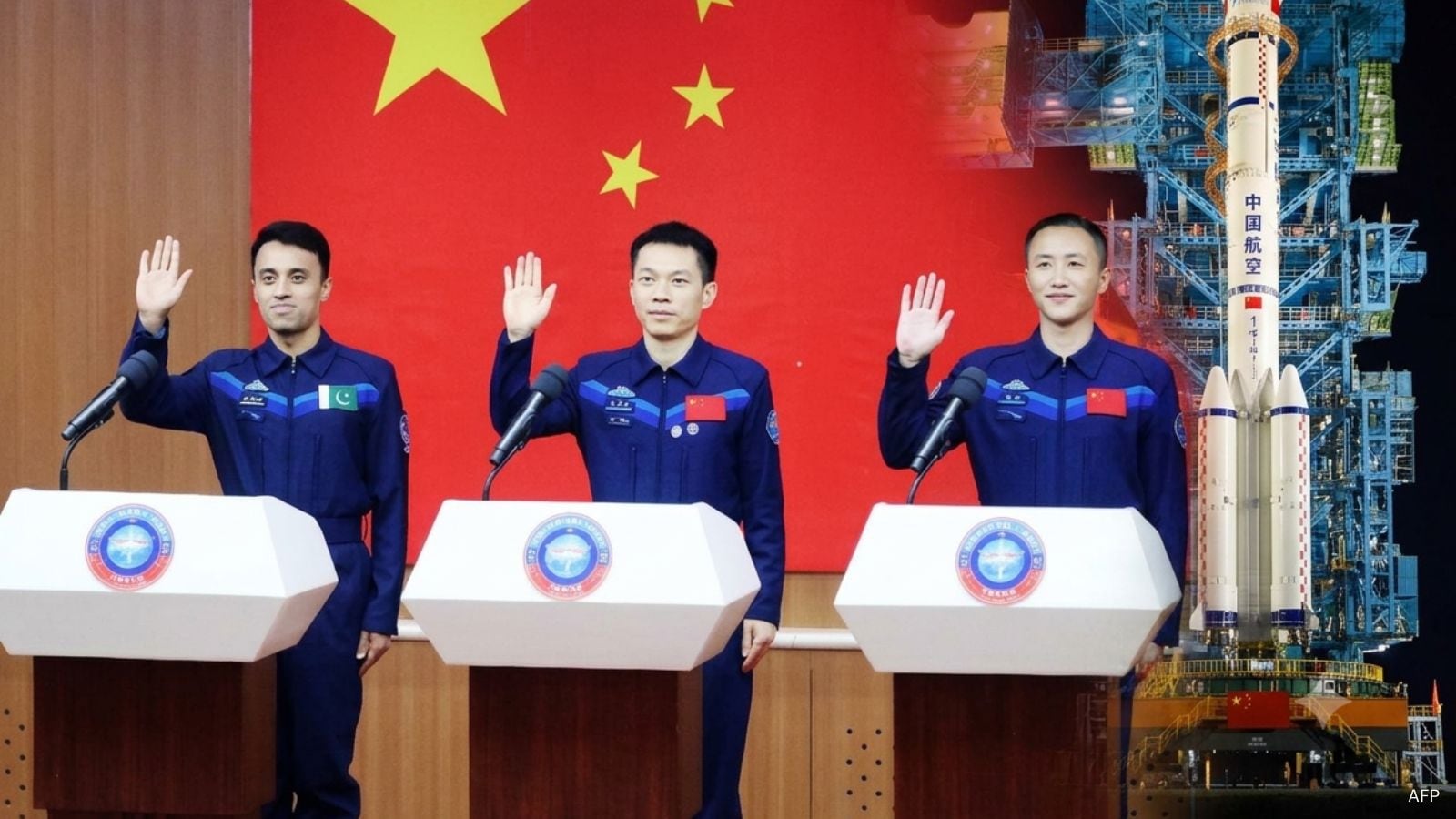
Ali described the Pakistan-China friendship as “higher than the mountains, deeper than the oceans, sweeter than honey and as vast as outer space” during the pre-launch news conference, the Associated Press reported. He added that the mission is “not a finish line” but a launchpad for future cooperation reaching the Moon, Mars and beyond, the AP said.
Indian Analyst Frames Mission as Strategic Signal
Retired Brigadier Anshuman Narang told NDTV that placing a Pakistani aboard Tiangong first is a “clear stamp of the friendship which they have,” adding that China cannot accept casualties with a foreign astronaut on a historic flight. He contrasted Ali’s payload-specialist role with Indian astronaut Group Captain Shubhanshu Shukla’s mission-pilot position on the 2025 Axiom flight, saying the latter involves controlling the spacecraft, NDTV reported.
China’s Shenzhou-24 crew—Chinese astronauts Tang Hongbo, Wu Yi, and Pakistani astronaut Muhammad Zeeshan Ali—is set to launch on Nov. 25, 2026. Ali will become the first foreign astronaut to visit the Tiangong space station and the first international crew member in China’s… pic.twitter.com/O2bdrNP75p
NDTV further reported that the Chang’e-6 mission carried Pakistan’s iCube-Qamar satellite to lunar orbit in 2024, developed at the Institute of Space Technology. Al Jazeera confirmed the satellite reached lunar orbit aboard Chang’e-6 last year.
Lunar Ambitions Frame the Cooperation
China aims to land astronauts on the Moon by 2030, with NASA targeting 2028 for its Artemis return. Brigadier Narang said that Tiangong serves as a testbed for the life-support and long-duration capabilities needed for a future lunar base. Pakistan has also stated a lunar target, with officials saying the human-spaceflight experience will feed back into medical and scientific applications on the ground.
Long Live China-Pakistan Friendship!🇨🇳🇵🇰 For Pakistan’s first astronaut to visit the Tiangong space station, Muhammad Zeeshan Ali, the hardest training challenge was not the centrifuge, but mastering Chinese. From daily phrases to professional aerospace commands, his journey… pic.twitter.com/NGWddumcFn
Pakistan’s Space and Upper Atmosphere Research Commission (SUPARCO), the national space agency leading the National Space Programme since its reorganization as an independent federal agency in 1981, shortlisted pilots Zeeshan Ali and Khurram Daud from over 300 experiment proposals under the February 2025 bilateral agreement with China.
SUPARCO also serves as secretariat for the Pakistan Space Activities Regulatory Board established in February 2024 under the National Command Authority to regulate all space-related activities in Pakistan.
Answering a question from CGTN ahead of the Shenzhou-24 launch, Muhammad Zeeshan Ali, an astronaut from Pakistan, described the mission as "not a finish line" but "a launchpad" for China-Pakistan space cooperation. pic.twitter.com/imIErRQFOU
“Just look up at the sky and remember that I am up there with your dreams.” Ali told children watching from Pakistan, speaking in English at the pre-launch news conference.
More on Muhammad Zeeshan Ali
Pakistani and Chinese astronauts hold press conference ahead of the historic Shenzhou-24 space mission. https://t.co/1Zzra1tvHs
#MegaProject "I was the last one to join the program. But now I can confidently say that from that last one to becoming the first one to be in space." Pakistani astronaut Muhammad Zeeshan Ali is preparing for the Shenzhou XXIV mission after completing a year-long training program… pic.twitter.com/CSIesdiCSv
Tomorrow, Pakistan will look to the skies with anticipation, pride and deep gratitude. As Shenzhou-24 prepares to carry a Pakistani astronaut to China’s Tiangong Space Station, our nation stands on the threshold of a historic first. It is a moment that belongs to every…
President Asif Ali Zardari has felicitated the nation on Pakistan’s historic participation in China’s Shenzhou-24 mission to the Tiangong Space Station, scheduled for tomorrow, describing it as a landmark achievement in the country’s scientific journey and a moment of immense…
At the Astronauts Media Briefing — filled with immense pride and excitement as I witness history in the making. Watching our astronaut, Muhammad Zeeshan Ali take center stage is a deeply moving moment. We had dared to dream big and laid the foundational blocks for Pakistan’s… pic.twitter.com/VEZhBbda34
My heartfelt congratulations to the entire nation and @SUPARCO_Official as Pakistan prepares to make history in space exploration and joint scientific advancement. With China’s #Shenzhou24 mission set for launch, a Pakistani astronaut, Muhammad Zeeshan Ali, will soon enter…
A proud moment for Pakistan! 🇵🇰 We congratulate Pakistani astronaut Muhammad Zeeshan Ali on his selection as a payload specialist for China’s Shenzhou-24 mission, marking a historic milestone in space exploration. This achievement underscores the immense potential of Pakistan’s… pic.twitter.com/CIRUjvs7rU
Meet Pakistani astronaut Muhammad Zeeshan Ali. He will become the first foreign astronaut to board China's Tiangong space station, as he has been selected to join the Shenzhou-24 spaceflight mission. #Shenzhou24 #ChinaSpace #SpaceStation pic.twitter.com/VIppWmU6aR