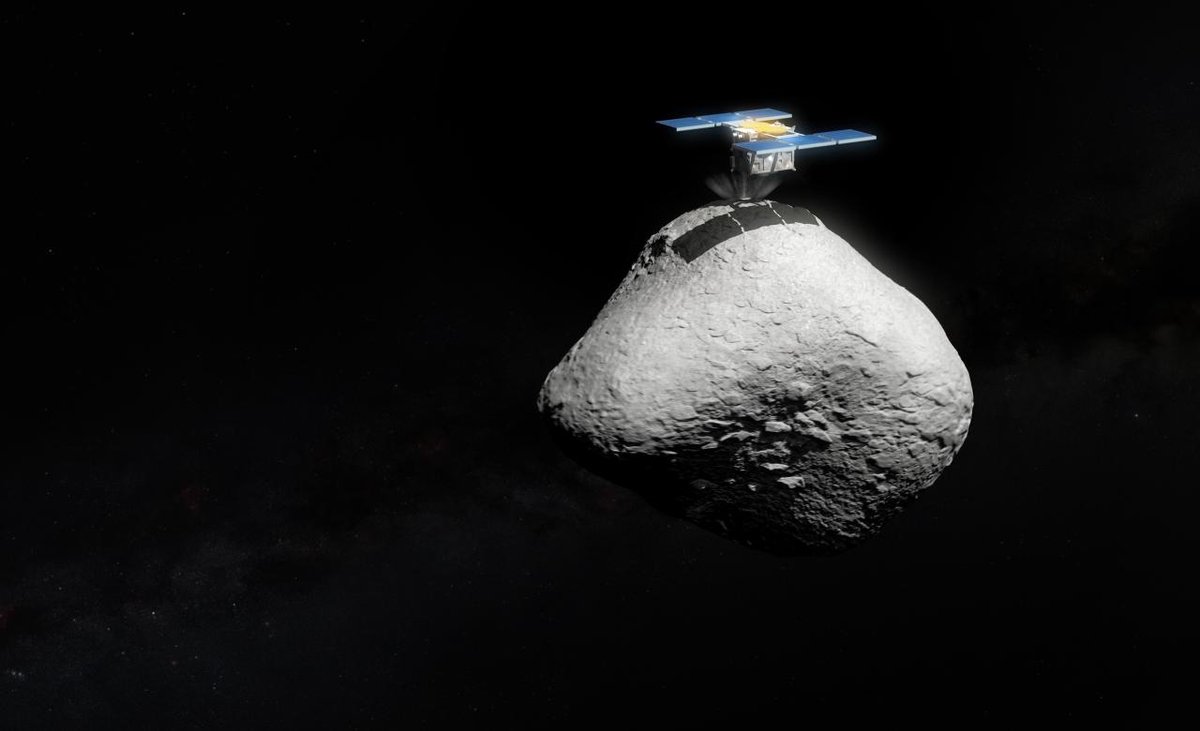
Physicists have reopened a theoretical window for ultralight primordial black holes by showing that their evaporation in the early universe would produce a much weaker gravitational wave signal than standard models assumed.
Revisiting Early Universe Reheating Through Critical Collapse
The hot big bang may have emerged from the evaporation of primordial black holes lighter than 109 g, according to a study published on October 29, 2026, in Physical Review Letters. The research was formulated at Johannes Gutenberg University Mainz and the Institut d’Astrophysique de Paris by Yann Gouttenoire, Nicholas Leister, and Pedro Schwaller. Their institutions also include the CNRS and Sorbonne Université.
Standard monochromatic treatments of these primordial objects predict nearly simultaneous evaporation, abrupt reheating, and a large scalar-induced gravitational wave signal. However, general relativity predicts an irreducible collapse mass tail described mathematically as $df_{text{PBH}}/dln M propto M^{3.78}$. This distribution smooths out the reheating process and suppresses the resulting gravitational wave signal by orders of magnitude.
“The early universe may have been heated by tiny primordial black holes,” the researchers said in their findings.
Energy Dynamics in a Radiation Dominated Cosmos
During a short phase in its history, the universe could have been dominated energetically by minuscule black holes. By evaporating, those compact bodies might have fed their stored energy back into radiation and particles, once more raising the temperature of the cosmos.
Radiation thins as space grows, and its particles also lose energy through redshift. Meanwhile, black holes spread farther apart while retaining approximately their individual masses, allowing their share of the total energy to rise.
That difference in dilution can turn an initially modest population into the dominant component. Near the threshold for collapse, the resulting mass depends on how strongly a region exceeds that threshold. Slightly different starting conditions therefore produce different black hole masses through a behavior known as critical collapse.
Implications for Dark Matter Searches and Future Detectors
Separate recent work published in the Astrophysical Journal on November 19, 2026, by MIT assistant professor of physics Ore Gottlieb and collaborators modeled how asteroid-mass primordial black holes could sink into sun-like stars and consume them from within. Matteo Cantiello of the Flatiron Institute, Cameron Norton alongside Matthew Kleban from New York University, and Ken Van Tilburg of Stanford University participated as co-authors on that paper.
Funding for the investigation was provided by the National Science Foundation and the U.S. Department of Energy Office of Science Advanced Scientific Computing Research Program. That study suggests astronomers might spot explosions triggered by such internal objects using current telescopes.
The Institut d’Astrophysique de Paris was created in 1936 by the French ministry of education under Jean Zay, initially to process data from the Observatory of Haute-Provence, founded simultaneously. Construction of its building began in January 1938, though scientists did not fully occupy it until 1944, with completion in 1952.
Today the institute, part of Sorbonne University and associated with CNRS, hosts 160 researchers, engineers, technicians, and administrators. Its main areas include general relativity and cosmology, cosmological structure formation, and high-energy astrophysics, placing it at the interface between astrophysics and theoretical physics.
While the existence of primordial black holes remains hypothetical, the weaker gravitational wave signal calculated by Gouttenoire, Leister, and Schwaller means that one possible route to cosmic reheating faces fewer restrictions than simplified pictures suggested.
The analysis includes waves associated with formation, the preceding radiation era, and the black-hole-dominated interval itself, leaving room for an early universe heated by evaporating black holes without contradicting existing constraints. “Future gravitational wave experiments probably won't be able to probe this theory,” Leister said.gh to preserve successful nucleosynthesis.