University of Queensland physicists transmitted the word “Gravity” through a brick wall by moving an elevator counterweight and detecting the resulting gravitational changes with a gravimeter, a proof-of-concept published in Science Advances on Friday.
- The experiment sent a 49-bit binary message 0.7 metres through a solid wall at one bit per minute.
- A 1.8-tonne elevator counterweight in a 1950s lift encoded zeros and ones by shifting between two floors.
- A gravimeter in an adjacent bathroom detected the gravitational shifts.
- Modelling suggests quantum sensors could eventually reach 500 metres at 15 bits per minute.
The study, led by Andrew Groszek, Charles Woffinden, Michael Harvey, Andrew White and Matthew Davis, frames a fundamental question: can information travel through a channel that no material can block? Electromagnetic signals — radio, Wi-Fi, mobile — are easily screened by walls, metal or rock.
Gravitational fields, sourced only by positive mass, cannot be passively shielded. The authors are affiliated with the Australian Research Council Centre of Excellence for Engineered Quantum Systems and the School of Mathematics and Physics at the University of Queensland, St Lucia, QLD 4072, Australia.
“Unlike the electromagnetic signals used in modern wireless communication, a gravitational signal cannot simply be screened out by placing ordinary material in its path,” said Dr Charles Woffinden, a co-author from UQ’s School of Mathematics and Physics.
Elevator, Bathroom, Brick Wall
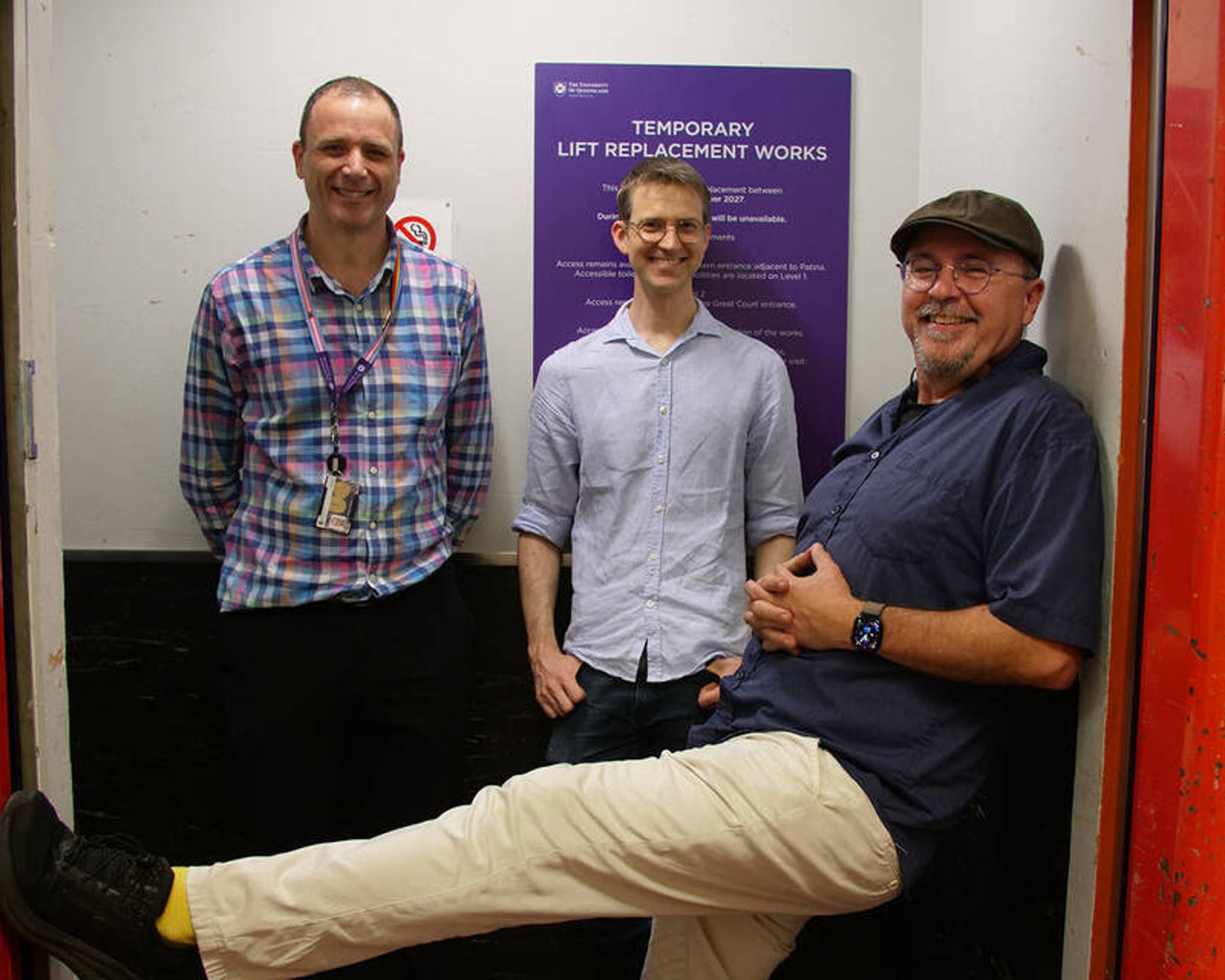
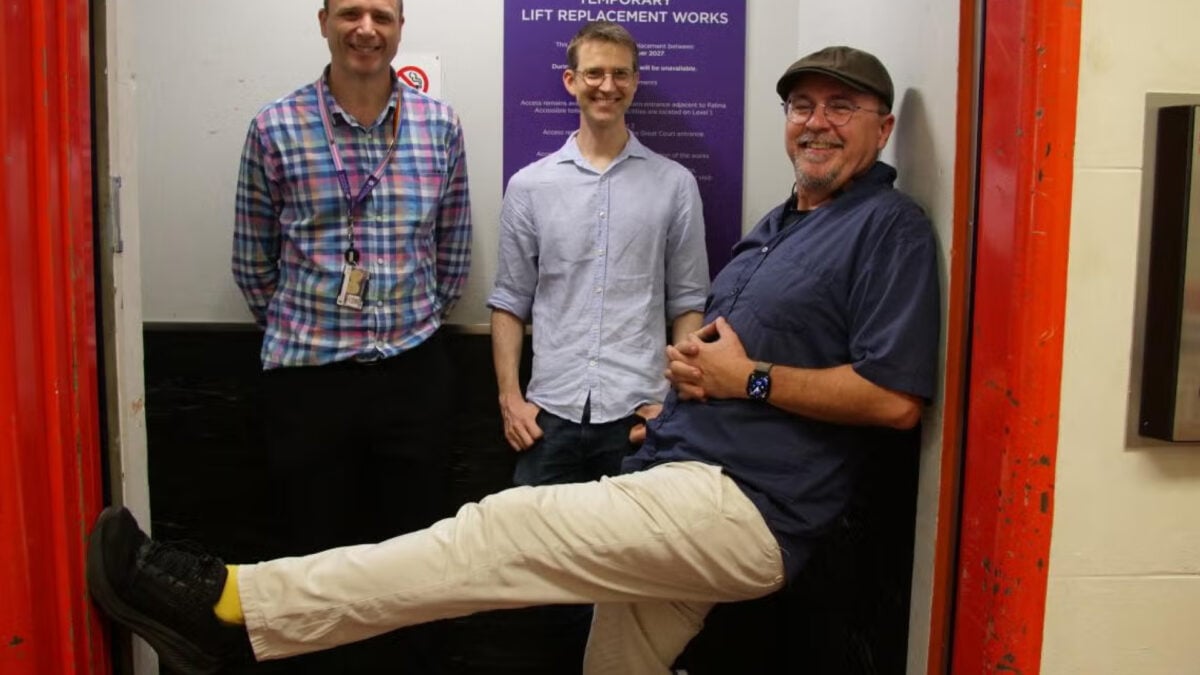
The experiment ran inside UQ’s Parnell Building, home of the world’s longest-running science experiment, the pitch drop experiment, which began in 1927. Researchers used the building’s vintage elevator, whose 1.8-tonne counterweight travelled between two floors. The lower position, with the counterweight’s centre of mass 0.39 metres above the sensor, represented binary 0; the upper position, 5.80 metres above, represented binary 1.
A gravimeter — a spring-based instrument normally used for geophysical surveys — sat in a men’s bathroom on the other side of a brick wall, about 0.68 metres from the counterweight at its closest.
Each bit allotted 25 seconds for the mass to move, 10 seconds for vibrations to settle, and 25 seconds for signal averaging. The full 49-bit word “Gravity” (seven-bit ASCII per letter, plus start and stop markers) took 63 minutes to transmit. The binary sequence was 1000111 1110010 1100001 1110110 1101001 1110100 1111001.
“Our lift was snail-paced — it's from the 1950s — so our experiment transmitted just 1 bit per minute, meaning it took an hour to send a single word,” said Professor Andrew White, a quantum scientist at Queensland and study co-author.
Why Gravity Penetrates
Electromagnetic waves interact with electrons in matter; a Faraday cage or thick concrete attenuates them. Gravity differs. Electric charges come in positive and negative, allowing fields to cancel. Mass, the source of gravity, has only ever been observed as positive. No arrangement of ordinary matter can neutralise a gravitational field. The measured signal was resolved by the gravimeter after correcting for Earth tides and instrument drift.
The researchers stress they were not generating gravitational waves — the ripples in spacetime detected by observatories such as LIGO — but modulating the local static field, the same pull that keeps feet on the ground. The team exploited the property that gravitational fields cannot be passively shielded by ordinary matter, unlike electromagnetic waves used in radio communication which can be blocked by materials such as metal plates.
From Weighbridges to Messages
The project began as an effort to design a contactless weighbridge for heavy trucks. Dr Andrew Groszek and colleagues found they could detect a moving mass at a distance by its gravitational pull.
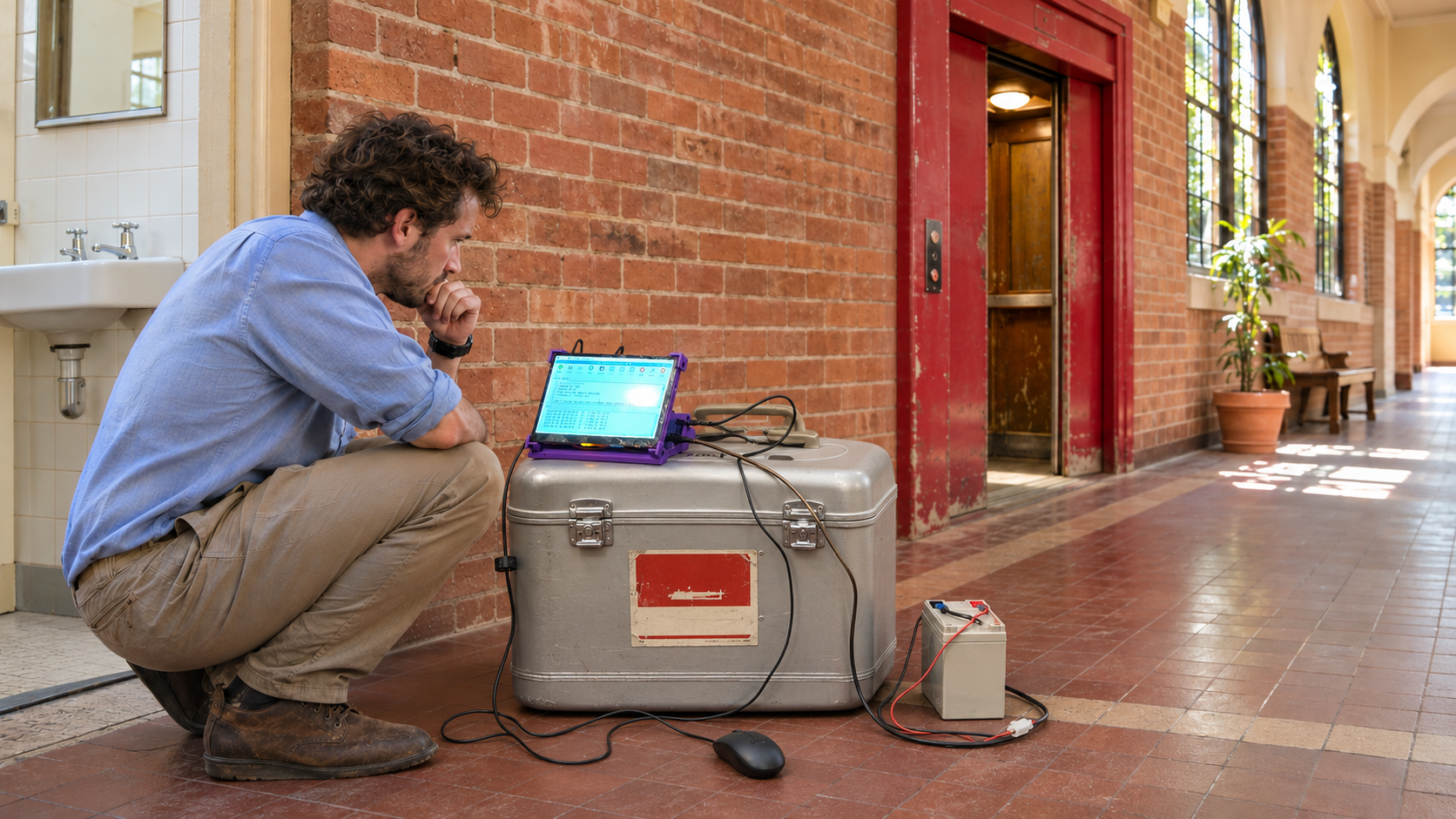
Once that worked, encoding data in the motion became the logical next step. The idea for the elevator study arose from this project to develop a contactless weighbridge, which would use quantum sensors to detect changes in the strength of the gravitational field.
“Once we had shown that the idea worked, we realised the same physics could be used to encode and transmit information,” the team said. The elevator counterweight served as a convenient, massive, movable test mass already installed in the building.
Quantum Sensors Could Extend Range
Professor Matthew Davis, the study’s corresponding author, modelled the potential of next-generation quantum gravity sensors. Under ambitious assumptions — a 75-tonne mass, a more sensitive detector, and acceptance of a noisier signal — the range could extend to roughly 500 metres and the data rate to about 15 bits per minute. These figures are theoretical projections, not experimentally demonstrated capabilities. The paper sets different conditions for increasing speed and for extending range.
“It’s not often that you get to demonstrate an entirely new way of communicating,” Davis said. He added that the Voyager 1 spacecraft, despite being roughly a light-day away, can communicate with Earth faster than the experimental gravity-based system.
Researchers Frame Work as Proof of Principle
Professor Matthew Davis, the study’s corresponding author, said the experiment was theoretically interesting enough that it was worth doing, according to reporting from The Guardian.

“theoretically interesting enough that it was worth doing,” Professor Matthew Davis, the study's corresponding author, told Guardian Australia.
Charles Woffinden acknowledged the system remains far from practical while emphasizing it shows the possibility of communicating by a method that ordinary physical barriers cannot block. The authors frame the demonstration as answering a fundamental question: whether information can travel through an unblockable channel.
Team Traces Idea to Weighbridge Project
Professor Andrew White said it took more than 100 years to go from the first telegraph to the mobile phone, so while gravity communication is not practical today, it could be in the future, as reported by The Brighter Side of News.
Not the First Unblockable Channel
In 2012, a Fermilab team transmitted a neutrino message through 240 metres of bedrock at about six bits per minute, using a particle accelerator and a massive detector. The Queensland experiment achieved a similar barrier-penetrating feat with only an ordinary moving mass and a commercially available gravimeter.
A comparison in the paper notes the gravity communication (2026, UQ) sent a 49-bit message over about 0.7 metres through a brick wall at 1 bit/min with a bit error rate of about 0.01 in raw measurements, while the neutrino communication (2012, Fermilab) sent a message over 1.035 km through 240 m of bedrock underground at about 0.1 bit/s with a 1% bit error rate.
The study appears in Science Advances (DOI: 10.1126/sciadv.aee0802).