Canada is seeking an interim trade arrangement with the United States by the end of the year to address sweeping U.S. levies, even as high-level negotiations remain deadlocked over core automotive disputes.
Stalled Talks and Stumbling Blocks Over Auto Tariffs
Chief trade negotiator Janice Charette informed a federal advisory committee that these unresolved matters are currently preventing a finalized deal. The core of the disagreement involves a 25 per cent U.S. tariff on Canadian automobiles, a sector already strained by previous U.S. trade actions.
Canada-U.S. Trade Minister Dominic LeBlanc, alongside Janice Charette, has been in regular contact with U.S. Trade Representative Jamieson Greer. Despite these engagements, the Liberal government has refrained from labeling these interactions as formal negotiations, a move one advisory council member suggested is intended to manage public expectations regarding the likelihood of a breakthrough.
During a recent briefing, LeBlanc indicated that if Canada can reach an interim agreement, it would likely restart formal discussions on reviewing the broader trilateral trade pact.
Peter Navarro, a top trade adviser to President Donald Trump, publicly criticized Ottawa’s negotiating strategy, describing it as “offensive in the extreme.” In a social media post, Navarro attacked the “arrogance and dishonesty” of Canadian officials, likening their approach to a “high school team taking on the New York Knicks.” He further warned that Canada’s attempt to leverage relationships with China against the U.S. would not end well for the country.
Prime Minister Carney Pursues Global Diversification
Prime Minister Mark Carney met with President Trump for a conversation lasting just under 20 minutes in Shenzhen, China. Carney, who has made doubling Canadian exports to non-U.S. markets by 2035 a central policy goal, told reporters that while they are making progress, the two nations are not yet at the finish line for a bilateral deal.
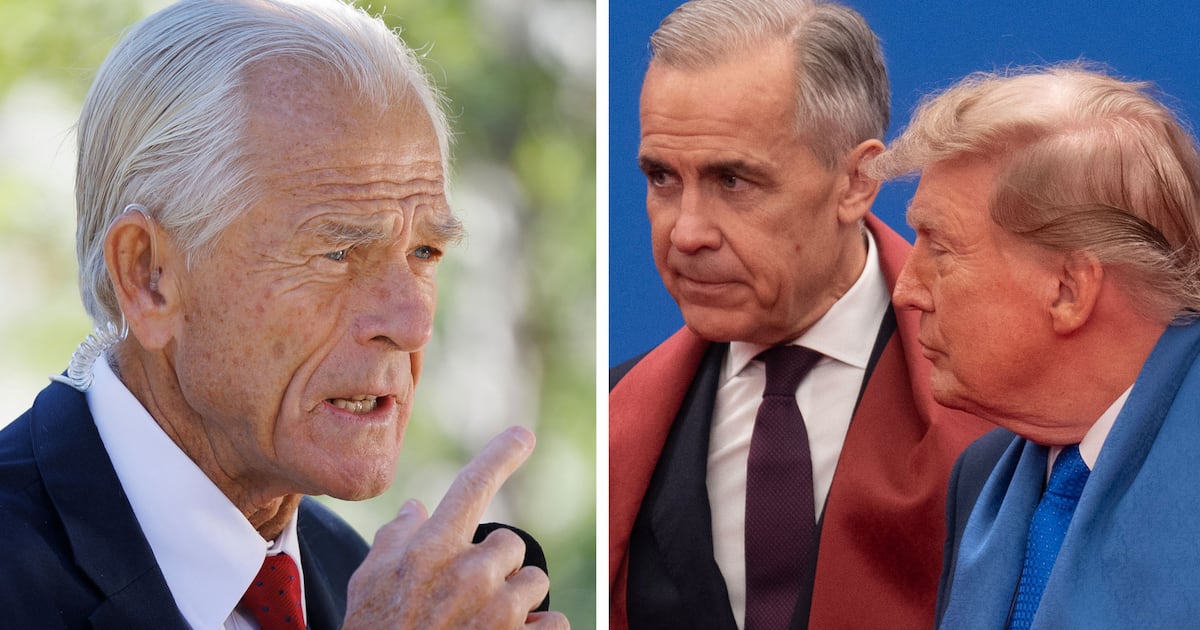
U.S. Trade Representative Jamieson Greer and White House Chief of Staff Stephen Miller also participated in the call.
We are making progress. There is the possibility of a deal, a bilateral deal. But we’re not yet there.
Prime Minister Mark Carney
While engaging with the Trump administration, Carney has moved to finalize trade agreements elsewhere. He announced that Canada has substantially concluded free-trade negotiations with the Association of Southeast Asian Nations (ASEAN)—a bloc representing nearly 700 million people—and completed separate negotiations with the Philippines.
The arrogance and dishonesty of Ottawa on trade and misreading of their position is really something else. They are like a high school team taking on the New York Knicks. That doesn’t end well for Canada. pic.twitter.com/rsb6zdQKBC
Government estimates suggest the ASEAN deal could add nearly 2 billion Canadian dollars to the economy and create approximately 14,000 jobs, primarily in the manufacturing and agriculture sectors. Officials aim to sign these agreements next year.
Weighing Asian Alternatives for the Auto Sector
Carney has emphasized that he will not agree to a deal that leaves the Canadian auto sector without a viable long-term future. Facing the prospect of a less-integrated North American market due to U.S. trade actions, Carney has said that Canada is looking at other options, including European, Japanese, and Chinese investment.
He specifically said that he plans to discuss Chinese investment in the Canadian auto sector with President Xi Jinping, provided that such investments meet strict standards for Canadian parts, labour, and critical minerals.
This pivot toward China has faced pushback. Stephanie Kusie, the Conservative international trade critic, stated it is “always concerning” to engage with Beijing given its human rights record. She accused the government of using these trade missions as a “distraction” from its inability to secure a deal with the United States, which she described as Canada’s most significant trading relationship.
Chief trade negotiator Janice Charette, who assumed the role on February 16, 2026, is a career public servant who previously served two separate terms as clerk of the Privy Council, from 2014 to 2016 and again from 2021 to 2023.
Between those tenures, she was Canada’s high commissioner to the United Kingdom from 2016 to 2021. She was the second woman to hold the clerk position, the top civil service post in the federal government, and was made an Officer of the Order of Canada on December 31, 2025.

The “Detroit Three”—Ford, General Motors, and Stellantis—operate plants that rely on parts crossing the border multiple times. Trump’s pressure on carmakers to shift production from Canada to the U.S. has exacerbated these tensions.
As the year draws to a close, Canada remains in a dilemma: attempt to secure a deal that might leave some tariffs in place, or hold out while awaiting the seating of a new U.S. Congress in January.