Google’s Willow processor won a quantum coordination game 98.3% of the time, beating the 88.9% classical ceiling and demonstrating that contextuality — a property scientists believe powers certain quantum algorithms — survives at scale.
The results, published November 19, 2026 in Science, mark a demonstration of measurement contextuality at scale on superconducting processors. Until recently, this effect had mostly been shown in small systems of just a few particles.
The Game Classical Logic Cannot Win
Picture a 3×3 grid. Every cell must hold either +1 or −1. Each row must multiply to +1; each column must multiply to −1. Try it — you can’t. The row constraints demand an even number of −1s across the whole grid, while the column constraints demand an odd number. Arithmetic refuses to cooperate.
Turn that impossible puzzle into a two-player game. Alice gets a row, Bob gets a column. They can agree on a strategy beforehand but cannot communicate during a round. They win if their answers match at the intersecting cell. Any pre-written answer table fails at least one of the nine possible row-column pairings, capping classical success at 8 of 9 rounds — 88.89%.
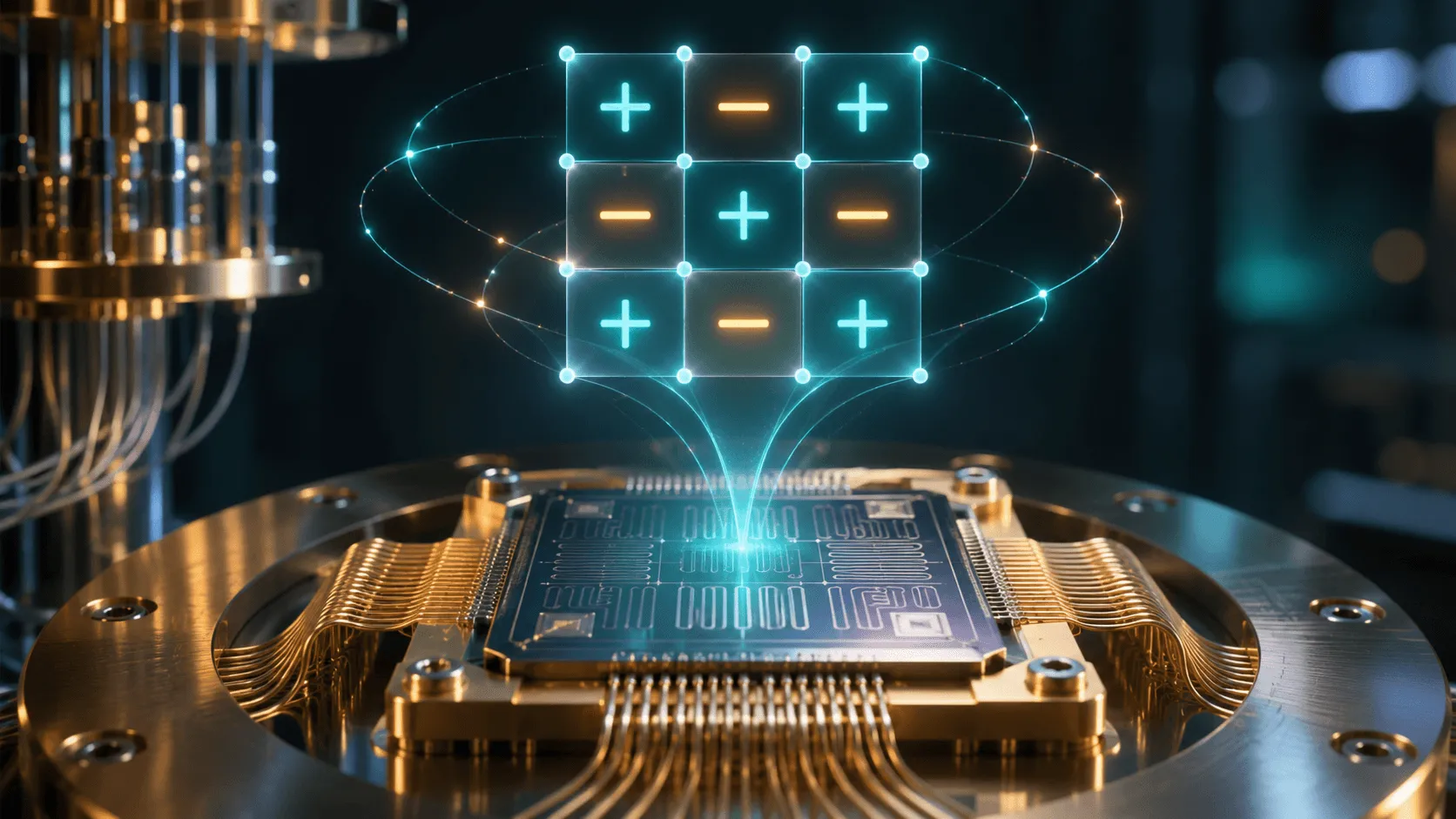
Google’s team ran all nine pairings on four qubits of the Willow chip, two entangled Bell pairs shared between the players. Each pairing was tested 100,000 times. The processor won 98.3% of the 900,000 total rounds. The losses, the researchers say, trace to residual hardware noise, not to any flaw in the quantum strategy itself.
Contextuality: A Property Without a Pre-Existing Script
Quantum contextuality means a measurement outcome is not a fixed value waiting to be revealed; it depends on which other compatible measurements are performed alongside it. In the magic square game, Alice and Bob don’t consult a hidden answer key — no such key exists. Their answers come into being as they measure, stitched together by quantum correlations tighter than any classical rulebook allows.
Entanglement usually gets the headlines, but a growing body of theory argues contextuality is the deeper resource powering certain quantum algorithms past their classical counterparts. The question was whether it survives in large quantum systems.
Beyond Four Qubits: Scaling the Test
The team didn’t stop at the magic square. They ran two additional experiments that pushed contextuality into larger registers:
- N-player GHZ parity game: Using up to 71 qubits, each representing a player sharing a Greenberger-Horne-Zeilinger entangled state, the processor stayed above the classical win rate at every tested size. The quantum advantage narrowed as qubits were added — 75% at three players, decaying toward 50% — but never crossed the classical line. Genuine entanglement was verified across 45 qubits.
- Two-dimensional Hidden Linear Function problem: Constant-depth quantum circuits on grids up to 105 qubits solved instances with success probabilities above one-half, the largest system reaching about 60%. The classical comparison here concerns computational models with restricted circuit depth and gate structure, and the result does not imply an advantage over every classical algorithm.
A Benchmark That Catches Errors Random Circuits Miss
Perhaps the most practical payoff: these structured contextuality tasks act as sensitive hardware diagnostics. Standard random-circuit evaluation tends to average out small, systematic coherent errors — tiny over-rotations that nudge a quantum state off its intended target. But the magic square and GHZ games demand exact multi-qubit phase agreement. When that coordination frays, the win rate drops in a measurable, interpretable way.
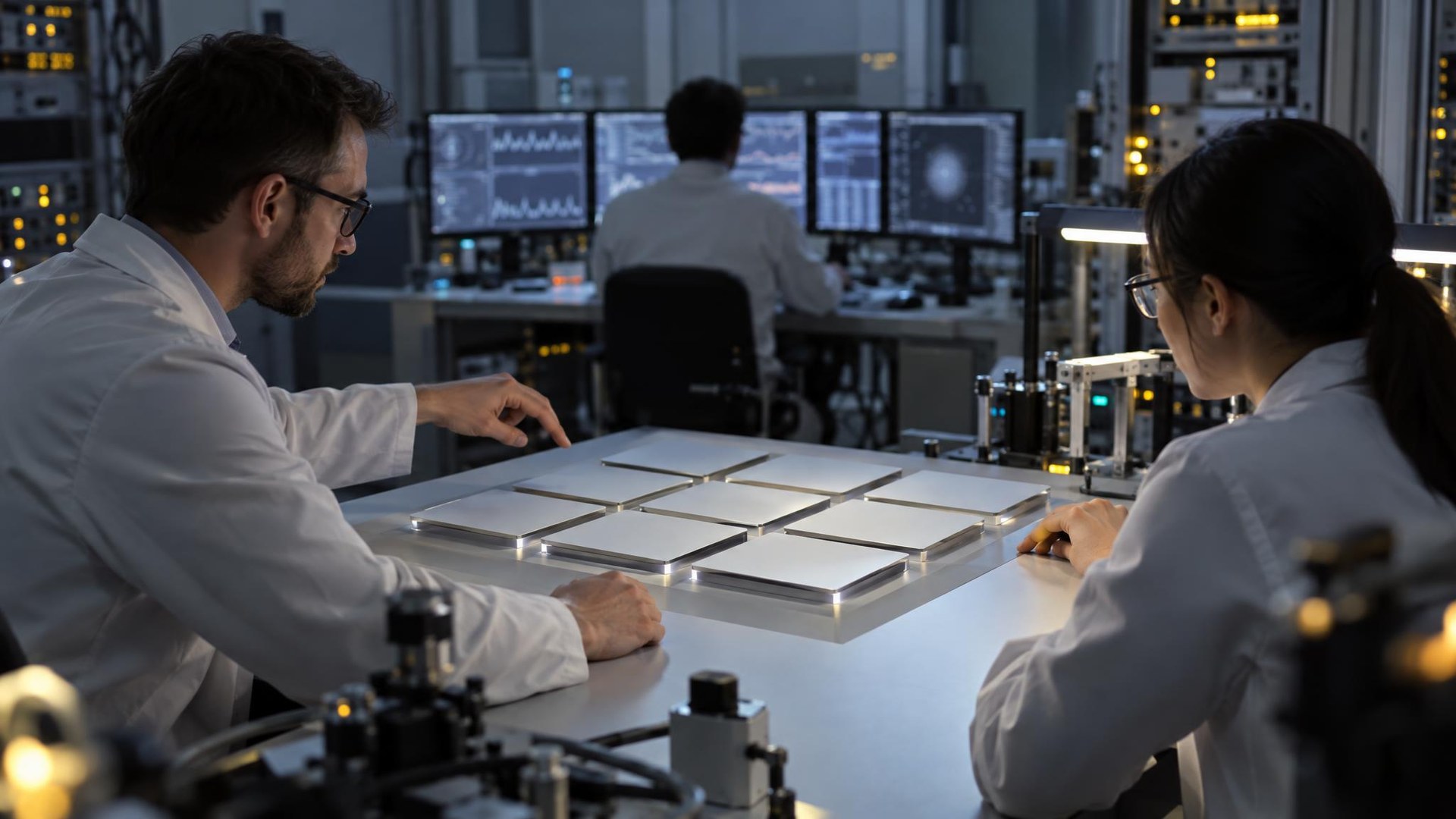
The researchers converted the fraction of correct outputs into an “effective depth” — a time-to-solution metric reflecting the extra runs needed to obtain a correct answer. As system size grew, effective depth rose, showing that preserving the quantum benefit becomes harder with more qubits.
Google is proposing these contextuality-based games become a regular way of measuring hardware quality as processors improve, offering a fixed physical ceiling against which any chip can be calibrated.
What the Paper Does Not Claim
The authors are careful about limits. The demonstrated advantage applies to specific tasks and experimental conditions. The experiments did not perform any practical molecular simulation.
Independent replication on other groups’ quantum processors has not yet been reported, so whether the same diagnostic performance translates across different hardware architectures remains an open question.
From Preprint to Peer Review
The work first appeared as an arXiv preprint in December 2025. Peer review landed the paper on the cover of Science in November 2026. The Willow chip itself debuted in December 2024 with a random-circuit sampling benchmark that it finished in five minutes, against an estimated 10 septillion years for a top supercomputer.
Since then, the processor has been used for a verifiable quantum advantage demonstration in October, and now this contextuality suite — each test probing a different facet of what the hardware can reliably do.