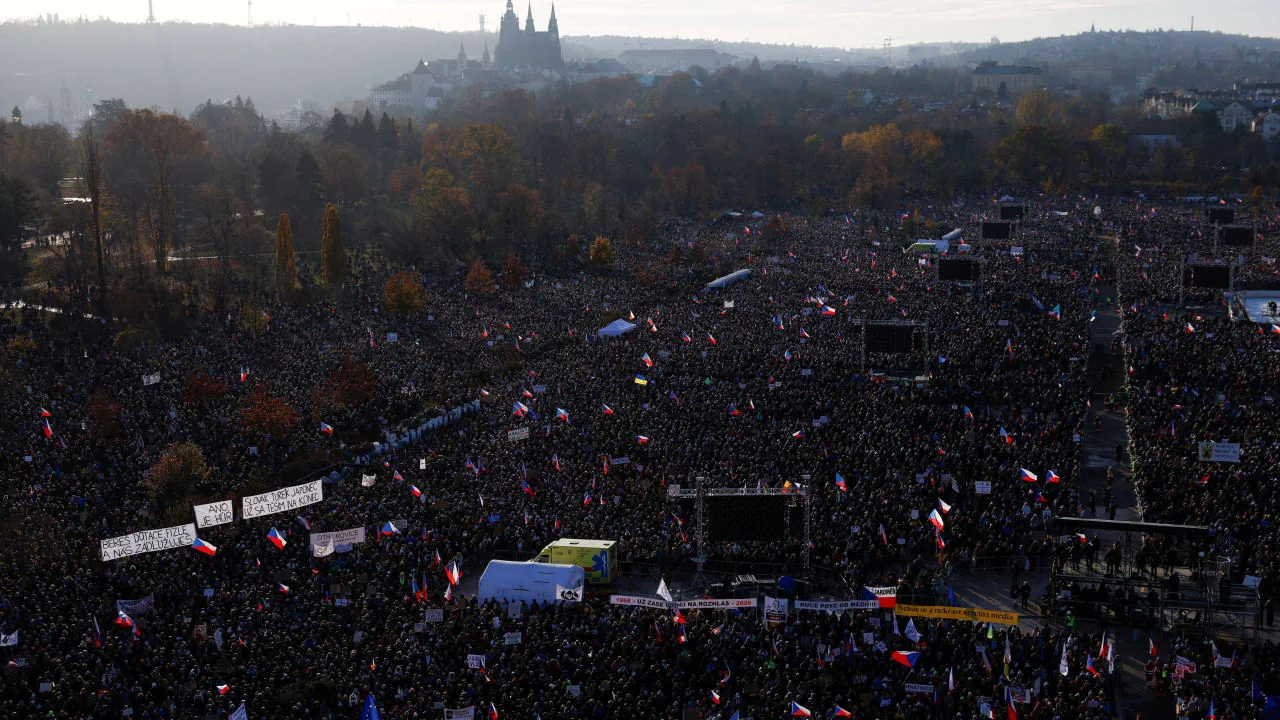
Hundreds of thousands of protesters filled Prague’s Letná Plain on Sunday to oppose the government’s plan to dismantle mandatory public broadcasting licence fees and shift state television and radio financing directly to the state budget.
Funding Overhaul and the 15 Percent Budget Cut
The proposed overhaul would cut state television and radio budgets by about 15%, reducing combined funding by approximately 1.4 billion koruna annually according to the European Broadcasting Union.
The populist government, which holds a coalition including Babiš’s ANO movement, the rightwing Motorists for Themselves party, and the anti-migrant, pro-Russian Freedom and Direct Democracy (SPD) party, maintains that the reform fulfills a campaign pledge to lighten financial burdens on citizens. Babiš has publicly defended the plan, stating that the government is merely meeting a promise to reduce costs for the public.
Parliaments, Protests, and the Specter of the Slovak Scenario
Tensions escalated significantly after the ruling coalition moved to advance the bill in the lower house of parliament on October 24. Lawmakers limited opposition speaking time during an overnight session, pushing the legislation through its first reading at 4:36 a.m. This event, which many demonstrators branded an act of “rule by force,“became a focal point of the rally, with protesters naming the event”Letná against 4:36.”
The civic movement Million Moments for Democracy, which organized the mass demonstration, reported attendance between 350,000 and 450,000 people. While organizers claimed it was the largest gathering in the country since the 1989 Velvet Revolution, a Prague police spokesperson, Eva Kropáčová, said that authorities would not publish an official estimated count, leaving the precise size of the crowd unverified.
The demonstration took place just days before the November 17 holiday, which commemorates the start of the 1989 protests that ended communist rule.

An elected government has the right to govern, but it does not have the right to do whatever it wants and to dismantle democratic institutions.
Mikuláš Minář, lead organiser of Million Moments for Democracy
Beyond the media funding issue, protesters voiced broader concerns regarding the government’s defense policy. Participants called for the resignations of parliamentary Speaker Tomio Okamura, the leader of the SPD, and taking the Defense Ministry away from SPD, citing the party’s oversight of the ministry as a threat to national security and the country’s defensive capacity.
International Warning and Prime Ministerial Defense
The dispute has become a test case for the European Union’s new rules, specifically the European Media Freedom Act (EMFA).
These organizations have drawn comparisons to controversial media reforms in Slovakia under Prime Minister Robert Fico and in Hungary. Critics argue that shifting funding to the state budget creates a vulnerability to political pressure, potentially forcing broadcasters to negotiate resources directly with the government.
Babiš has rejected all accusations of political interference, labeling the opposition’s claims as attempts to incite hatred and divide society. He maintains that the government has no intention of controlling or nationalizing public institutions.
As of mid-November 2026, the bill remains in the parliamentary process, with public media employees continuing to organize strikes and boycotts. Pensioners, students, and former dissidents who signed the Charter 77 initiative joined the rally, many wearing pointed paper hats in tribute to Večerníček, an animated children’s television mascot, signaling a deep-seated public attachment to the independence of Czech broadcasting.