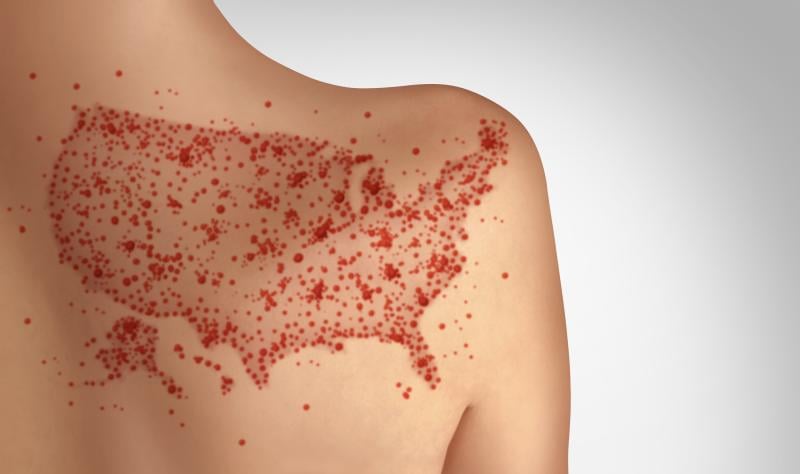
More than 5,182 confirmed measles cases have hit the United States this year, pushing the national total to its highest level since 1991.
Pan American Health Organization Review Deliberates Endemic Status
An independent technical body appointed by the Pan American Health Organization convened in Washington, D.C., to decide whether the United States has lost its official measles-free designation. The country earned the status in 2000 after decades of immunization efforts interrupted continuous domestic spread.
Measles elimination means no strain spreads here nonstop for 12 months. The U. S. reached it in 2000. This week, a PAHO panel reviews it. Johns Hopkins counts 5,400 cases in 2026. Save and send to a parent: https://t.co/VHt4y9dbbM Read & subscribe for free:… pic.twitter.com/Uve67kOxeR
The review hinges on whether the virus has circulated uninterrupted for 12 months or longer, with genetic analysis tracing outbreaks back to a West Texas cluster that began on January 20, 2025, according to Your Local Epidemiologist. State and federal health officials have recorded 11 deaths since early last year, according to state and federal health officials.
The current evaluation in Washington, D.C., runs through Friday. Independent experts appointed by PAHO examine epidemiological and laboratory evidence to determine whether transmission has persisted continuously across multiple states. “One could hypothesize that they didn't want to annoy the administration before the election. I don't know if that's true,” Tom Frieden, who runs Resolve to Save Lives, said.
“.. experts convening on Tuesday to decide whether the United States should lose its official designation as a nation that has eliminated measles.”@nytimes https://t.co/YAozbJwKeU pic.twitter.com/PtWLnjXHqQ
William Moss, MD, MPH, an infectious disease epidemiologist at the Johns Hopkins Bloomberg School of Public Health, emphasized that foreign governments frequently look to the United States for technical guidance on vaccination strategies.
Kindergarten Vaccination Rates Decline
Vaccination rates among U.S. kindergarteners fell to 92.4% during the 2025–26 school year, sliding away from the 95% threshold required to sustain herd immunity. This figure marks a decline from the 95.2% coverage recorded during the 2019–2020 school year.
PAHO's commission is meeting this week on whether the US keeps its measles elimination status. The US had 85 cases the year it eliminated measles in 2000. This year it's past 5,100. It may come down to sequencing, whether outbreaks across states trace to one lineage for 12… pic.twitter.com/R9lZIsJTmX
State-level vaccination metrics vary widely. Noel Brewer, a public health professor at the University of North Carolina who also chairs an independent U.S. advisory panel on measles, presented the CDC’s measles status report to PAHO experts, stating that whether or not the U.S. loses its measles elimination status, the country has a huge problem with measles.
“Measles is the great indicator of where the cracks are in our foundation,” said Demetre Daskalakis, a former top CDC official who resigned after Mr Kennedy took office.
My comments with @ABC @MaryKekatos about meetings this week to examine America’s measles elimination statushttps://t.co/QxvE5wulz0
State-level figures highlight deep geographic disparities. Pennsylvania reported 1,487 cases across 45 counties, while Wisconsin documented 431 cases and Ohio logged 310 confirmed infections since January, according to state health departments. In Ohio, Ashtabula, Geauga, and Wayne counties account for approximately half of all statewide cases.
Meanwhile, data compiled by the Centers for Disease Control and Prevention show that 96% of all recorded measles cases occurred in individuals who were unvaccinated or whose vaccination history remained unknown.

Economic Toll Mounts Across Public Health Systems
Researchers at Johns Hopkins University have built a forecasting model projecting that current outbreaks will generate roughly $83 million in total economic costs, incorporating $56 million in public health response costs, almost $25 million in lost productivity, and more than $1.8 million in direct medical expenses. Historical modeling previously estimated fixed costs at roughly $298,000 alongside about $16,300 for each additional case, largely driven by labor-intensive contact tracing.
Local health departments must constantly divert resources from other public health initiatives to track exposures, manage quarantines, and contain local outbreaks.
Global Context and Policy Stances Under Federal Leadership
If the designation is revoked, the United States would join Canada and several European and Asian nations that previously eliminated the virus only to experience its return. Experts note that Canada lost its elimination status in 2025.
“That is a tremendous step backwards,” said Dr Paul Offit, who serves as director of the Vaccine Education Center, works as an attending physician within the infectious diseases division at Children’s Hospital of Philadelphia, and acts as a vocal critic regarding the administration’s healthcare strategies.
Federal health secretary Robert F. Kennedy Jr. has faced intense scrutiny from medical professionals for promoting doubts about childhood immunization safety. Additional policy changes by the administration, such as the 2024 withdrawal from the World Health Organization and the Global Vaccine Alliance, have further complicated international cooperation and vaccine access.
Despite the challenging policy climate, CDC Director Dr. Erica Schwartz said that the agency will not fundamentally alter its operational response to outbreaks should the international panel strip the nation of its measles-free standing.
Readers wishing to understand their personal immunity or manage vaccination schedules should consult qualified healthcare professionals for tailored medical guidance.
Earlier coverage: U.S. Measles Cases Hit Highest Annual Total Since 1991, CDC Says