Connecticut Department of Education accountability ratings reveal top high schools
Deciding where to send a child to school is a perennial question for parents, but the state of Connecticut offers a metric to help answer it. The Department of Education’s annual accountability ratings evaluate each school’s academic success, student outcomes, and other metrics such as physical fitness and access to the arts.
Expressed as a number between zero and 100, the rating provides an apples-to-apples comparison between schools, giving parents and residents the ability to identify which institutions perform the best. A look across the state highlights three distinct high schools leading the pack across traditional public, magnet, and charter models.
Wilton High School leads non-magnet public schools
The highest-scoring school districts tend to be located in Fairfield County, which is also home to some of the wealthiest towns. Even among those high-performing districts, Wilton schools occupy a unique tier.
For multiple years, Wilton High School has alternated positions between the first- and third-best placements among non-magnet public high schools. The district’s success is mirrored in its lower grades, with Middlebrook School notching the second-highest score among middle schools and Miller-Driscoll School scoring the highest among elementary schools.
Following the 2014 arrival of Wilton School District Superintendent Kevin Smith, the high school’s standing improved dramatically from 37th place during the 2015-16 academic year.

“We used the pandemic to focus our entire staff, our entire community,” Smith said. “You can see that pretty clearly in our results going back over time.”
Smith pointed to curriculum shifts in reading and mathematics as key drivers. Over the past eight years, the district has introduced new mathematics courses at the high school level, adjusted when students can begin taking more challenging mathematics courses and focused on structured literacy programs. The district has also emphasized intervention, a strategy where staff work with individual students directly when data indicates they need support.
Above all, Smith credited the instructional staff. “I give all credit to the instructional staff,” Smith said. “They care about their kids. They know what their kids need to know and be able to do, and where the gaps are, and they work really hard to close the gaps.”
Connecticut IB Academy dominates magnet rankings
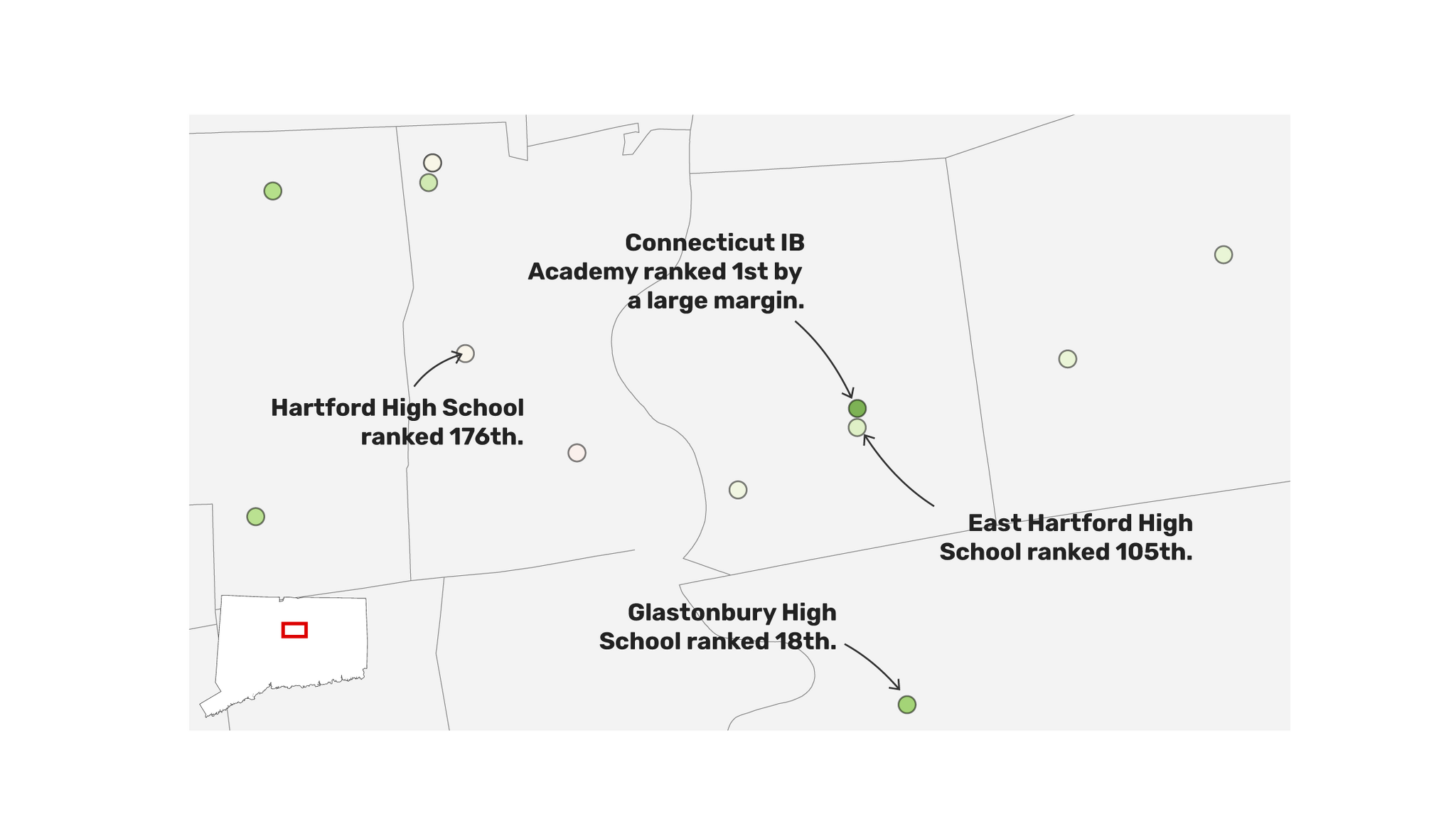
The Connecticut IB Academy (CIBA) in East Hartford has been the highest-ranking magnet school in Connecticut every year since 2017, omitting data not available for the 2019-20 and 2020-21 school years. Prior to 2017, it ranked as the second-highest.
U.S. News & World Report repeatedly ranked the magnet as the best high school in the state, a distinction it most recently received on Thursday, May 9, 2024. The performance gap between magnet and surrounding traditional schools remains stark. East Hartford High School, situated just a few hundred feet away, received an accountability rating about 25 points lower than CIBA, with other major Hartford area schools showing similar disparities.
This discrepancy carries direct policy weight in Hartford, where the state is mandated to place at least 95 percent of Hartford students who apply for entry-grade spots in school choice programs, including interdistrict magnet schools.

The Bridge Academy climbs charter school ranks
Among state charter institutions, The Bridge Academy—serving middle and high school students—climbed from sixth position to secure the top spot. This ascent was driven primarily by improvements in chronic absenteeism and the school’s ability to meet targets related to academic performance.
“We provide an inviting environment,” said The Bridge Academy District superintendent Tyrone Elliott, who has been with the district for 14 years. “We’ve put a lot of effort into making sure that we recruit certified and talented teachers.”
The school maintains two social workers and a school counselor for a student body of 281, yielding a support staff ratio higher than many institutions of comparable size. Elliott noted that this staffing model prioritizes students’ social and emotional well-being.
That support structure helps combat chronic absenteeism, defined as missing 10 percent or more of enrolled days for any reason. To minimize barriers to attendance, The Bridge Academy provides bus passes and access to a washer and dryer.
“We try to take care of the whole child,” Elliott said.