Legal Internships Across Ohio and Pennsylvania Expand Experiential Learning
For students at Ohio University, the path to a career in law is moving beyond the traditional classroom and into the high-stakes environment of courtrooms and public defender offices. Through the Center for Law, Justice and Culture (CLJC), a cohort of students spent their summer months gaining firsthand experience in legal service, supported by targeted funding that removes the financial barriers often associated with unpaid or low-paying internships.
These internships, reported by Ohio University, span a diverse range of legal sectors, including juvenile justice, civil liberties, and prosecution. By placing students in communities across Ohio and into Pennsylvania, the CLJC aims to cultivate a new generation of advocates who understand the practical realities of the American legal system. The program is bolstered by the generosity of alumni Leah Recht and Jennifer Stevens, alongside longtime university supporter Mary Stanley, whose funds allow students to pursue mission-driven roles in public service.
The Anatomy of Juvenile Justice in Athens County
The reality of legal work often differs sharply from the procedural dramas seen on television. For Nick Silliman, a senior studying political science, his summer internship at the Athens County Juvenile and Probate Court provided a jarring but necessary introduction to the profession. Working under Judge Zachary Saunders, Silliman spent his days navigating discovery requests, judgment entries, and case plans—the “anatomy of a case file,” as he described it.
Silliman observed that the questioning tactics used by attorneys were not designed to uncover new information, but rather to build a specific narrative for the record. This distinction, particularly evident when watching pro se litigants, highlighted the complexity of legal communication. As noted by the university, Silliman’s experience was supported by the Mary Stanley Public Service Internship Support Fund, a program designed to foster exactly this kind of institutional awareness.

Bridging the Access-to-Justice Gap
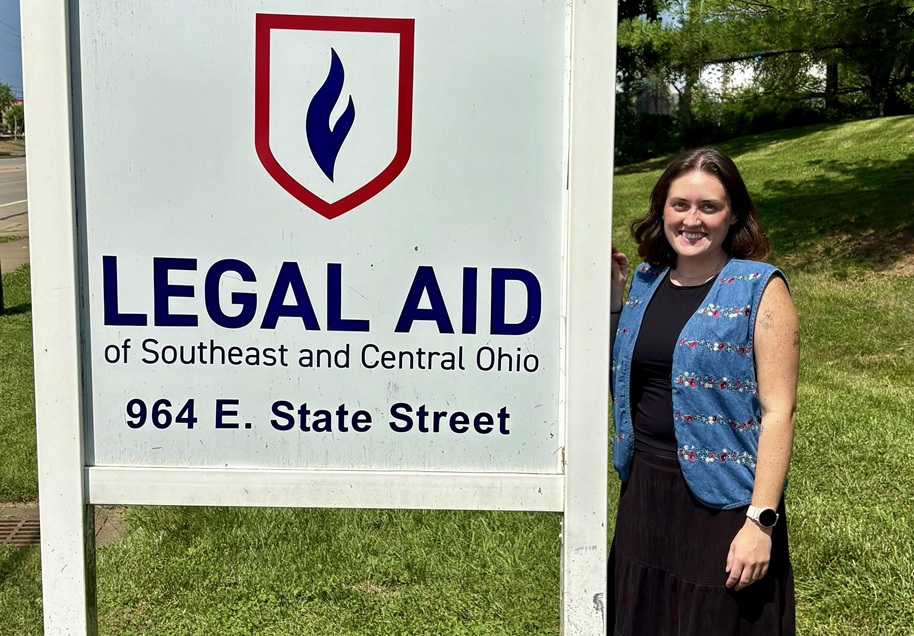
In civil law, students like Lilly Garner and Ella Pelton worked with Legal Aid of Southeast and Central Ohio (LASCO). Their focus was on the human side of legal representation, particularly in a region like Athens, where poverty can create significant barriers to using the judicial system. Pelton, working within the Tenant Advocacy Project (TAP), saw firsthand how housing law intersects with the personal struggles of low-income residents facing eviction.
The law is incredibly complex, and the knowledge and resources necessary to navigate the legal system are often inaccessible to the people who need them most.
Garner said of her experience. Both students highlighted that these interactions were the most meaningful aspects of their summer, transforming abstract legal principles into tangible impacts for families and individuals.

Public Service and Systemic Advocacy
The scope of the CLJC program reaches into the highest levels of state government and the most demanding corners of public defense. Giana Ray, an English pre-law student, spent her summer at the Ohio Attorney General’s Office, where she researched cases for the Major Litigation Unit and explored the growing field of elder justice. Her work included attending the World Elder Abuse Convention, an experience that demonstrated the urgent need for specialized representation for older adults.
Meanwhile, in Cincinnati, Sophia Maher worked with the Hamilton County Public Defender’s Office. Her time reviewing body camera footage and meeting with juvenile clients challenged her previous perceptions of public defense work.
The Sustainability of Experiential Learning
The CLJC’s initiative is not merely about providing temporary placements; it is about building a sustainable pipeline for legal talent in rural and underserved areas. Larry Hayman, director of legal engagement at the CLJC, emphasized that these internships represent the best of experiential learning. By connecting students with judges, prosecutors, and policymakers, the program ensures that the next generation of legal professionals is entering the workforce with a clear sense of purpose.
As Marshall Smittle, a history student who interned at the Jackson County Court of Common Pleas, observed, many of the families appearing in court are there due to a lack of access to basic support systems like food and housing assistance. His realization—that the court can be a facilitator of resources rather than just a site of judgment—reflects the broader goal of the program: to train lawyers who view the legal system as a tool for community stability rather than just a mechanism for litigation.
With students like Madison Peters at the Guernsey County Prosecutor’s Office and others engaged in civil rights work with the ACLU of Ohio, the program continues to expand its reach. For these students, the summer was more than a resume builder; it was an education in the vital, often quiet, work that keeps the wheels of justice turning in local communities.