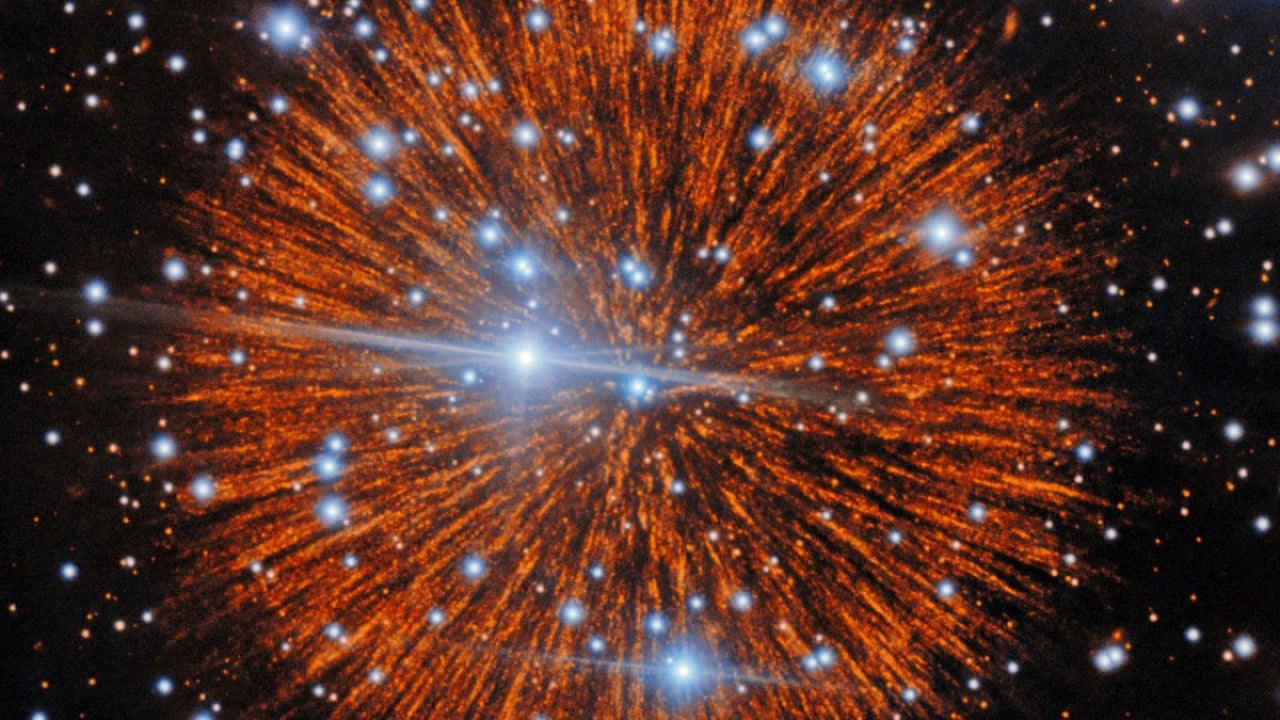
Astronomers using the Gemini North telescope in Hawai‘i have captured the most detailed view yet of Pa 30, a supernova remnant located about 7,500 light-years away. The new observations reveal unexpected chains of gas knots and provide fresh clues about SN 1181, an explosion recorded by historical observers in 1181.
New observations from the Gemini North telescope on Maunakea in Hawai‘i have exposed the most detailed view yet of Pa 30, a supernova remnant residing roughly 7,500 light-years from Earth. Its distinctive streaks of gas look like sparks shooting outward. When researchers zoom in, those seemingly smooth trails turn out to be chains of knots resembling pearls on a string, and they measure on an immense scale.
The planetary region of our solar system could fit in each knot about 10 times with room to spare.
Ilaria Caiazzo, astrophysicist and assistant professor at the Institute of Science and Technology Austria
The findings come from a research team co-led by Caiazzo and astrophysicist Tim Cunningham, and the results are published in The Astrophysical Journal. The Gemini observations reveal roughly 10 times as many filamentary features as earlier images showed, while the red ionized sulfur and blue-green ionized oxygen surrounding the surviving white dwarf expose chains of gas knots that give researchers new clues about how the debris took shape.
Historical Records and the Discovery of SN 1181
Experts view Pa 30 as the probable aftermath of SN 1181, an exploding star documented in 1181 by chroniclers across Arabic, Chinese, and Japanese historical records. That stellar event remained visible in the constellation Cassiopeia for 185 days. Connecting those historical accounts to an object astronomers could study today took centuries.

Through a citizen science project in 2013, citizen scientist Dana Patchick spotted Pa 30 while reviewing data gathered by NASA’s Wide-field Infrared Survey Explorer. SN 1181 is one of only five supernovae documented before the telescope era.
Zombie Star Defines Milky Way Type Iax Supernova Remnant
Pa 30 stands out because of its unusual resident: a surviving stellar remnant at its center, nicknamed a “zombie star.” It is considered the only known remnant of a Type Iax supernova in the Milky Way. These events are relatively low-energy, incomplete stellar explosions that leave a surviving star behind, unlike a standard Type Ia supernova that completely destroys the exploding white dwarf.
The knots are quite strikingly uniform. We are excited to try to model them.
Ilaria Caiazzo, astrophysicist and assistant professor at the Institute of Science and Technology Austria
The bigger mystery is the survivor itself. Within the recent photographs, the white dwarf rests nearly dead-center inside an even nebula instead of being displaced toward the periphery. An uneven explosion typically gives a surviving star a “kick,” sending it away from the center. Pa 30’s structure suggests its star experienced no significant lateral shove, providing further evidence of an explosion characterized by order rather than disorder, likely connected to the collision or merger of a pair of white dwarfs.
Gemini North Telescope Captures Crisp Stellar Remnant Images
Achieving these crisp observations required specialized equipment. The Gemini North telescope employs a laser guide star that beams up into the atmosphere to measure turbulence, allowing the telescope to correct for it and achieve clear images of the night sky.
Variations in density or temperature within the surrounding stellar material may have assisted in carving out the outward-moving ejecta, according to NOIRLab. Exactly how those remarkably uniform knots formed remains an open question for researchers to investigate. Scientists anticipate using the unique characteristics of Pa 30 to help locate comparable remnants in our own galaxy and in neighboring ones.