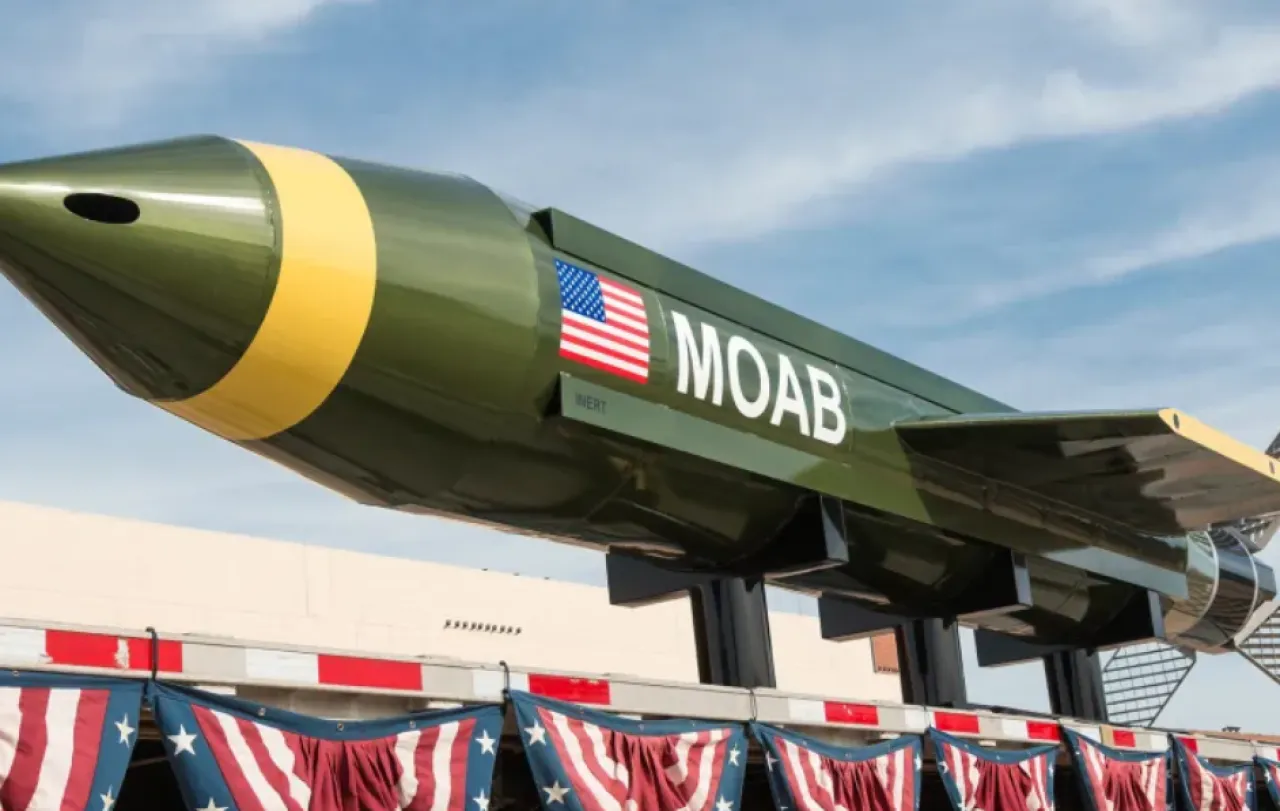
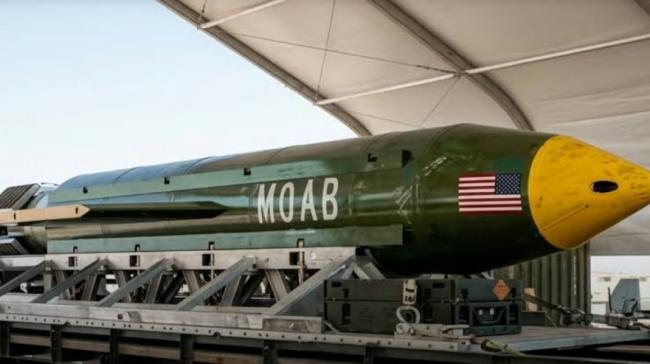
Researchers have calculated the explosive force of the U.S. Massive Ordnance Air Blast, known as MOAB, by analyzing infrasound shockwaves captured by a monitoring station in Pakistan 249 kilometers away from the 2017 deployment in Afghanistan.
The device known as the MOAB returned to public discussions after a mention by President Donald Trump in mid-October regarding its potential deployment against Iran. Developed in 2003 and carrying the military designation GBU-43/B, the 9.1-meter weapon has seen combat only once, on April 13, 2017, in the Achin district of Afghanistan. Unlike deep-penetration munitions, the weapon is engineered to detonate in the air above the ground, spreading its blast energy and pressure wave across a wide area rather than concentrating force at a single impact point.
Infrasound Detection Across Borders
Explosions generate a range of acoustic frequencies, including infrasound waves falling below 20 hertz that human ears cannot register under standard conditions. When a bomb detonates, expanding hot gases shove the surrounding air outward, creating pressure shifts that can travel long distances depending on atmospheric conditions.
Researchers based at the National Centre for Physics in Islamabad examined seismic and acoustic data recorded by a monitoring station located 249 kilometers from the Achin strike. Their findings were published in the Journal of the Acoustical Society of America. The analysis revealed that the atmospheric pressure wave retained a distinct acoustic signature capable of being measured by sensitive instruments despite the vast distance.
Scientists Evaluate Blast Using Recorded Signal Pressure Amplitude
The recorded signal yielded an average pressure amplitude of 0.1717 pascals. While modest compared to normal sea-level atmospheric pressure of roughly 101 thousand pascals, this precise fluctuation allowed scientists to evaluate the blast after accounting for atmospheric propagation factors such as winds, temperature gradients, and refraction through air layers.
The idea is similar to dropping a stone in a pond, where strong ripples form near the point of impact, then spread in widening circles and gradually weaken the further they get from their source. In a similarly analogous way, the infrasonic waves resulting from the explosion spread across the atmosphere, reaching distant monitoring stations with a signal weaker than it was near its source.
Abdel Nasser Tawfik, theoretical physics professor at the Canadian Pyramids University in Cairo and visiting professor at the Islamic University in Madinah
According to the physical models applied by the research team, the periodicity of the infrasound wave and its peak repetition timing correlate directly with blast energy. By combining wave period scaling laws with measured pressure amplitude and distance data, the investigators calculated the explosive yield of the 2017 Afghanistan detonation to be equivalent to roughly 14 tons of TNT.
There is a relationship connecting the period of the infrasound wave or the time of its peak repetition with the blast power, which is directly proportional to the third power of the wave period (the cube of the wave period). Also, the measured wave amplitude and the distance from the source can be linked with the blast power, and by merging these two relationships we can determine the power and location of the explosion that generated the infrasonic wave with high accuracy.
Abdel Nasser Tawfik, theoretical physics professor at the Canadian Pyramids University in Cairo and visiting professor at the Islamic University in Madinah
Measurement precision depends on geometric wave expansion, atmospheric absorption, wind interference, and reflections within atmospheric strata. The methodology demonstrates that infrasound monitoring can successfully track explosions and atmospheric events in remote zones where direct on-site data collection remains impossible.