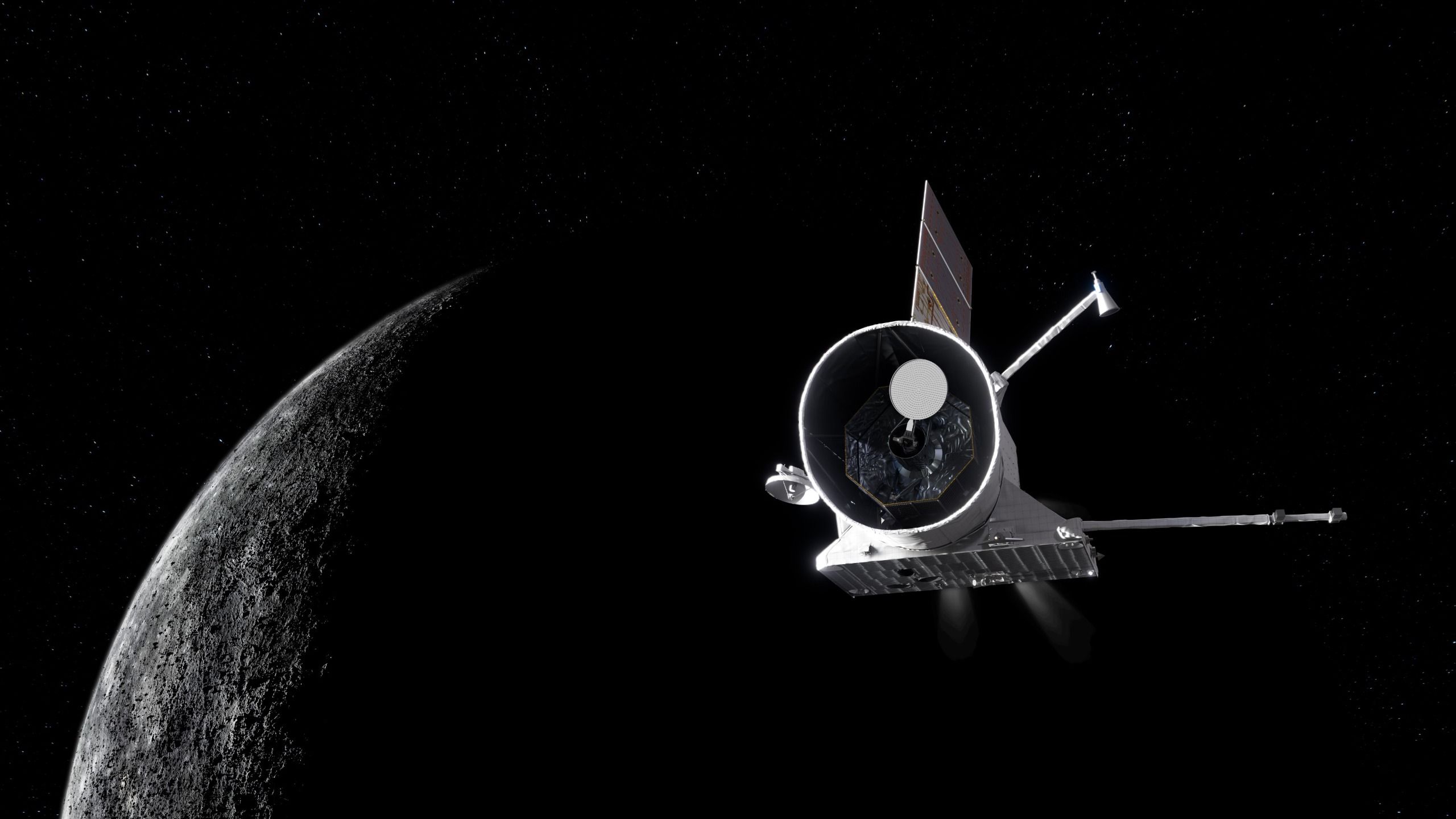
After an eight-year interplanetary voyage, the BepiColombo spacecraft entered orbit around Mercury on Saturday becoming only the second mission in history to achieve orbit around the solar system’s innermost planet.
The milestone arrived with unexpected drama. A 37-minute engine burn designed to slow the spacecraft was cut short by a software glitch, prompting teams at the European Space Operations Centre to assess incoming telemetry while confirming the spacecraft remained safe in its new path.
Built jointly by the European Space Agency and the Japan Aerospace Exploration Agency, BepiColombo consists of two distinct science orbiters stacked together: the Mercury Planetary Orbiter built by Europe and the Mercury Magnetospheric Orbiter built by Japan.
BepiColombo is safely in orbit around Mercury! Despite a software issue that cut its orbit insertion manoeuvre short, the ESA/JAXA spacecraft is safe and in a stable orbit after an eight-year journey. Next up ➡️ separation of its two science orbiters on 9 December. Read more:… pic.twitter.com/8bPbK9wNz4
The composite vehicle reached the planet after a trajectory that featured nine planetary flybys—one of Earth, two of Venus, and six of Mercury—designed to shed immense kinetic energy against the powerful gravitational pull of the sun.
The mission follows NASA’s pioneering MESSENGER probe, which orbited the planet from 2011 to 2015, and Mariner 10, which completed three flybys in the 1970s. Scientists hope the dual-probe setup will finally clarify why Mercury possesses an oversized iron core that extends about 85 percent of the distance from the center to its surface, alongside a mysterious global magnetic field.
Today, two new spacecraft are about to orbit Mercury for the first time in a decade! Europe and Japan’s BepiColombo mission has arrived at our innermost planet, to unlock its biggest secrets. Story by me in Scientific Americanhttps://t.co/ebjI1a405X
Reaching the innermost planet is an extraordinary challenge because spacecraft must shed a great deal of kinetic energy to match the target’s path around the sun. The mission was named after Giuseppe “Bepi” Colombo, the late Italian scientist and mathematician who helped work out how Mariner 10 could reach Mercury.
Testing the X-Ray Telescope in Space
Ahead of the orbital arrival, researchers at the University of Leicester evaluated the Mercury Imaging X-ray Spectrometer, the only U.K.-led science instrument on the mission. Designed to analyze surface composition by measuring fluorescent X-rays emitted by surface rocks, the telescope captured calibration data by observing the Crab Nebula over 39 hours on September 11 and 12.
Yesterday, we confirmed BepiColombo’s successful capture into orbit around Mercury. During the manoeuvre, the thruster burn was shorter than planned due to a software issue. The spacecraft is safe & teams at ESOC are working to understand what happened. Updates provided on…
We have waited a long time to make measurements with MIXS and it is fantastic to see it operating brilliantly in space. 80% of the technology on MIXS is new!
Professor Emma Bunce, Principal Investigator for the MIXS instrument
The calibration campaign revealed that the instrument’s angular resolution was slightly better than baseline laboratory measurements recorded in 2015. Researchers said that the detector suffered no radiation damage during its eight-year transit. The main observation sequence consisted of 55 spacecraft slews across the designated window in September.
BepiColombo, and MIXS in particular, are like part of my family. I’ve been involved since I was an undergraduate and touched almost every part of the instrument before it was launched.
Dr. Adrian Martindale, MIXS Instrument Scientist
Orbiter Separation and the Road to Science Operations
While the spacecraft is safe and in a stable orbit around Mercury, engineers continue analyzing the software issue that shortened the insertion burn. The event follows an earlier transit delay caused by a 2024 thruster power issue that pushed arrival from December 2025 to late 2026.
We've heard back from Bepi – the spacecraft is now in contact with the ground and the teams at ESOC are busy assessing the telemetry. Flight Dynamics already has confirmed it achieved orbital capture around Mercury! Early next week we'll share the next update with the upcoming…
The mission schedule points next toward the separation of the two orbiters on December 9. Following separation, the Japanese probe will enter a highly elliptical polar orbit while the European orbiter executes further trajectory adjustments to reach its final circular polar orbit in March 2027.
Full science operations are set to begin on April 6, 2027, opening a planned year-long nominal mission phase dedicated to mapping the planet’s rugged terrain, thin exosphere, and interior structure.
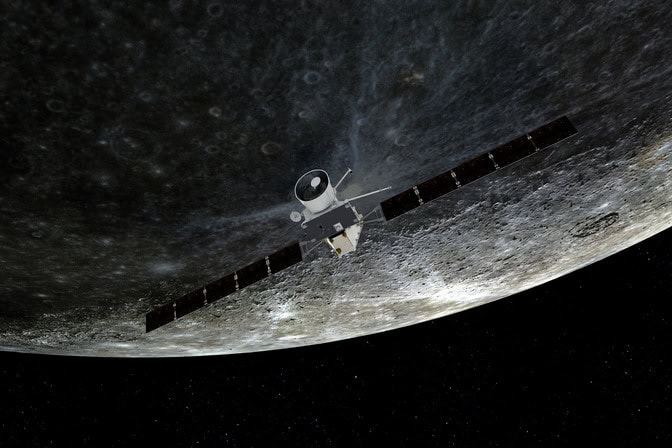
Mercury’s Internal Mysteries and Contraction
Sean Solomon of Columbia University, former lead for the MESSENGER mission, said that Mercury has a range of mysteries that the two probes will investigate, adding that the mission will tell researchers whether features seen in the northern hemisphere also appear in the south.
Solomon said that every visit to Mercury brings surprises and expects that trend to repeat. Shoshana Weider, Mercury science lead at NASA Headquarters, said Mercury is a strange little oddball that does not fit with the rest of the solar system, and expressed hope that observations in the coming years will finally explain why.
Burn cut short, yet orbit secured! After 8 years of interplanetary travel, our mission is safely in orbit around #Mercury ! Despite the shortened burn, we're on track for separation of @JAXA_MMO & @ESA_Bepi on 9 December. Details 👉https://t.co/uakfbiGtsQ
Research findings released in the publication Geophysical Research Letters in September 2026 indicate that the diameter of Mercury may have shrunk by as much as 23 kilometers since the planet’s initial formation roughly 4.5 billion years ago.
Researchers plan to compare relatively smooth regions with heavily cratered terrain to determine whether the distribution of fractures supports these latest estimates of planetary contraction. Planetary scientist Carolyn Ernst of the Johns Hopkins University Applied Physics Laboratory said that the leading theory for material composition suggests it came from either a volatile asteroid or comet impact.
Arrival Phase and Instrument Operations
The arrival phase kicked off on September 3 with the separation of the Mercury Transfer Module from the spacecraft stack. During the livestream of that separation, Azul Pinochet-Barros, editor for operations activities at ESA’s European Space Operations Centre, said that reaching Mercury is harder than reaching Pluto because of the intense energy-shedding requirements.
Regarding the initial light observations, Professor Emma Bunce shared that the team’s thoughts were with the late Professor George Fraser, who served as the original principal investigator and conceived the innovative optic design prior to his passing in March 2014. Bunce said that Fraser would be very, very proud of the team and delighted at the observations.
The European Space Agency serves as a central hub for international space exploration, coordinating a diverse range of activities that extend far beyond its collaboration on the BepiColombo mission. As a 23-member organization, it manages an extensive portfolio of scientific and operational endeavors, including human spaceflight participation in the International Space Station and the development of the Orion spacecraft’s European Service Module for the Artemis program.
Beyond its work on Mercury, the European Space Agency oversees missions targeting the Sun, the Moon, Mars, Jupiter, Venus, and various comets and asteroids. Its mandate encompasses the operation of space telescopes, Earth observation satellites, and navigation systems, while also maintaining the Guiana Space Centre to support its broad technological objectives in space research and commercialization.
Funding for the instrument and its journey has been provided by the UK Space Agency as the lead funding organization, along with STFC, the European Space Agency, and the University of Leicester. As the mission prepares for the next operational steps, teams will continue monitoring the spacecraft to ensure both the European Mercury Planetary Orbiter and the Japanese Mio probe are fully ready for their respective science paths.