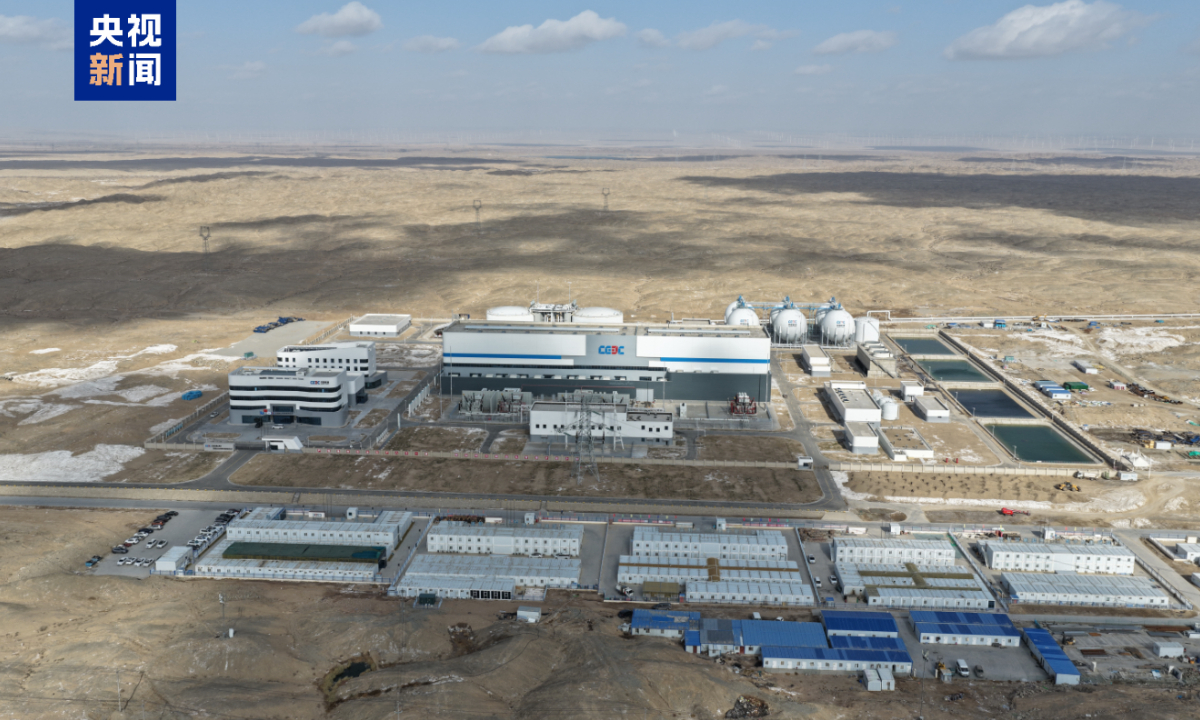
China Energy Digital Technology Group connected the Yuanchu No. 1 compressed air energy storage station to the grid on Monday.
Located in Yumen within Gansu province, the installation is rated at 300 megawatts with an energy storage capacity of 1,800 megawatt-hours. The facility can generate electricity continuously for six hours on a single discharge.
Engineering Purpose-Excavated Rock Caverns
The plant’s defining feature is an engineered underground air storage system excavated approximately 110 meters below the surface in hard rock. Four interconnected chambers create a pressurized storage space of around 200,000 cubic meters with a design pressure of 18 MPa, though the combined cavern volume is about 215,000 cubic meters according to China Electric Power News.
This artificial-cavern approach addresses a geographical constraint on compressed air energy storage deployment. While salt caverns offer economical underground storage, they require suitable geological formations. Excavating and sealing chambers in competent hard rock broadens site selection, although construction costs remain high.
Because suitable geological formations are widely distributed across different areas in China, this technology allows for greater flexibility in plant site selection, as reported by China Electric Power News on the website of the Institute of Engineering Thermophysics of the Chinese Academy of Sciences.
The project reached a key testing milestone in September when an initial air-injection test at its No. 4 underground storage cavern succeeded. Pressure reached 12.63 megapascals, setting a record for compressed air storage in large artificial caverns according to China Energy.

Responsibility for the investment, construction, and operation of the undertaking was shouldered by China Energy Digital Technology Group, operating as a unit of the China Energy Engineering Corporation.
Thermal Systems and Efficiency Metrics
The plant employs non-combustion, adiabatic CAES technology. During charging, electricity drives compressors that pressurize air, while heat generated during compression is recovered and stored. When the system discharges, turbines expand the compressed air after it has been reheated by the stored heat, thus bypassing any requirement to burn supplementary natural gas.
Estimated at roughly CNY 2.5 billion ($368 million), the overall financial commitment is paired with an expected yearly power output of 600 GWh and a 72% round-trip electrical efficiency.
Yuanchu No. 1, the world's first 300-megawatt artificial cavern compressed air energy storage (CAES) station, has been connected to the grid in northwest China's Gansu Province, China Energy Engineering Corporation announced on November 16.#China #EnergyStorage… pic.twitter.com/Dg1zloO0u4
Grid Integration in the Hexi Corridor
Yumen lies within the Hexi Corridor, a major wind and solar development region in northwest China. Designed to take in excess renewable power during off-peak hours and dispatch it back onto the grid during high-demand periods, the facility supplies multi-hour balancing capabilities.
Data from the National Energy Administration shows that the nation’s total installed new energy storage capacity stood at 136 million kilowatts by the conclusion of 2025, marking an 84 percent increase compared to the previous year.
Out of the cumulative total, lithium-ion batteries constituted 96.1 percent, whereas flow batteries, flywheels, compressed air storage, and alternative technologies comprised the remaining 3.9 percent. Rising roughly 12 percentage points from the close of 2024, installations featuring an energy storage duration of four hours or more made up 27.6 percent of all installed capacity.
An October 2026 publication by the Energy Storage Application Branch of the China Industrial Association of Power Sources said 13 CAES projects were under construction, totaling 4.95 GW/23.95 GWh.

Yumen, a county-level city in western Gansu province with a population of 106,812 as of 2002, sits on the historic Silk Road within the Hexi Corridor. The site was brought under Chinese control around the end of the 2nd century BCE and later became the location of China’s first oilfield, established in 1939 at Laojunmiao.
Large-scale petroleum development began in 1949, and the city subsequently developed thermal and wind power-generating facilities alongside its refining industry. In 2003, the municipal government relocated from the old oil-dominated urban area to Yumen Town, which was primarily agricultural.
Under the development plan for the 15th Five-Year Plan period (2026-2030) jointly issued by the National Development and Reform Commission and the National Energy Administration, China is seeking to diversify its energy storage technologies. The plan sets a target of 300 million kilowatts of installed new energy storage capacity by 2030, with an average storage duration of about three hours.