Global equities retreated on Thursday, October 22, 2026, as disappointing corporate earnings from major technology giants reignited doubts over the sustainability of the artificial intelligence boom, while escalating Middle East tensions pushed crude oil above $111 per barrel.
Updated October 26, 2026
Technology Giants Test Investor Patience on Capital Spending
Following a multi-year rally that had lifted the S&P 500 up roughly 120% from its 2022 lows, high equity valuations left the market vulnerable to any disappointing figures. Futures on the Nasdaq 100 slid 1.3%, while contracts on the S&P 500 declined 0.7%. The pullback across worldwide markets followed mixed financial reports from Tesla and Meta Platforms, forcing investors to examine capital expenditures.
Corporate strategies diverged sharply in extended trading. Tesla shares dropped 3.3% after the automaker lowered its capital expenditure outlook, while Meta shares advanced 2.2% following an upward revision to its AI infrastructure spending plans. Meanwhile, semiconductor equipment maker Lam Research fell 7.4% after issuing an earnings forecast that missed market expectations.
Tim Waterer said that it is difficult to please the market currently when it comes to capital spending.
Kanhary Singh said that “markets are essentially telling us that we are transitioning from trading based on enthusiasm surrounding artificial intelligence and related narratives, to a phase that now requires extremely high standards for what constitutes beating earnings expectations.”
Singh added that investors are moving from broad enthusiasm to strict scrutiny of future capital expenditure pathways and the actual timeline for converting heavy investments into revenue.

Asian Markets Suffer Broad Losses Amid Chip Sector Sell-Off
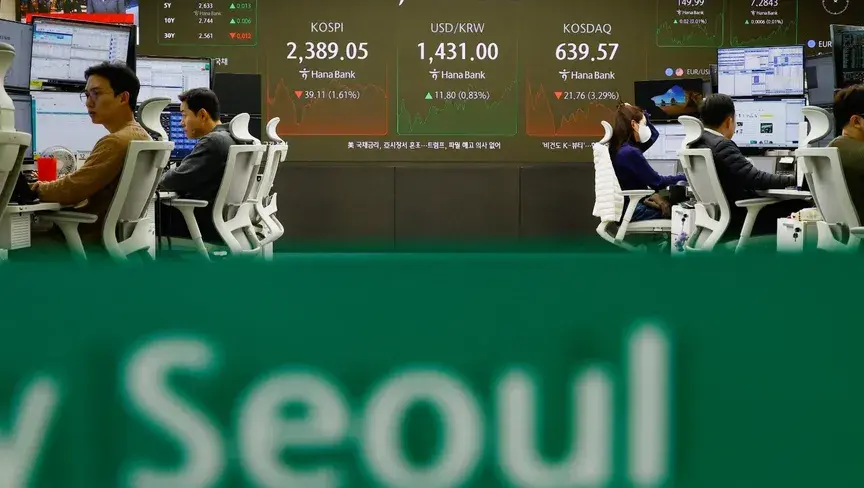
South Korea’s Kospi index dropped 3.3%, heading toward its lowest closing level since April, weighed down by heavy losses in SK Hynix and Samsung Electronics. Japan’s Nikkei 225 fell 2.29%, and Hong Kong’s Hang Seng index retreated 2.94%. The cautious sentiment rippled through Asian exchanges, pressuring technology and semiconductor shares.
In mainland China, the CSI 300 index declined 1.31%, pushing closer to bear market territory as e-commerce stocks such as Alibaba Group faced additional headwinds from government calls for tighter product quality controls. The MSCI Asia Pacific index fell 1.5%.
Geopolitical Tensions Push Brent Crude Past 111 Dollars
Brent crude rose roughly 2% to trade above $111 per barrel, driven by supply disruption fears as security threats intensified in the region following a deadly attack on a Saudi Arabian oil facility. Energy markets added to global economic anxieties. The yield on standard ten-year U.S. Treasury securities fell by five basis points to 5.19% as cash trading resumed following an official holiday.
The U.S. State Department ordered certain diplomatic staff and family members to leave Saudi Arabia amid rising threats from Houthi militants in Yemen. Economists warn that sustained high energy costs threaten to fuel stagflationary pressures just as northern hemisphere countries head into winter.
Mark Cranfield said that that will bring high oil prices back to the forefront, especially after the U.S. State Department ordered some diplomats to leave Saudi Arabia.
Safe-Haven Assets Draw Institutional Demand as Gold and Bitcoin Slip
U.S. Treasury bonds rallied across maturities, pushing the 30-year Treasury yield down three basis points to 5.38%, its lowest level since September 23. As equities and commodities diverged, investors shifted capital toward traditional safe-haven debt. Among G10 currencies, the Japanese yen emerged as a primary beneficiary against the dollar.
David Forrester said that more importantly, this is happening on a broad scale, and even against the dollar, which demonstrates the yen's status as a safe haven in the event that the artificial intelligence boom suffers disruptions.
Precious metals and digital assets faced downward pressure during the session. Gold prices declined 1.2% to trade below $4,100 per ounce, while Bitcoin dropped more than 2% to approximately $82,800. Market participants now look ahead to upcoming earnings reports from Microsoft and Alphabet scheduled for the following week.
Update (October 24, 2026)
According to Reuters, Wall Street indexes closed lower on Friday, wrapping up a turbulent week as investors looked ahead to a busy earnings slate and a Federal Reserve policy meeting. The Dow Jones Industrial Average fell 1.23% to 52,215.16, the S&P 500 lost 0.52% to 7,623.68, and the Nasdaq Composite declined 0.21% to 25,955.34.
Telecommunications stocks dropped following a report that SpaceX was seeking thousands of cell sites for a fourth wireless carrier, causing shares of AT&T and T-Mobile to sink nearly 8% each. Meanwhile, the S&P 500 energy sector climbed 2.5% to a record high, tracked by a jump in oil prices, while consumer sentiment edged down near a record low in October.
Update (October 26, 2026)
Stock futures rose on Sunday evening as traders awaited central bank decisions this week from the U.S. Federal Reserve, the European Central Bank, and the Bank of Japan, according to CNBC. S&P 500 futures rose 0.4%, Dow Jones Industrial Average futures added 128 points or 0.2%, and Nasdaq-100 futures gained 0.6%. Meanwhile, France avoided a credit downgrade after Moody's maintained its Aa3 rating and negative outlook.