Israelis head to the polls for their first national election since the October 7, 2023, Hamas attacks. The consequential vote unfolds amid a tight race between Prime Minister Benjamin Netanyahu and opposition challenger Gadi Eisenkot, with neither political bloc securing a clear majority in recent polling.
Three years after the seismic Hamas attacks on October 7, 2023, voters across Israel are casting ballots in what many candidates and political correspondents describe as the most consequential election since 1948. The vote functions largely as a referendum on longtime Prime Minister Benjamin Netanyahu, weighing accountability for security failures against his aggressive military response across Gaza, Lebanon, and Iran.
Naftali Bennett, a former prime minister and candidate in the election, has called the vote an existential moment for the country.
Polling Numbers and Coalition Arithmetic in the Knesset
Recent polling published by N12 News and Channel 13 shows a razor-thin contest. Gadi Eisenkot’s centrist party Yashar placed first in both surveys, raking in between 20 and 23 seats in the 120-seat Knesset.

Neither major political bloc is anywhere near capturing the 61 seats required for an outright parliamentary majority. State broadcaster Kan forecast 52 seats for Eisenkot’s opposition bloc and 51 for Netanyahu’s coalition, while other poll projections similarly leave both sides short. If neither side can assemble 61 seats, Netanyahu appears poised to stay on as interim minister, approaching matters on a day-by-day basis. This tight mathematical split has galvanized thousands of Israelis living abroad to fly home to cast ballots, recognizing that marginal shifts could alter the outcome.
Opposition Leaders Formulate Plan B to Replace Knesset Speaker
Because Zionist opposition parties are reluctant to sit in a formal coalition with Arab parties, anti-Netanyahu leaders have formulated an alternative strategy known as Plan B.
If Netanyahu and his far-right allies return to power, that would, first and foremost, be a catastrophe for the State of Israel. There is no doubt that the consequences would be extremely serious for us as an Arab community.
If successful, the opposition’s first critical move after the new Knesset convenes on November 10 would be replacing the Knesset Speaker and the head of the Arrangements Committee.
Diverging Stances on Iran, Gaza, and Regional Security
Despite fierce domestic competition, foreign policy analysts note a broad consensus across the Israeli political spectrum regarding Iran and military force. Both Netanyahu and his main challengers view Tehran as the central strategic threat. Netanyahu has stated that Israel must prioritize prevention and offense over containment and defense, emphasizing pre-emptive strikes to thwart emerging threats.
There is only one way to remove this threat once and for all: overthrow the regime in Iran.
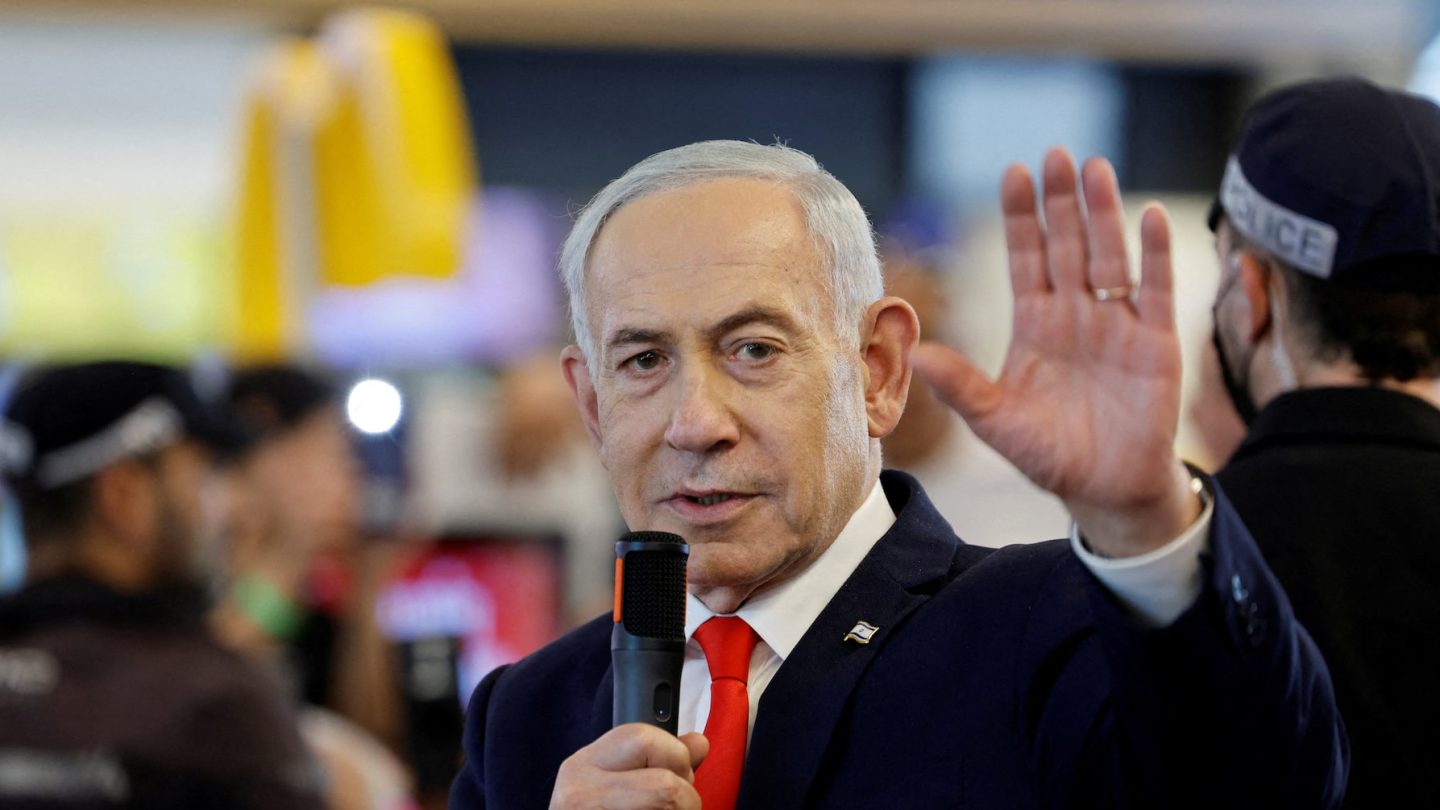
Benjamin Netanyahu, Prime Minister of Israel, via Reuters
On the ground in Gaza, the military campaign that followed the October 7 attacks has left vast destruction, while international bodies and officials continue to monitor security developments. Both Netanyahu and Eisenkot insist that Israel must retain ultimate security control over all territory between the Jordan River and the Mediterranean Sea. Both candidates have explicitly stated they would not form a government with parties primarily representing Israeli citizens of Palestinian descent.

While Netanyahu has presided over a rapid expansion of settlements and outposts, opposition figures have critiqued certain aspects of his expansionist approach while still opposing an independent Palestinian state alongside Eisenkot. Analysts such as Abdulaziz Sager of the Gulf Research Center note that while regional Arab states want Iranian influence curbed, they view Netanyahu’s policies across Gaza, the West Bank, Syria, and Lebanon as damaging.