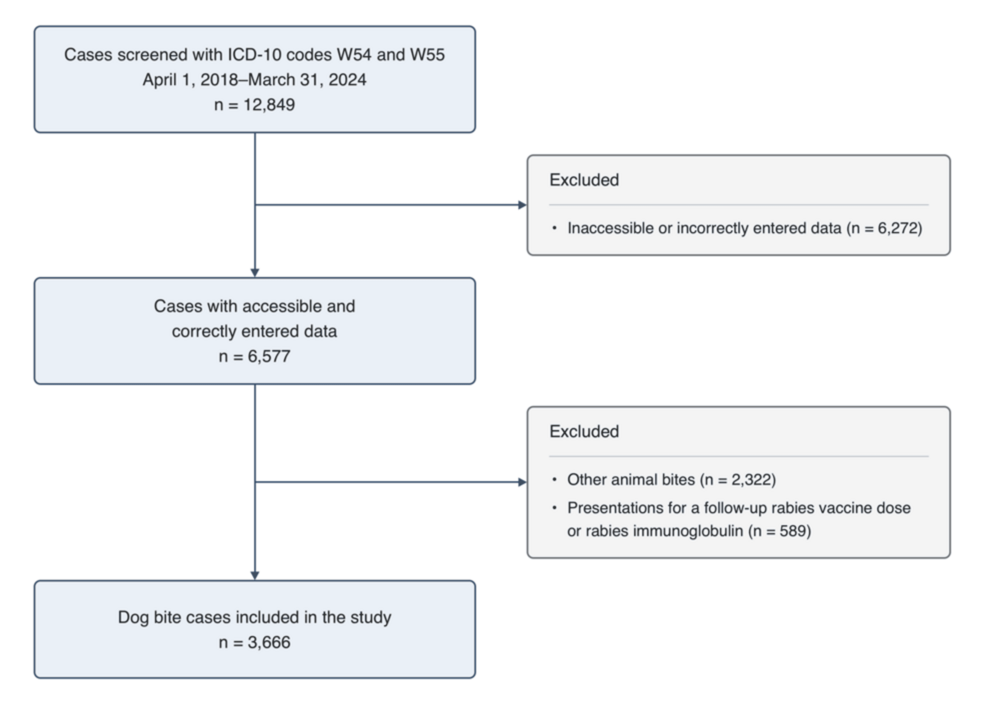
Emergency rooms across regions dealing with animal bite management face a distinct clinical balancing act every single day. Between April 1, 2018, and March 31, 2024, the emergency department at Ankara Training and Research Hospital treated 3,666 dog bite cases, recording data that captures the baseline reality of animal exposures before significant legislative shifts took effect.
A retrospective cross-sectional study analyzed these records to outline the clinical profiles and emergency department management strategies used at the tertiary care facility, which functions as a regional rabies center in the capital of Türkiye. The findings illustrate how physicians handle the dual challenge of physical trauma and potential rabies exposure.
Clinical Profiles and Injury Patterns in Emergency Care
Of the thousands of cases evaluated in the study, the median patient age stood at 29 years, with males accounting for 66.1% of the presentations. When tracking the specific anatomical locations of the injuries across 2,464 cases with documented site records, lower extremities bore the brunt of the incidents at 56.1%. Yet, the pattern shifted noticeably among younger patients.
In patients under the age of 18, lower extremity injuries dropped to 44.1%, while head and neck injuries climbed to 7.1%. Most clinical findings remained superficial. Among 1,709 cases with detailed clinical notes, 58.5% involved an isolated abrasion. Only 4.0% of cases required surgical intervention beyond routine wound care, and just 10 patients—amounting to 0.3% of the total—required hospital admission.
Managing Animal Bites Through Vaccination and Observation
Managing animal bites requires strict adherence to prophylaxis guidelines determined by exposure category and animal observability. According to the data, 71.4% of the 3,078 cases with a recorded rabies exposure category were classified as Category II.
Rabies vaccine administration was documented in 94.9% of Category II and III cases that had treatment records. For unvaccinated individuals, a recommendation to keep the biting dog under a 10-day observation period was documented in 73.7% of cases. Out of 2,938 cases where the origin of the dog was known, stray dogs accounted for 86.1% of the biting animals.
Contrasting Owned and Stray Dog Incidents
An exploratory analysis within the research uncovered contrasts between bites inflicted by owned dogs versus strays. Rates of skin laceration reached 49.3% for owned dogs compared to 38.9% for strays, a statistically significant difference with a p-value of 0.003. Similarly, surgical interventions were required in 9.5% of owned dog bites, versus 3.8% for stray dog bites.
The authors noted that these unadjusted figures require further confirmation through studies that rigorously account for injury location and severity. These figures serve as single-center baseline data gathered just before Law No. 7527 regarding stray animals came into force in Türkiye in August 2024.