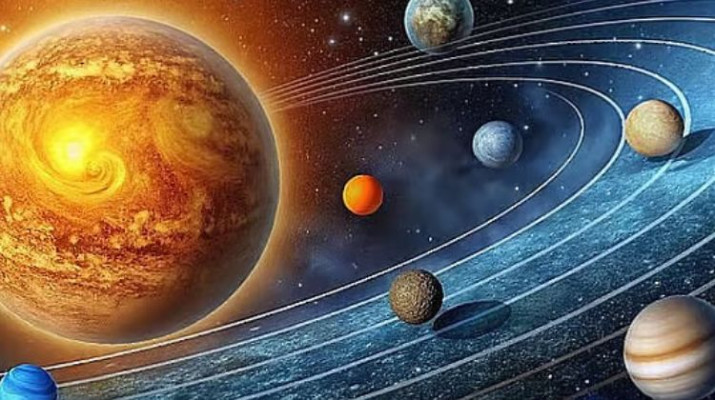
Scientists at the Paris Observatory have calculated that minor gravitational perturbations could eventually disrupt planetary orbits, creating potential risks of interplanetary collisions involving Earth, Mercury, Mars, or Venus.
Planetary orbits are not entirely stable due to mutual gravitational pulls. According to research published in the journal Nature by scientists Jacques Laskar and Mickaël Gastineau of France’s Paris Observatory, mutual gravitational attractions mean that planetary pathways lack absolute stability.
Over time, these orbits can progressively grow chaotic, behaving somewhat like an unbalanced wheel tearing free from a moving vehicle’s axle. Smaller rocky planets like Earth are less stable than gas giants such as Jupiter and Saturn, which can cause bodies to be hurled through space and collide with one another.
Scientists ran thousands of computer simulations to map these long-term dynamics. The modeling revealed that Mercury’s orbit could drift out of alignment in roughly 25 of those simulations, triggering a broader wave of instability across the inner solar system.

In one extreme simulation, every rocky planet lost stability. This chaotic shift created conditions where Mercury, Mars, or Venus could cross paths with Earth. A separate simulation tracked Mars and Earth drawing within just 794 kilometers of each other.
A close approach of that magnitude would prove catastrophic for life on Earth. Such proximity would generate severe tidal fracturing on Mars, followed by multiple subsequent impacts on Earth as the two bodies interacted according to the findings. When researchers introduced minor tweaks to that specific simulation run, the modeling showed Mars being ejected entirely from the solar system.
Across the wider set of computer models, researchers recorded 196 instances where planetary collisions occurred. Out of those collision scenarios, 48 involved direct impacts between Earth and either Mars or Venus.
Researchers said that the Sun’s closest planet, Mercury, features a somewhat elliptical orbit that leaves it most vulnerable to disruption under the gravitational influence of Jupiter. This orbital deviation of Mercury carries the capacity to upend the orbits of Mars, Venus, and Earth through a domino-like effect.
While the mathematics point to profound long-term instability, researchers emphasize that humanity faces no immediate danger. The entire process unfolds over hundreds of millions of years. Because the mechanism operates on an extremely slow timescale, the current and near-term future of human civilization remains entirely unaffected by these orbital mechanics.