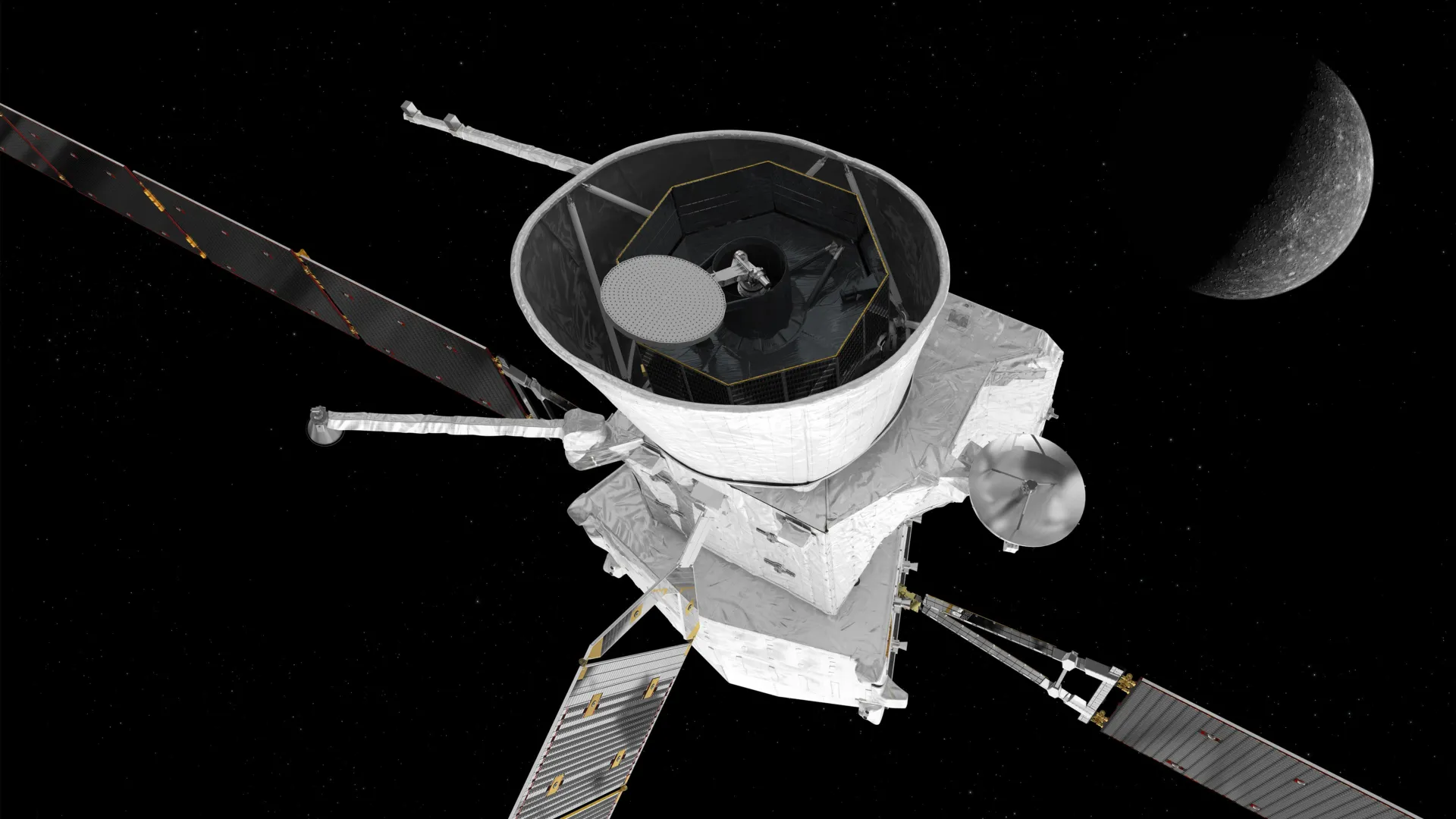
After an eight-year journey spanning 10 billion kilometers, a pioneering U.K.-built X-ray telescope traveling aboard the European Space Agency and Japan Aerospace Exploration Agency’s BepiColombo mission has captured its first observations of a distant cosmic object, according to Phys.org.
The instrument successfully detected X-rays from the Crab Nebula, located about 6,500 light-years from Earth.
The spacecraft approaches the solar system’s smallest planet for an orbital arrival on November 21.
The instrument, known as the Mercury Imaging X-ray Spectrometer (MIXS), is the first imaging X-ray telescope operating on a planetary science mission.
Developed by a Europe-wide consortium led by the University of Leicester and supported by the UK Space Agency, MIXS is aboard the mission’s Mercury Planetary Orbiter.
The Mercury Transfer Module separated from the two science orbiters, the Mercury Planetary Orbiter and the Mercury Magnetosphere Orbiter, leaving the telescope’s view unobstructed.
To evaluate how the hardware has weathered the harsh space environment, the team carried out 39 hours of observations over September 11 and 12, executing 55 carefully controlled spacecraft slews.
By measuring how widely the Crab Nebula’s X-ray signal spread across the detector, scientists determined the telescope’s angular resolution: its ability to distinguish small details.
MIXS delivered slightly sharper resolution in space than it had during laboratory tests conducted in 2015.
It is fantastic to see it operating brilliantly in space.
Emma Bunce, principal investigator for MIXS and director of the Institute for Space at the University of Leicester, said according to TheReader.ai.
Bunce said the instrument represents the lasting legacy of Professor George Fraser, the original principal investigator and mastermind behind the novel optic design who passed away in March 2014.
Researchers said the detector suffered no radiation damage during its long transit.
“We see some effects in the instrument that we are still studying and expect to undertake some optimization procedures during the Mercury commissioning phase to fine tune MIXS in preparation for the science phase.” Emma Bunce, principal investigator for MIXS, said.
“BepiColombo, and MIXS in particular, are like part of my family. I’ve been involved since I was an undergraduate and touched almost every part of the instrument before it was launched,” said Dr. Adrian Martindale, MIXS Instrument Scientist at the University of Leicester's School of Physics and Astronomy.
Martindale said, according to USA Today.
Following the spacecraft’s arrival at Mercury, the two orbiters are scheduled to separate from each other on December 9–10.
The University of Leicester, which leads the MIXS consortium and hosts its principal investigator Emma Bunce, was established as a university college in 1921 and gained university status by royal charter in 1957. It is known for the invention of genetic fingerprinting and for partially funding the discovery and DNA identification of the remains of King Richard III in Leicester.
MIXS will then work alongside the Solar Intensity X-ray and particle Spectrometer to analyze characteristic X-ray signals emitted from Mercury’s surface and nighttime environment, ultimately producing a global map of the planet’s atomic composition when the main science phase begins in April 2027.
Earlier coverage: Mercury Imaging X-ray Spectrometer Captures Crab Nebula After Eight-Year Transit