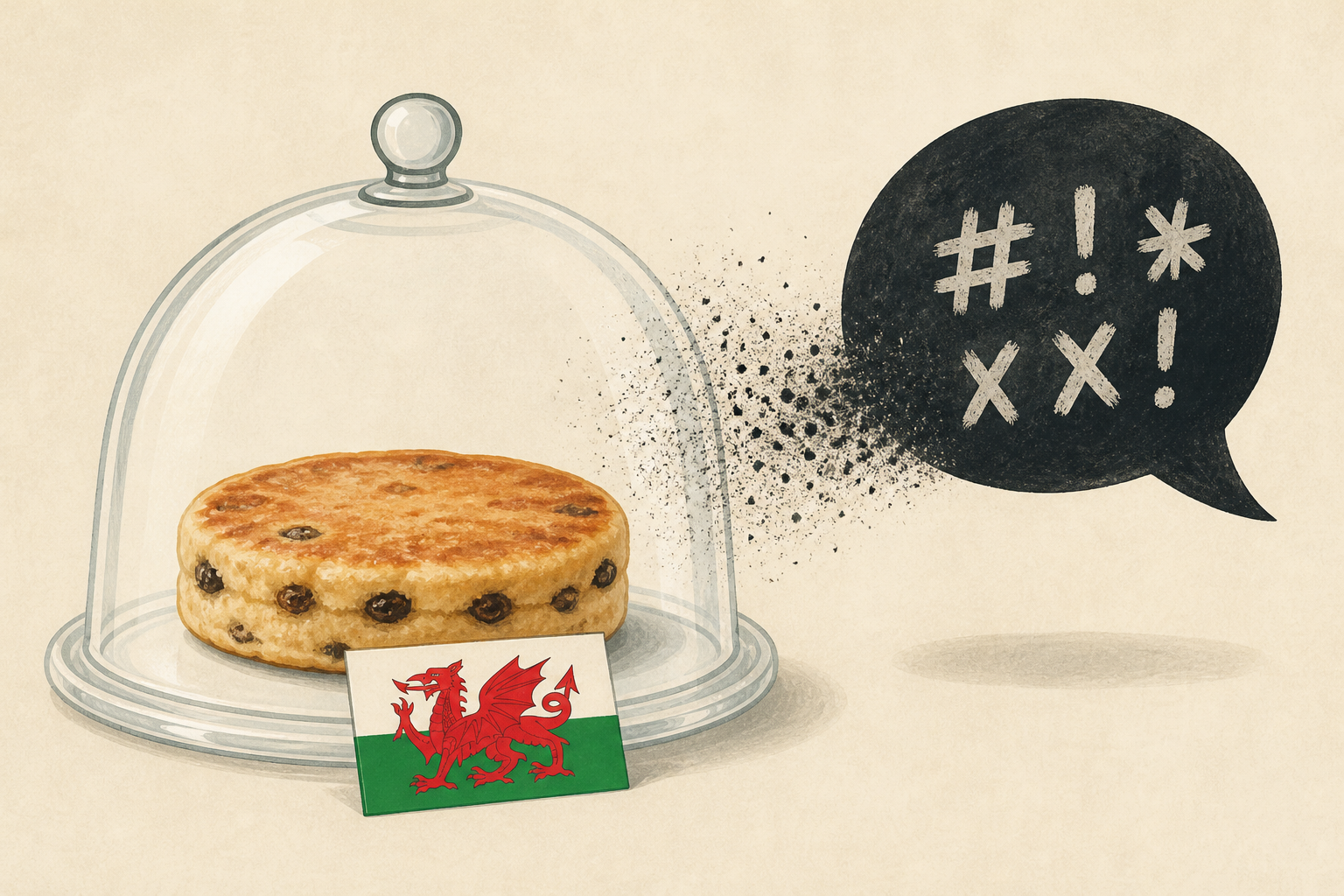
Adam El Tagoury, owner of a viral Welsh cake business in Cardiff, publicly called out online trolls who subjected his staff to racist abuse.
Tagoury named and shamed commenters on TikTok after people questioned whether his staff members of Asian heritage should be allowed to produce traditional Welsh products. The business, located in Cardiff Market, gained wider prominence after a visit from actor Stanley Tucci for a new television series, according to reporting by tl;dr daily news.
Tagoury said that he has a duty to protect his employees, describing them as private people who should not be targeted by online commentators. “It just it just makes you angry, doesn't it? Why do people want to be like that?” Tagoury said. The business also received positive recognition, including praise from celebrity Stanley Tucci, who enjoyed the Welsh cakes.

They’re keyboard warriors and they sit behind the desk. They just want to try and make themselves feel better by running somebody else into the ground.
Adam El Tagoury, owner
The business owner said that his operation relies on local producers and a family recipe while offering opportunities to anyone legally entitled to work.
My father is an immigrant. Came here in 1978 from Libya. He’s the one who founded this business and I’m obviously, you know, the son of an immigrant.
Adam El Tagoury, owner
Race Council Cymru condemned the remarks directed at the staff.
Race Council Cymru, with Prof Uzo Iwobi as chief executive, framed the Cardiff Bakehouse incident as a pivotal question for Welsh identity and belonging in modern Wales, arguing that cultural heritage and traditional recipes should be shared by people from all ethnic backgrounds.
The organization backs the business to celebrate the positive contribution that ethnic minority communities make to Wales, aligning with its decade-long mission since 2010 to drive the vision of an Anti-Racist Wales through policy advocacy, community empowerment and the Zero Racism Wales pledge across four hubs and over 3,000 pledges.
We believe this raises an important question about how we understand Welsh identity and belonging in modern Wales.
Prof Uzo Iwobi, chief executive of Race Council Cymru
The organization expressed strong support for the bakery, saying that cultural heritage and traditional recipes should be shared by people from all ethnic backgrounds. They stand in support of this business and hope this incident provides an opportunity to celebrate the positive contribution that ethnic minority businesses and communities make to Wales.
Data from the 2021 census shows that 93.8% of people in Wales identified as white, down from 95.6% a decade earlier, with the country’s overall population growing by 1.4% to 3,107,500. The proportion identifying as Asian, Asian Welsh or Asian British, the next highest group in the survey, rose from 2.3% to 2.9%. Mixed or multiple ethnic groups rose from 1% to 1.6%, and those identifying as black, black Welsh, black British, Caribbean or African rose from 0.6% to 0.9%.