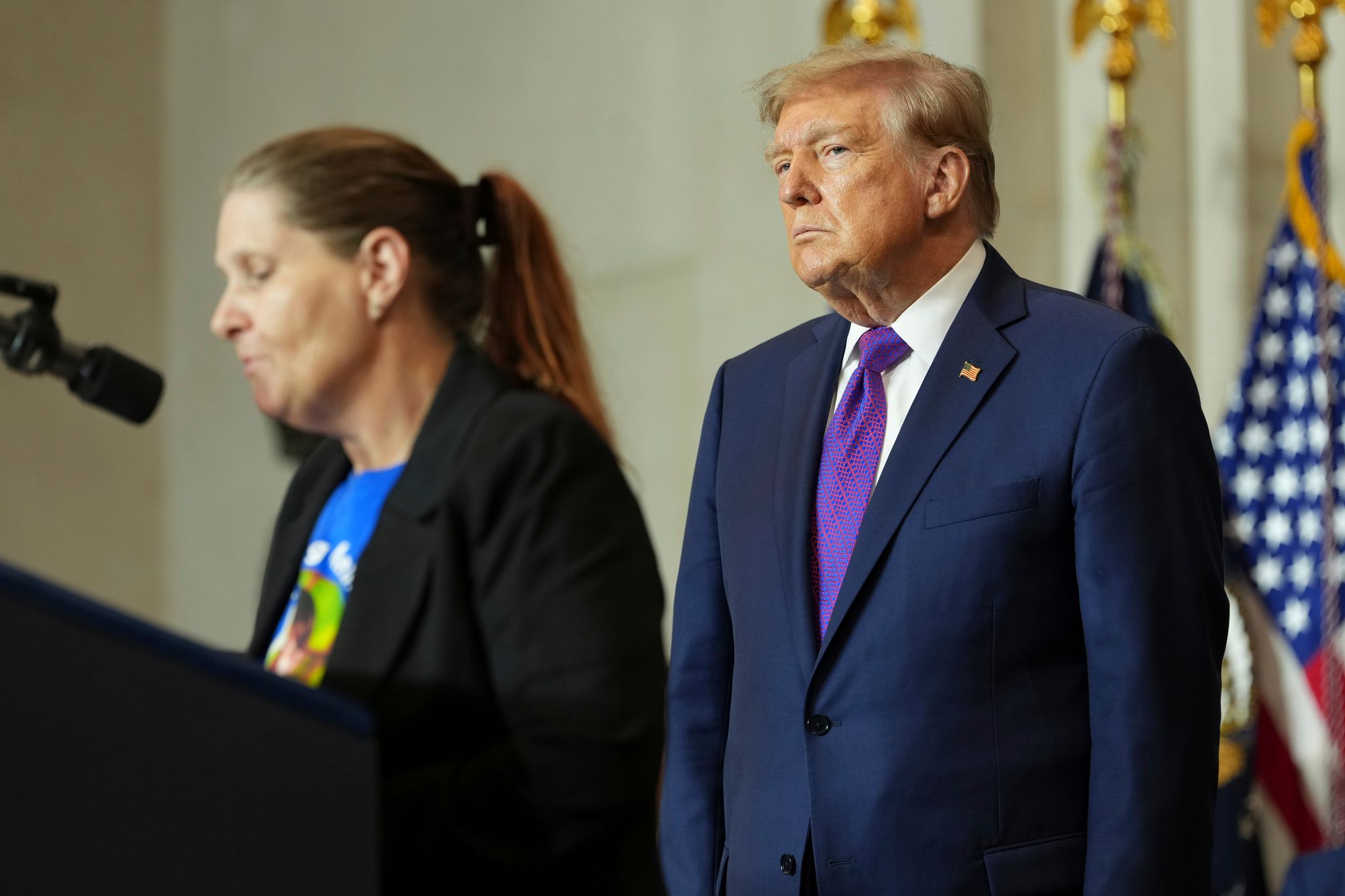
President Donald Trump on Monday used a speech at the Department of Justice to condemn California Governor Gavin Newsom’s plan to commute 548 death sentences, a move the president labeled “one of the most shocking acts of injustice our country has ever seen.”
The event, held in the building’s ceremonial Great Hall, featured the families of murder victims. While Newsom remains in office until January, the proposal has triggered legal challenges and a renewed national debate over the state’s moratorium on executions, which he established in 2019.
The administration’s focus on the victims and their families highlights the divide between the White House’s push for aggressive use of the federal death penalty and Newsom’s arguments that the practice is error-prone and incompatible with state values.
Trump's Justice Department prosecutes his enemies and pardons his friends. America needs foundational federal reform. No president should turn the power of mercy into a business. No one should be able to sell a pardon. Justice is not for sale. pic.twitter.com/YnZmroP96A
During the event, which was attended by law enforcement officers from the FBI, the Drug Enforcement Administration, the U.S. Marshals Service, the Bureau of Alcohol, Tobacco, Firearms and Explosives, and the Bureau of Prisons, Trump announced nearly $150 million in new Justice Department grants for public safety.
Trump also praised Rep. Brandon Gill, R-Texas, for his intent to introduce the Just Punishment for Murder Act to strengthen the death penalty in America.

Legal Challenges to the Commutation Plan
The Criminal Justice Legal Foundation (CJLF) filed a lawsuit on November 22 at the California Supreme Court seeking to block the sweeping commutations. The filing argues that the governor has failed to follow required procedures, including providing formal notice to district attorneys and victims’ families.
Anne Marie Schubert, president and CEO of the CJLF and a former Sacramento County District Attorney, said that the governor’s attempt to predetermine the outcome for every death row inmate violates constitutional safeguards and ignores legally required procedures.
Every person @CAGovernor Gavin Newsom commuted from California's death row will die in prison. Not one walks out. But Donald Trump's criminals? They walk free as wealthy donors and lobbyists secure pardons amid serious pay-to-play allegations. Convicted murderers, deadly drug… https://t.co/4xp95APFZV
According to the governor’s office, the move would not lead to the release of any inmates, as all would remain in prison for the duration of their lives. However, the legal path forward is complicated by the state constitution.
For inmates with multiple felony convictions, Newsom must obtain a recommendation from at least four California Supreme Court justices before a commutation can take effect. The court has requested legal briefs by December 4 to address the governor’s request, with the goal of resolving the issue before he vacates the governor’s mansion in January.
CALIFORNIA'S HOMICIDE RATE IS AT A RECORD LOW. In 2025, the rate fell to 3.5 per 100,000 residents — the lowest since statewide reporting began in 1966. That's a 20% drop since @CAGovernor Gavin Newsom took office.
Victims’ Families and the Debate Over Closure
Several families of murder victims joined the president at the Justice Department to voice their opposition to the governor’s decision. For many, the death sentences represented the finality of the judicial process. Marc Klaas, whose 12-year-old daughter Polly was kidnapped, raped, and murdered in 1993, told the attendees that he had thought for decades that justice would be served with the death sentence against Richard Allen Davis.
Sandy Friend, whose 8-year-old son Michael Lyons was killed in 1996, challenged the governor directly during the proceedings. “Face me, Gov. Newsom,” Friend said. “Tell me Michael’s life doesn’t matter.” The White House also highlighted the cases of other victims, including Rachel Newhouse, Aundria Crawford, and Kesha Gurke.

Family members of former Placer County Sheriff Detective Michael Davis Jr., who was murdered in 2014 by a twice-deported national named Luis Enrique Monroy-Bracamonte, were also reported to be in attendance.
In a video response released on Monday, Newsom acknowledged the grief of the families, stating, “Your grief is real.” He maintained that every person currently on California’s death row would die in prison, while pivoting to criticize the president’s own history with clemency.
“Donald Trump’s criminals—they walk out,” Newsom said, accusing the president of using the pardon power to benefit political allies while prosecuting his opponents. He argued that the state cannot morally kill prisoners and suggested that the commutations would allow offenders to die in obscurity while the public honors their victims.
Critics decry the governor’s clemency authority
The California District Attorneys Association joined the chorus of opposition, with CEO Greg Totten stating that the governor is stabbing crime victims in the heart. Totten argued that district attorneys have a legal responsibility to protect the rights of victims and that the governor is circumventing constitutional safeguards designed to ensure justice.
Zack Smith, a senior legal fellow at the Heritage Foundation, told Fox News Digital that Newsom is attempting to impose his personal views on capital punishment despite voters repeatedly rejecting abolition at the ballot box. Smith described the mass commutation as a troubling abuse of power that overrides the decisions made by juries of peers.
National figures escalate the political rhetoric
White House communications director Steven Cheung launched a harsh personal attack on the governor, calling Newsom a “raging lunatic” on social media. Cheung claimed that the governor shows no remorse for the additional heartache and tragedy his decision forces upon the families of murder victims.

The dispute has drawn attention from experts like Sandra Babcock, founder of the Cornell Center on the Death Penalty Worldwide, who told The Nation that Newsom’s decision is huge. Conversely, Natasha Minsker of the California Anti-Death Penalty Coalition clarified that the governor’s action does not require the court to review cases individually, a point central to the debate over the legality of the mass commutation.
Political Stakes for 2028
The public confrontation highlights the intensifying rivalry between the two men. With Newsom considering a potential 2028 presidential run, the administration has framed his death row policy as a “sickening abuse of power,” according to a statement from the White House.
Gavin Newsom is a raging lunatic who has no remorse for putting victims’ families through more heartache and tragedy. What he has done to reopen old wounds is an abomination to everything that is decent. He’ll never become president. https://t.co/97v2OxSugP
White House spokeswoman Lauren Bis asserted that the governor is failing innocent victims and playing politics with public safety. The governor, meanwhile, has used his open letters and video statements to argue that the state’s death penalty system is fundamentally broken, noting that California has not executed an inmate since 2006.
The California Supreme Court serves as the highest and final court of appeals in the state, holding binding authority over all other California state courts.
TRUMP SLAMS NEWSOM: President Donald Trump on Saturday blasted California Gov. Gavin Newsom's plan to commute the death sentences of hundreds of inmates, calling the move a "disaster for Justice in America" and expressing hope that it would be overturned. "Gavin Newscum’s… pic.twitter.com/TTtKy1DyUP
Under the current 1879 state constitution, the court maintains a total of seven justices—one chief justice and six associate justices—to oversee legal matters. This structure provides the court with the constitutional oversight necessary to address complex petitions, including those regarding the governor’s executive actions.
Regarding clemency, the California Supreme Court holds specific authority to review the governor’s decisions for inmates with multiple felony convictions. For these cases, the governor is constitutionally mandated to obtain a recommendation from at least four justices before a commutation can take effect.
While the president signed an executive order in January 2025 to restore the federal death penalty, he lacks the authority to reverse the governor’s commutations directly. The administration’s current strategy relies on supporting ongoing court challenges brought by prosecutors and victims’ rights groups.
As the December 4 deadline for legal briefs approaches, the state Supreme Court remains the final arbiter on whether the mass commutation of 548 sentences can proceed before the governor’s term ends.
President Donald Trump on Saturday criticized California Gov. Gavin Newsom's plan to commute the state's death sentences, calling it "a disaster for justice."https://t.co/RsVBMDP6ae