North Korean leader Kim Jong Un personally received the credentials of 10 newly appointed foreign ambassadors in Pyongyang on Sunday marking a diplomatic protocol shift not seen in the country for more than 30 years.
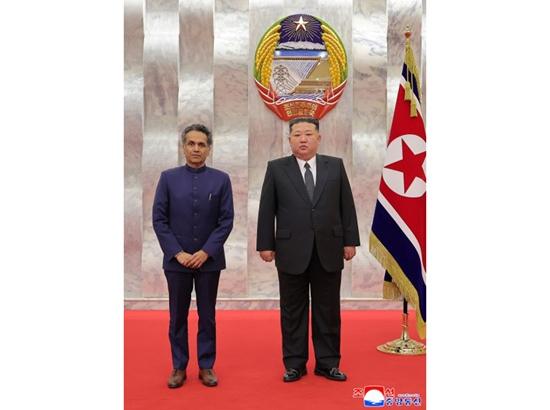
Ten envoys presented credentials directly to the North Korean leader at the headquarters of the Central Committee of the Workers’ Party of Korea. The official Korean Central News Agency reported that Foreign Minister Choe Son-hui attended the rare ceremony.
Diplomats representing Russia, India, Brazil, Sweden, Indonesia, Vietnam, the Czech Republic, the Philippines, Thailand, and Bangladesh handed over their papers.
Sanjeev Jain took up the post of India’s Ambassador to the Democratic People’s Republic of Korea.
Official records from India’s Ministry of External Affairs indicate that India established consular relations with North Korea in March 1962, followed by a Consulate General in 1968 and embassy-level diplomatic ties on December 10, 1973.
During the event, Kim Jong Un asked the diplomats to convey his best wishes to their respective national leaders and peoples. He pledged that diplomatic privileges and immunities would be fully guaranteed under both international law and domestic regulations.
Constitutional Changes Alter Protocol
A constitutional amendment enacted in March granted the chairman of the State Affairs Commission the authority to receive foreign ambassadors, moving the duty away from the Supreme People’s Assembly.
Kim holds this position. During the eras of founding leader Kim Il-sung, credentials were traditionally presented directly to the top leader, while the practice changed during the period of Kim Jong-il.
Lim Eul-chul, a professor at Kyungnam University’s Institute for Far Eastern Studies, told AFP that the move signals a shift towards multipolar sovereignty-based diplomacy while ignoring recent diplomatic overtures from the United States.
South Korea’s Unification Ministry, through spokesman Yoon Min-ho, assessed the ceremony as an effort by Kim to solidify his status as head of state on the international stage, describing the defense and sovereignty statements as a reaffirmation of long-standing policy rather than a new departure.
By welcoming ambassadors while remaining unmoved by Trump’s diplomatic overtures, the North has signalled a shift towards what could be described as ‘multipolar sovereignty-based diplomacy’.
Lim Eul-chul, professor at Kyungnam University’s Institute for Far Eastern Studies
Security Concerns Drive Defense Posture
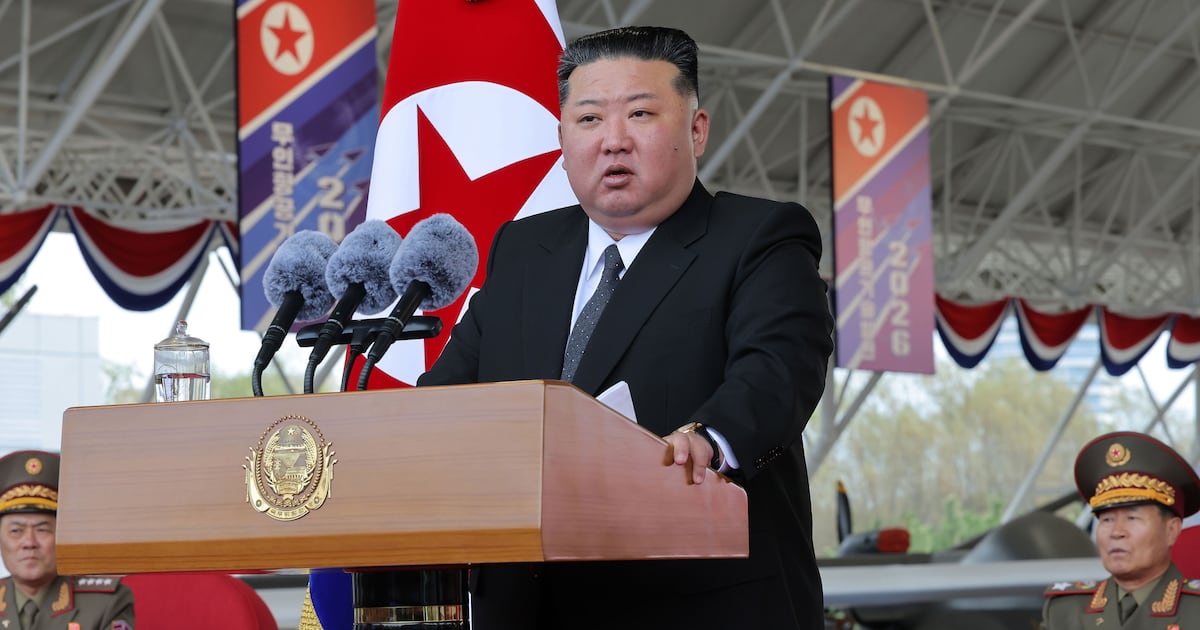
In his address to the assembled diplomats, Kim Jong Un pointed to global instability and affirmed his government’s foreign policy priorities, stating that Pyongyang aims to expand international relations grounded in independence, peace, and friendship while safeguarding national sovereignty and security. He said that the world is experiencing an unstable security crisis alongside political and economic chaos across the globe.
The DPRK neither pursues supremacy nor expansion.
Kim Jong Un, North Korean leader
The ceremony occurred just days after U.S. President Donald Trump concluded a visit to China for the Asia-Pacific Economic Cooperation summit without arranging a meeting with the North Korean leader.
Global Crises Influence Regional Stability
Expounding on these diplomatic goals, Kim told the envoys that North Korea intends to build foreign relations founded on independence, peace, and friendship while concurrently safeguarding national sovereignty and security, as noted by UPI and RTÉ. He further emphasized that the nation’s military buildup remains an exercise of sovereign self-defense to cope with a critical international environment, according to NK News.
Military Capabilities Shape Strategic Intentions
Andrei Lankov argued that stated political intentions hold little weight because a country’s actual military capacities matter far more than its rhetoric. He added that any military buildup by Pyongyang is inevitably perceived by neighboring countries as a direct threat.
International Context and Regional Reactions
The Russian Embassy in Pyongyang reported via its Telegram channel that Ambassador Andrei Podelyshev presented his credentials during the event.
Kim Sung-bae, president of the Institute for National Security Strategy, noted in a report that North Korea may be attempting to set the agenda on Korean Peninsula issues by setting terms with the United States, China, and Russia.
Hosting the credential presentation at the headquarters of the Central Committee of the Workers’ Party of Korea underscores the preeminent authority of the ruling party in North Korea’s governance structure. Serving as the highest organ between national meetings, the Central Committee functions as a top forum for discussing relevant policy issues and formally implementing decisions.
While state bodies manage diplomatic relations, the party apparatus—operating through the Central Committee and controlled by the Politburo—exercises supreme oversight over national governance, reflecting a political system where party structures outrank standard state institutions.
Andrei Lankov suggested that stated intentions carry less weight than actual military capabilities, noting that military expansions are consistently viewed as threatening by neighboring nations.