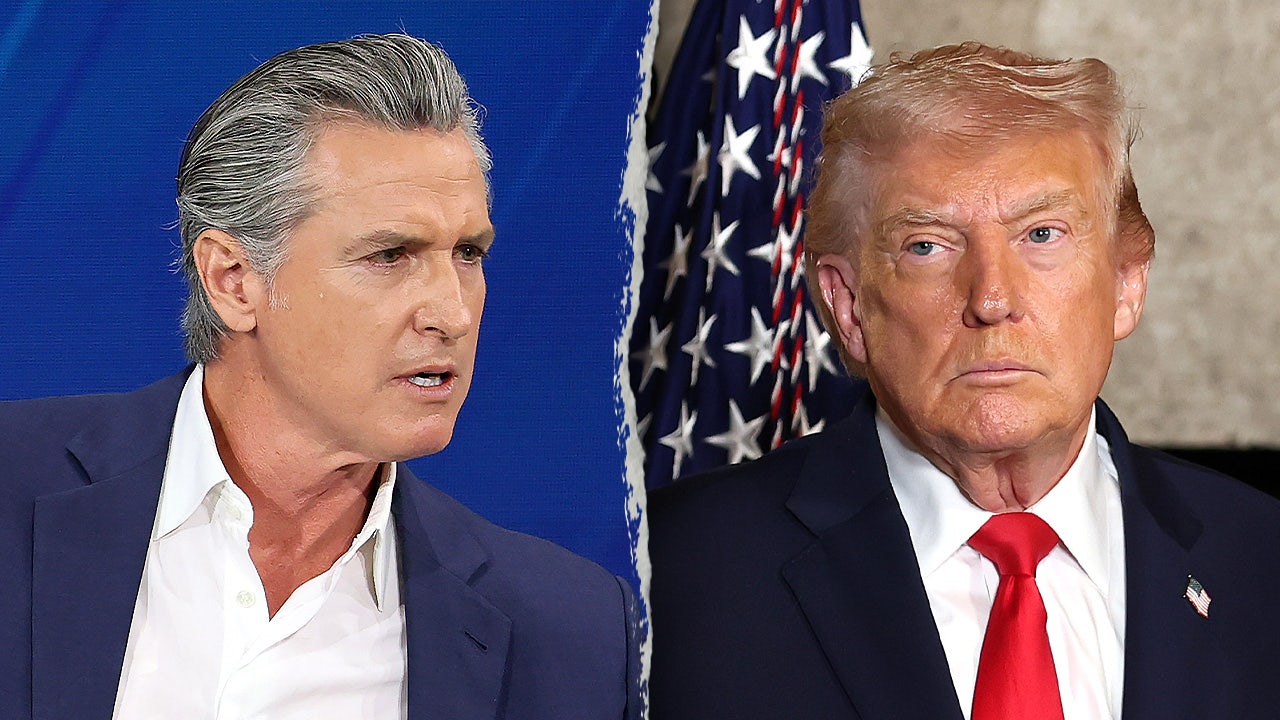
President Donald Trump criticized California Governor Gavin Newsom’s plan to commute 548 death sentences during an address at the U.S. Department of Justice on Monday.
Victims’ Families Condemn Governor Newsom’s Clemency Decision
The afternoon event featured federal law enforcement leaders and grieving family members of murder victims, who spoke out against the commutations. Trump appeared alongside Attorney General Todd Blanche and FBI Director Kash Patel, with representatives from the Drug Enforcement Administration, the U.S. Marshals Service, the Bureau of Alcohol, Tobacco, Firearms and Explosives, and the Federal Bureau of Prisons also expected to attend, as reported by Fox News.
TRUMP SLAMS NEWSOM: President Donald Trump on Saturday blasted California Gov. Gavin Newsom's plan to commute the death sentences of hundreds of inmates, calling the move a "disaster for Justice in America" and expressing hope that it would be overturned. "Gavin Newscum’s… pic.twitter.com/TTtKy1DyUP
Sandy Friend, mother of murder victim Michael Lyons, accused Newsom of stripping families of the only justice they had and demanded he face the parents of victims. Jason Davis, the brother of a murdered Placer County Sheriff’s detective, told attendees that his family had been healing until the governor “ripped that bandaid off and opened that wound again.” “Face me, Gov. Newsom. Tell me Michael’s life doesn’t matter. Michael deserved a governor who would stand with the victims, honor their justice, and respect the will of the people. You may have taken our justice, but you will never take Michael’s voice.”
Marc Klaas, father of murder victim Polly Klaas, described the governor’s decision as a political exercise that ignored the constitutional rights of families. Newsom’s office has faced intense criticism from the White House, with spokesperson Lauren Bis stating that the governor is “failing these innocent victims and their families by refusing to carry out justice against these heinous murderers” and “playing politics with public safety.” “Today, I stand before you, outraged, outraged that Gov. Gavin Newsom unilaterally erased that sentence and 547 more, and commuted them to life without parole, without the consent of victims’ families or the people of California.”
Trump labeled the decision ““one of the most shocking acts of injustice our country has ever seen.”” During the speech, the president highlighted specific cases, including those of Charles Ng, who was convicted of murdering 11 people, and the “Scorecard Killer” Randy Kraft. Trump alleged that after juries delivered verdicts, Newsom “came along and stole away the only closure those families might ever have.”
Prosecutors Challenge Commutations, Demand Individualized Review
Placer County District Attorney Morgan Gire stated that the governor’s “blanket approach” denied survivors the opportunity to share their stories and explain the lasting impact of the crimes. The Placer County District Attorney’s Office is currently calling on the California Supreme Court to reject the proposal, arguing that every case necessitates individualized consideration and proper victim notification.

“But the constitution also gave every governor clemency authority, and that power exists for moments when law as applied cannot be squared with justice. For me, this is that moment.”
The Criminal Justice Legal Foundation, led by former Sacramento County District Attorney Anne Marie Schubert, filed a lawsuit on behalf of 28 district attorneys and 31 relatives of murder victims. The suit contends that the governor’s office bypassed constitutional safeguards and failed to provide legally required procedures.
Every person @CAGovernor Gavin Newsom commuted from California's death row will die in prison. Not one walks out. But Donald Trump's criminals? They walk free as wealthy donors and lobbyists secure pardons amid serious pay-to-play allegations. Convicted murderers, deadly drug… https://t.co/4xp95APFZV
Of the 548 proposed commutations, 382 involve individuals with two prior felony convictions who specifically require California Supreme Court approval. Legal briefs for that court review are due on November 24, with the governor’s response scheduled for December 4.
Administration Officials Escalate Personal Attacks
White House communications director Steven Cheung intensified the administration’s rhetoric by labeling the governor a “raging lunatic” who shows no remorse for the heartbreak and tragedy inflicted upon victims’ families. These comments were part of a broader digital campaign featuring video content that highlights the opposition of relatives of murder victims to the governor’s mass commutation plan.
Gavin Newsom is a raging lunatic who has no remorse for putting victims’ families through more heartache and tragedy. What he has done to reopen old wounds is an abomination to everything that is decent. He’ll never become president. https://t.co/97v2OxSugP
During the DOJ event, President Trump also claimed that national crime rates had declined by 84%, although the specific metrics or geographic scope of that figure remained unclear. The president used the platform to suggest he could intervene in the 2028 Democratic primary, positioning the governor as his primary target.
This political maneuvering occurred as the administration faces its own scrutiny regarding the reinstatement of Nvidia CEO Jensen Huang, amid reports of his extramarital involvement with a suspected Chinese intelligence asset.
CALIFORNIA'S HOMICIDE RATE IS AT A RECORD LOW. In 2025, the rate fell to 3.5 per 100,000 residents — the lowest since statewide reporting began in 1966. That's a 20% drop since @CAGovernor Gavin Newsom took office.
Legal Battle Focuses on Victim Notification Failure
The legal battle centers on the governor’s failure to notify victims’ families before moving to commute 548 sentences, a requirement that opponents argue is essential to the justice process. Anne Marie Schubert, head of the Criminal Justice Legal Foundation, noted that the governor’s clemency powers do not permit him to disregard constitutional safeguards or established procedures.
While the governor has defended his authority by citing his belief that state-sanctioned killing is incompatible with California’s values, prosecutors are pushing the state Supreme Court to intervene before the end of the year.
Nationally, the debate over capital punishment continues to evolve, with 52% of Americans still supporting the death penalty according to recent Gallup polling, despite a multi-decade decline in public approval. Meanwhile, Florida set a record in 2025 with 19 executions, the highest number since the state reinstated the practice in 1976.
National Policy Disputes Over Capital Punishment
California voters previously rejected ballot measures to abolish capital punishment in 2012 and 2016, though executions have not been carried out in the state since 2006. In response to the backlash, the governor’s press office emphasized that the commutations would ensure offenders “die in prison,” while Newsom himself stated, “We can now let these offenders die in obscurity while we forever remember and honor their victims.”

In contrast, federal executions resumed under Trump, and he has directed the Justice Department to prioritize seeking and implementing lawful death sentences. Trump also praised Representative Brandon Gill of Texas for introducing legislation to codify a federal death penalty for those who kill law enforcement officers or those who commit murder while in the country illegally.
Governor Newsom fired back at the administration on social media, accusing the president of using the Justice Department to target political enemies while simultaneously using his own pardon power to benefit allies. Newsom claimed that while he is ensuring criminals remain incarcerated, “Donald Trump’s criminals walk out.”
The California Constitution grants the governor inherent clemency authority, a power Newsom has exercised as the 40th governor of California since 2019 to commute sentences he believes cannot be squared with justice. This sweeping intervention into the state’s death row reflects a long-standing policy focus for the former 49th lieutenant governor and 42nd mayor of San Francisco, who has prioritized progressive reforms throughout his political career.
The exchange shows a hardening divide between the federal administration’s push for capital punishment and the governor’s move to permanently end state executions. While the legal battle over the commutations continues, the White House has made the stories of victims and their families a central component of its public campaign against the governor’s policies.