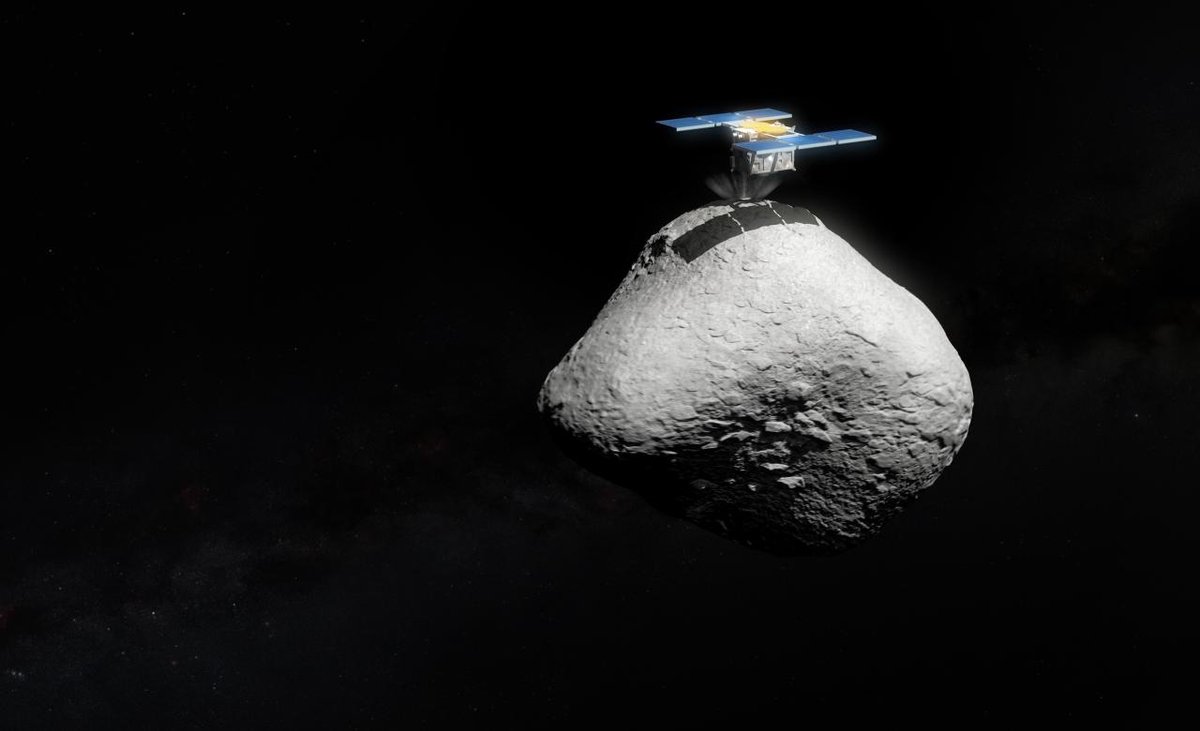
A tiny object orbiting the Sun between Earth and Mars accelerates in strange ways that gravitational physics alone cannot explain.
Discovered in 1998 by astronomer Tom Gehrels of the University of Arizona, the small body known as 1998 KY26 has baffled astronomers for decades. Recent research shows it measures roughly 36 feet (11 meters) across, spinning rapidly about once every five minutes.
While comets achieve acceleration through the sublimation of surface ice that creates visible tails, 1998 KY26 displays no tail. A study published in Icarus on October 28, 2026, by Korbin Hansen and Masatoshi Hirabayashi of the Georgia Institute of Technology found the object’s temperature sits at minus 53 degrees Fahrenheit (minus 47 degrees Celsius). Darryl Z. Seligman of Michigan State University explained the implication of that temperature in The New York Times.
If something has ice, then it’s a comet. But no ice means no comet. The surface of KY26 is too warm.
Darryl Z. Seligman, Michigan State University
Radiation Pressure and the Search for Answers
With ice ruled out, scientists turned to solar radiation pressure and thermal forces. Davide Farnocchia of NASA’s Jet Propulsion Laboratory suggested that massless photons striking the body could generate measurable momentum over time. Telescope data have revealed that 1998 KY26 is significantly smaller than previously thought, and Farnocchia led a study that showed how, given this smaller size, the effects of sunlight alone could explain 1998 KY26’s motion.
David Jewitt, director of the Institute for Planets and Exoplanets at the University of California, Los Angeles, detailed how light pushes against small bodies.
“Light photons carry momentum; it’s very small per photon, but there’s a hell of a lot of photons,” Jewitt said in reporting published by EarthSky. Combined with the Yarkovsky effect—where an object radiates absorbed heat unevenly—these forces offer a plausible explanation for the velocity shifts.
The Soviet Probe Hypothesis
While most researchers categorize the object as an unusual asteroid, Harvard astrophysicist Avi Loeb has proposed an alternative origin. Loeb suggested the body might be the lost Soviet Phobos 1 spacecraft, launched toward Mars in 1988 before contact was lost due to a command error.
However, that theory lacks widespread support. NASA Administrator Jared Isaacman said that there is no evidence the object is “anything but an asteroid,” according to findings covered by EarthSky. Bryce T. Bolin of Eureka Scientific Inc. also dismissed the spacecraft hypothesis, noting that the object is far too heavy and dense to be derelict hardware.
Hayabusa2 Mission Changes Course
Direct investigation of the puzzle hit a roadblock on November 16. Officials from the Japan Aerospace Exploration Agency announced that the Hayabusa2 spacecraft will no longer execute an intended 2031 rendezvous with 1998 KY26.
Before his work on near-Earth objects, Davide Farnocchia earned a Ph.D. in mathematics from the University of Pisa in 2012. His career includes contributing to trajectory predictions and risk assessments for the close flyby of Comet Siding Spring past Mars, as well as navigation and science efforts for the OSIRIS-REx mission to asteroid Bennu.
Operating well beyond its original operational lifetime in an extended mission, the probe encountered engine problems that prevented it from reaching the target. JAXA adjusted the trajectory to visit a different near-Earth asteroid, 2015 BM510, in 2028 instead.