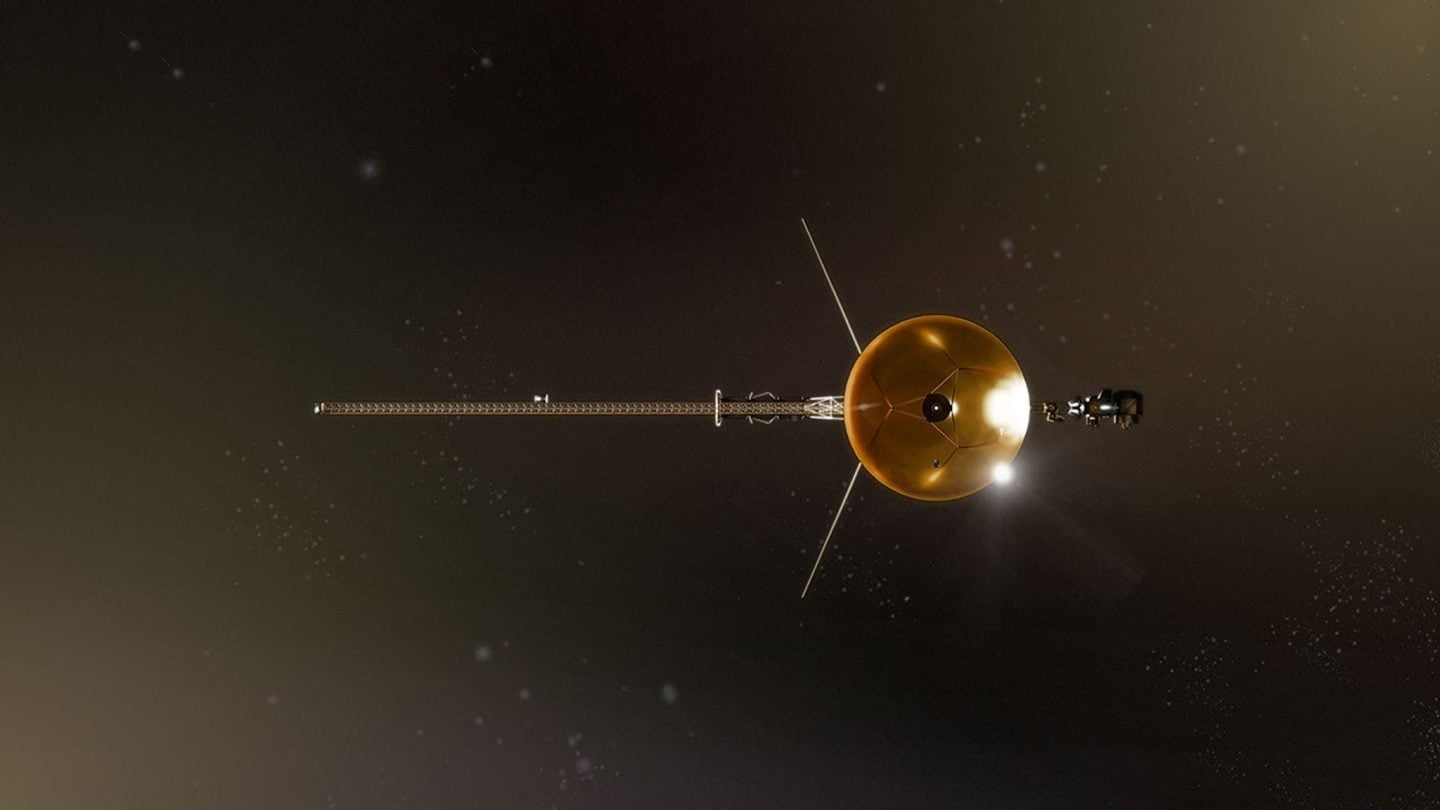
Launched on Sept. 5, 1977, NASA’s Voyager 1 has spent more than 49 years traveling through space.
On Wednesday, Nov. 18, 2026, at 5:16:07 a.m. EST, the probe will cross a distance of 16.094 billion miles, or 25.902 billion kilometers. That vast span equals one light-day, making Voyager 1 the first human-made object in history to reach such a distance from Earth.
Crossing Into Interstellar Space
The twin spacecraft Voyager 1 and Voyager 2 were originally designed to explore the outer planets by using a rare planetary alignment that occurs once every 176 years. Voyager 1 left Earth 16 days after its sibling, launched atop a Titan IIIE-Centaur rocket from Cape Canaveral in Florida. Both probes were built in the mid-1970s. While Voyager 2 took a different trajectory past Uranus and Neptune, Voyager 1 focused on Jupiter and Saturn.
Voyager 1 took advantage of gravity-assisted speed boosts from Jupiter and Saturn in 1979 and 1980. After completing its primary planetary mission with its Saturn flyby in 1980, Voyager 1 continued outward.
Voyager 1 officially left the sun’s protective bubble, known as the heliosphere, in August 2012 and entered interstellar space. Its twin, Voyager 2, crossed that historic boundary into interstellar space in November 2018.
Powering The Spacecraft
Traveling at roughly 38,000 miles per hour through the vacuum of space, the spacecraft are powered by nuclear power plants on board that use decaying plutonium to turn heat into electricity.
With that power supply nearly tapped out, mission engineers at NASA’s Jet Propulsion Laboratory (JPL) in Southern California have done everything they can to extend the life of Voyager 1.
To conserve power, ground-based researchers have devised new methods, which involve turning off non-essential equipment.
Because most of that energy is required to keep Voyager 1 functioning, NASA has turned off eight out of the 10 original instruments that came with the spacecraft at launch.
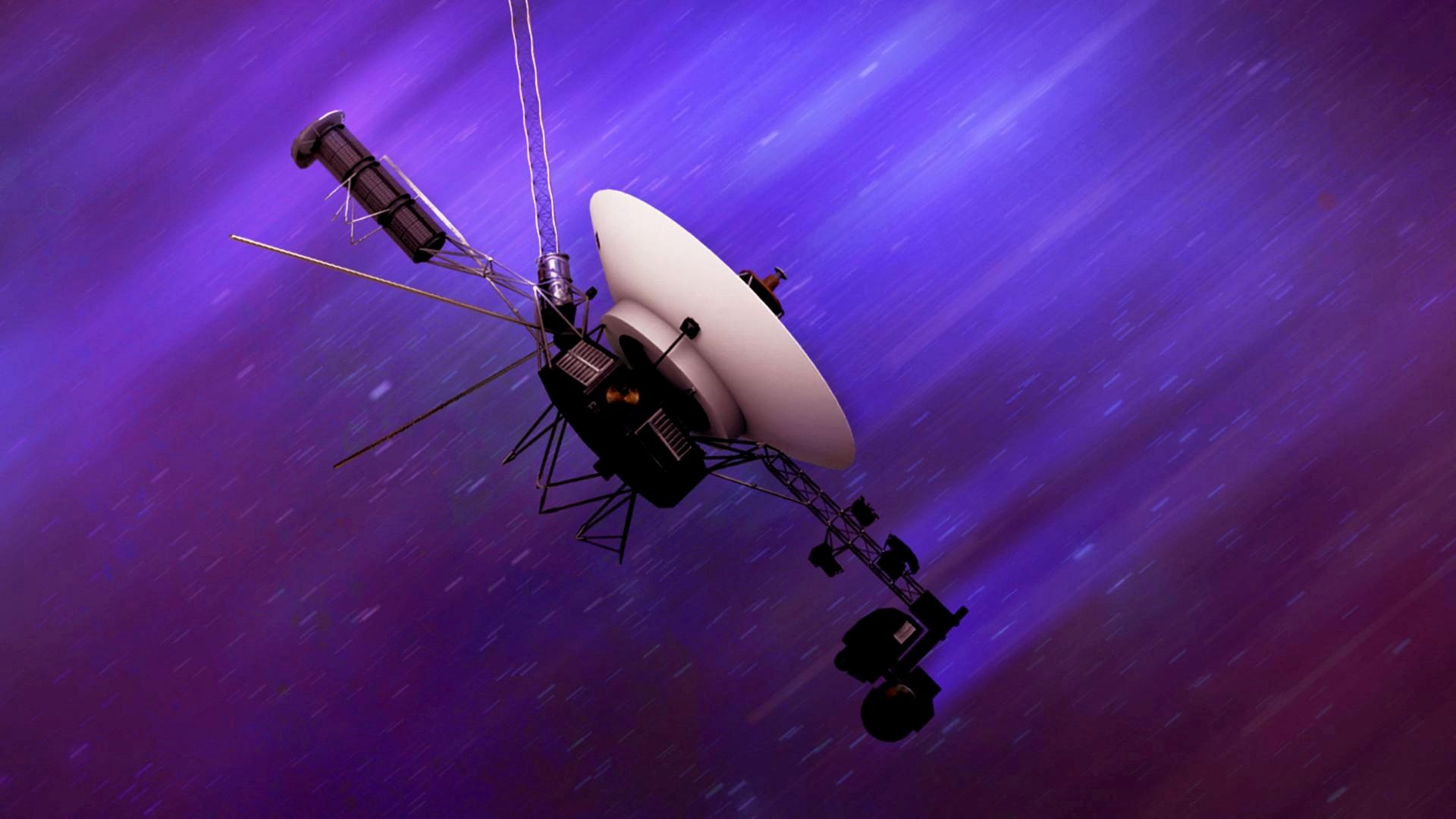
An internal undertaking named The Big Bang was finalized by the group in September 2026—a process previously executed on Voyager 2 as well—which extends Voyager 1’s dwindling energy reserves while maintaining sufficient heat to function within the freezing environment of interstellar space.
Given the current consumption and degradation pace, Voyager 1 is projected to turn off its final scientific apparatus sometime during the 2030s.
The probe will ultimately sever communication with Earth by 2036 because it will lack adequate power for transmitting radio signals.
Teams also resolved an unexpected loss of communication with Voyager 1 when the Deep Space Network did not detect the probe’s signal during two scheduled comms passes. Contact was reestablished on Oct. 20, and the team has maintained communication since then.…
The Voyagers exchange information with Earth-based operators through radio transmissions handled by the Deep Space Network of NASA, which consists of a global network of massive satellite dishes.
Radio waves travel at the speed of light.
Communication with the probe requires a 24-hour delay each way, so a simple exchange takes 48 hours.
If you want to say ‘hello’ to Voyager, you send your message, and then you go home, and you wait two days before you finally get a response.
Suzanne Dodd, Voyager project manager at JPL
The mission is funded by NASA’s Heliophysics Division at NASA Headquarters in Washington.

A minimal crew of NASA specialists maintains operation of both spacecraft, issuing directives about once weekly, or more frequently if anomalies arise.
Communications with Voyager 1 were briefly interrupted in October when technicians discovered a failure in a thruster bank and an automatic switch to auxiliary thrusters; normal links were successfully restored on October 20.
NASA Invites Public to Celebrate Voyager Distance Milestone
To mark the historic distance milestone, NASA invited the public to participate in “Shine Bright for Voyager’s Light-Day” on Tuesday, Nov. 17, by using the agency’s automated flasher on a phone or following instructions to deliver the Morse code for V-G-R into the sky with a flashlight after sunset.
On Nov. 18, NASA’s Jet Propulsion Laboratory (JPL) in Southern California will host a moderated discussion with mission members and NASA leadership about the status of Voyager 1 and 2, the unique science the twin probes continue to gather in interstellar space, and the challenges of keeping the spacecraft operating for so long over such vast distances.
The public can watch on NASA’s streaming service, NASA+, or YouTube.
Both spacecraft carry a Golden Record designed to introduce Earth to any intelligent extraterrestrial species that might find them, featuring audio samples, greetings, and recordings such as the Latin phrase “ad astera per aspera,” meaning “to the stars through struggles.”

The initiative’s lasting cultural legacy features the iconic “Pale Blue Dot” image of our planet captured by Voyager 1 in 1990.
All of us — everyone on Earth — have been touched by these missions.
Bill Nye, the Planetary Society
By November 2035, roughly nine years from now, Voyager 2 is projected to reach the one light-day threshold from Earth, likely after its propellant has run out.
As Voyager 1 continues its journey through interstellar space, it is heading towards Gliese 445, a star more than 17 light-years from Earth, and NASA estimates that Voyager 1 will pass within approximately 1.7 light-years of the star in about 40,000 years, though it will not reach or orbit the star.
Joe Westlake, head of NASA’s heliophysics division and a space physicist, said that the Voyager mission continues to uncover secrets of the distant galaxy nearly half a century after launch.
Voyager 1 project manager Suzanne Dodd described Voyager 1 as “a national treasure” and told The Associated Press news agency that the routine operations of the two spacecraft resemble those of meteorological satellites.
Linda Spilker, a planetary scientist at NASA’s Jet Propulsion Laboratory (JPL), said: “I just never imagined [the mission] would last that long.”
Garry Hunt, an astrophysicist who was part of the original Voyager imaging team, said that the spacecraft are each powered by a “nuclear power plant on board” that uses decaying plutonium.

Ed Stone, a former Voyager project scientist, and other members of the scientific team have spent decades analyzing data from the probes.
For Alan Cummings, a cosmic ray specialist, joining the Voyager science group happened by pure chance when a stratospheric balloon test—the foundation of his doctoral dissertation at Caltech—missed its intended drop zone in northern Canada; he said that losing that balloon turned out to be a fortunate break that shaped the entire trajectory of his professional life.
Cummings joined the Voyager team at age 29 and is now 82, having worked on and analyzed data from the spacecraft for 53 years.
Margherita Bassi said the upcoming milestone shows scientific endeavor and ingenuity.
For more information about NASA’s Voyager mission, visit science.nasa.gov/mission/voyager/.
Earlier coverage: NASA Reestablishes Contact With Voyager 1 Near One-Light-Day Distance