Antarctica’s Thwaites Glacier is losing mass twice as fast as previously estimated, according to new research published in Nature Communications. By accounting for a grounding zone
where warm seawater penetrates beneath the ice, scientists suggest the glacier—roughly the size of Florida—could contribute significantly more to global sea-level rise by 2100.
Refined Modeling of the “Doomsday Glacier”
For decades, glaciologists treated the grounding line
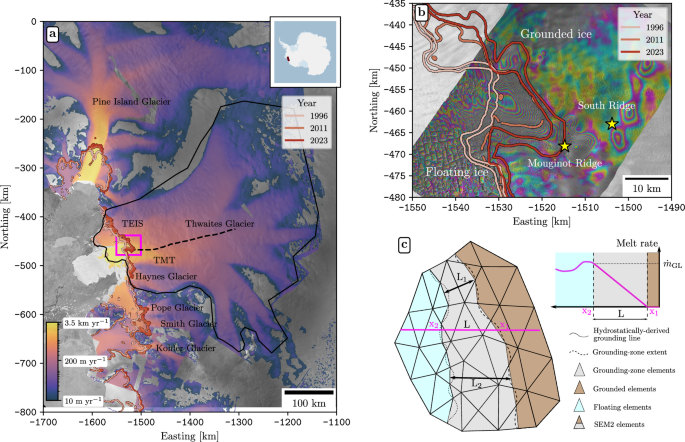
—the boundary where a glacier lifts off the seabed to float—as a single, stable point. New research, led by project scientist Mattia Poinelli, suggests this view is incomplete. By incorporating data that accounts for a grounding zone
several kilometers wide, the updated model better reflects the reality of how warm ocean water flushes in and out with the tides. The study, which included collaboration from researchers at the University of California, Irvine, and NASA’s Jet Propulsion Laboratory, utilizes the Ice-sheet and Sea-level System Model (ISSM) to simulate these dynamics.
Typical models that utilize a fixed grounding line struggled to reproduce the rapid retreat observed by satellites. The new approach, which simulates a grounding zone approximately 4 to 6 kilometers wide, more accurately matches historical data from 1996 to the present. This adjustment produces projections that are twice larger than before, estimating that Thwaites could contribute up to 30 millimeters (1.2 inches), plus or minus 6 millimeters, to global sea levels by 2100, even without additional climate warming.

The Role of the Mouginot Ridge
The glacier’s retreat is not uniform, largely due to the bathymetry of the seafloor. The main trunk of the Thwaites Glacier is currently held back by the Mouginot Ridge, a raised section of the seafloor that acts as a natural barrier. Since 1996, the main trunk has retreated about 25 kilometers along a deep seafloor channel, while the eastern ice shelf has pulled back 10 to 20 kilometers. However, the study warns that this stabilization is temporary.
Once that ridge is unpinned, the glacier will continually retreat across a predominantly retrograde seafloor toward its next topographic high, the South Ridge.
Mattia Poinelli, project scientist at UCLA
Simulations indicate a 60 percent probability that the glacier will detach from the Mouginot Ridge before 2100, with some scenarios suggesting this could occur as early as 2038. Once unpinned, the ice would be exposed to deeper, warmer water, further accelerating the thinning process. The bedrock beneath the glacier slopes downward toward greater depths, which makes the retreat difficult to halt once it begins.
Implications for Global Sea-Level Rise
While 1.2 inches of sea-level rise may seem incremental, experts emphasize that it significantly compounds the risks for coastal communities. Eric Rignot, a professor of Earth system science at UC Irvine and a study author, noted that the results predict greater risk of and exposure for coastal flooding than anticipated in the coming decades.
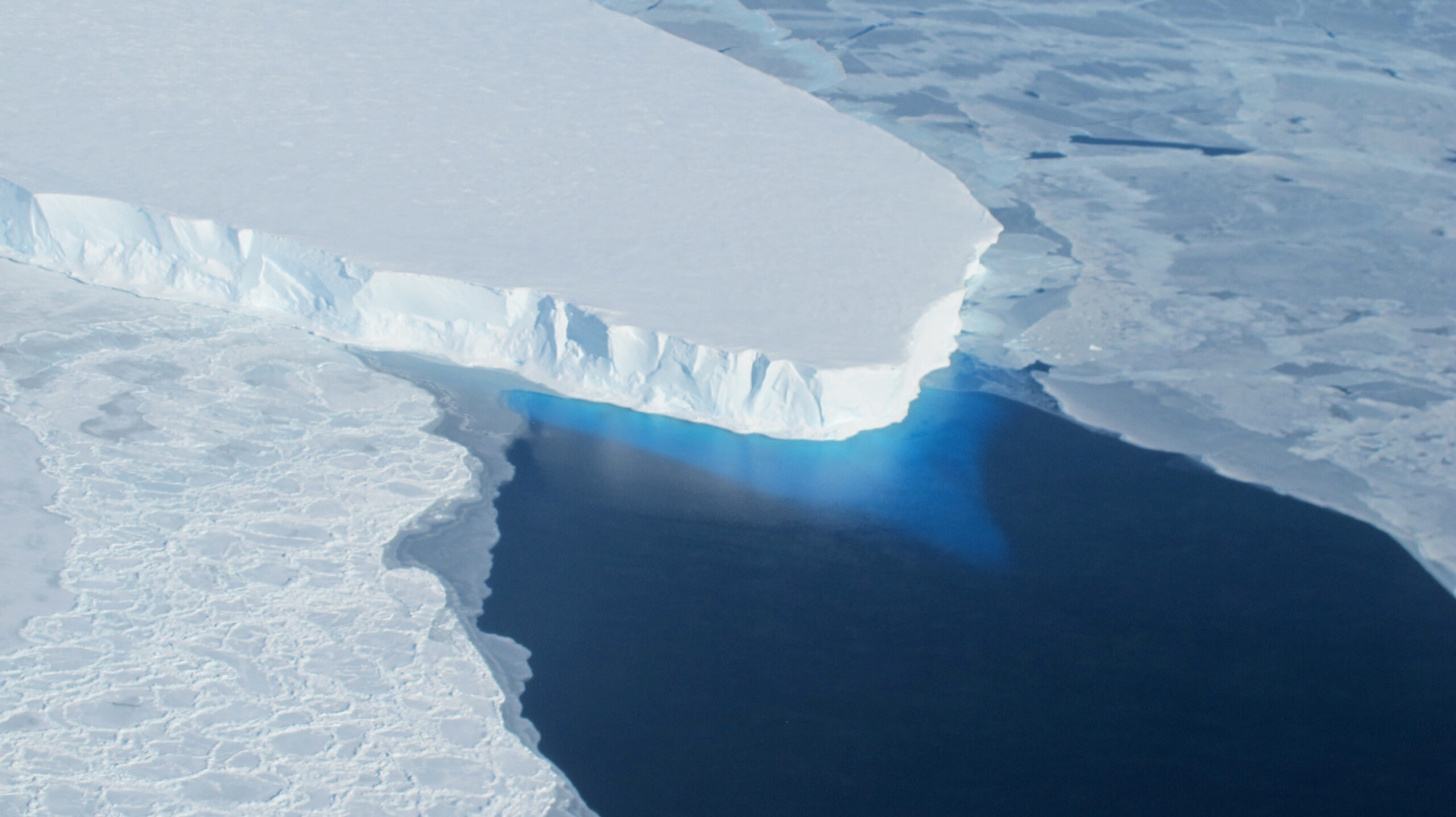
Thwaites serves as a critical cork
for the West Antarctic ice sheet; its total collapse holds the potential to raise sea levels by more than 2 feet, or roughly 61 centimeters, on its own, and potentially up to 10 feet if the wider ice sheet loses stability. Currently, the glacier contributes about 4% to global sea level rise.
The findings have been described by Ted Scambos, a senior research scientist at the Earth Science and Observation Center at the University of Colorado Boulder, as a real game changer for sea level forecasting from Thwaites.
Despite the urgency, researchers acknowledge that significant uncertainty remains regarding the specific processes within the grounding zone. Rignot emphasized that most projections to date have struggled to match the rapidity of mass loss because of missing physics.
Future Observational Missions
To improve predictive accuracy, scientists are preparing for follow-up research. Teams are planning to travel to the glacier in 2028 to deploy instruments capable of documenting the specific mechanisms of seawater flushing beneath the ice. Robert Larter added that the environment beneath the glacier is even more complex than the current paper describes.
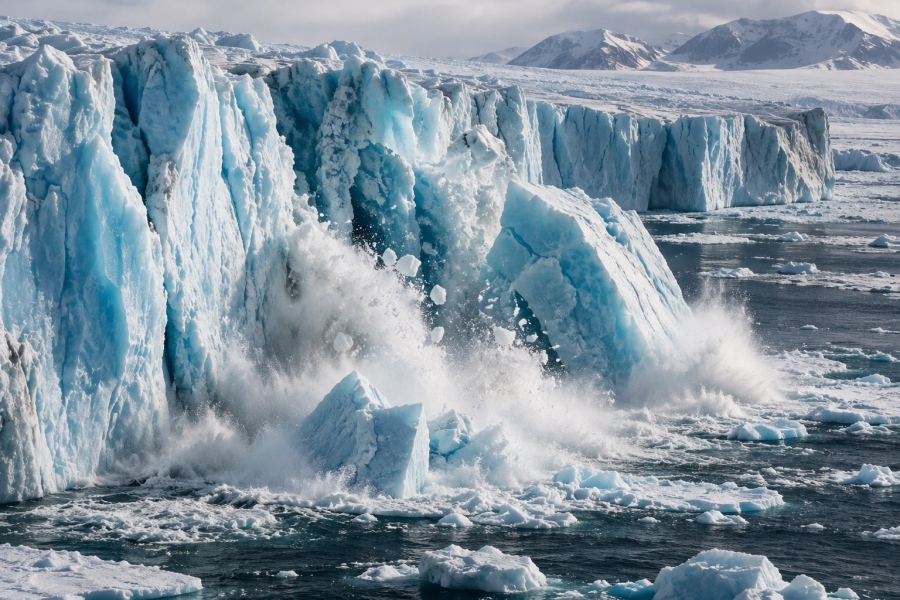
Meanwhile, separate modeling published in Geophysical Research Letters indicates that Thwaites Glacier is already in a state of committed change. Experts warn that even with immediate efforts to curb greenhouse gas emissions, society can expect higher sea levels resulting from the damage that has already been done.