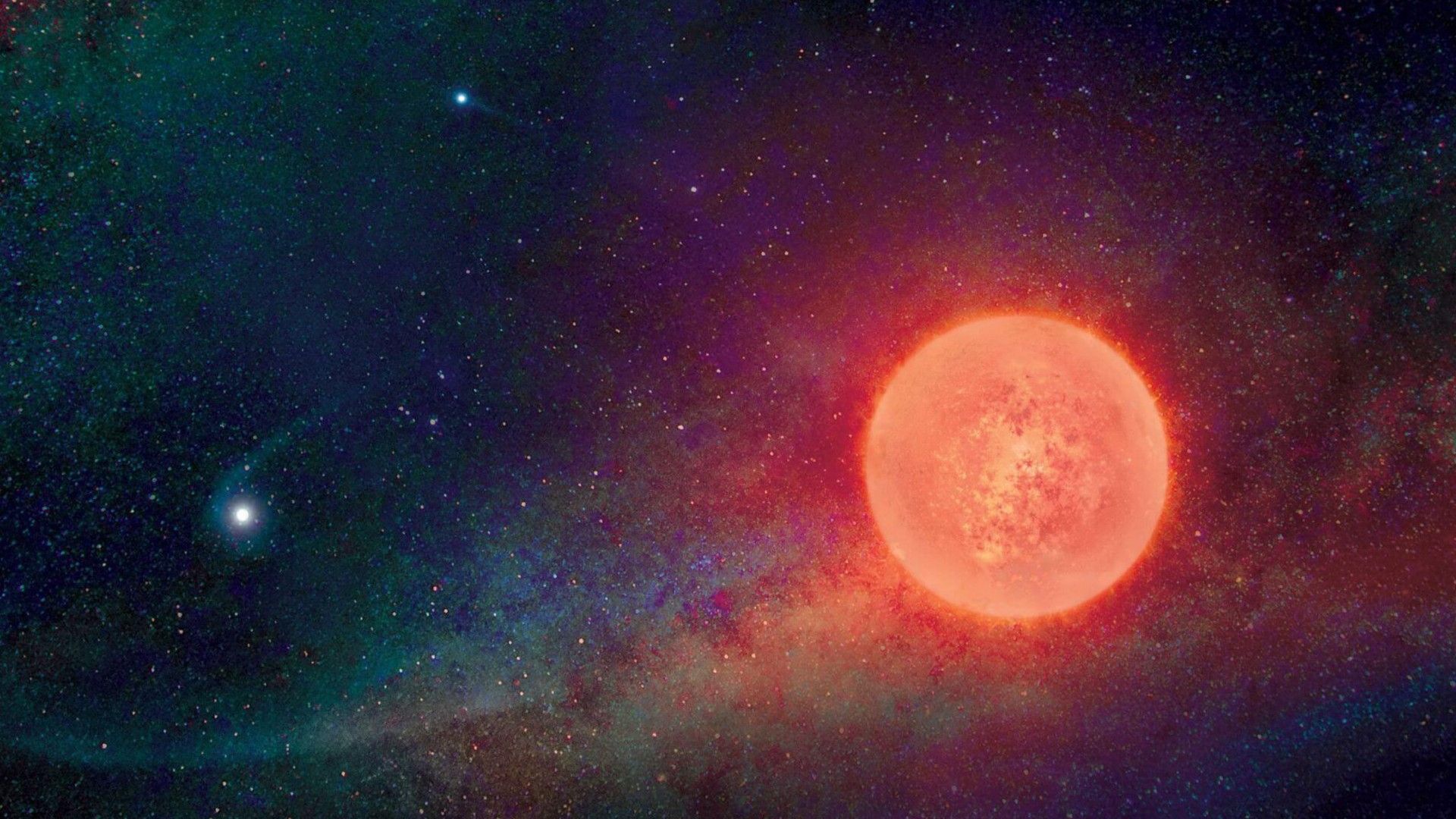
Astronomers hunting planets 28 light-years from Earth found a triple-star system with two white dwarfs that, by standard theory, should not have survived together.
The system, named Welopōʻai, consists of a red dwarf orbited closely by one white dwarf every 9.8 years. A second white dwarf circles the pair at a projected distance of about 124 astronomical units.
The inner white dwarf’s mass was pinned to 0.618 solar masses with a precision of 0.7%, making it one of the most precisely weighed white dwarfs within 65 light-years. Its progenitor star was roughly 40% more massive than the Sun and would have swollen into a giant large enough to engulf the red dwarf. The red dwarf remains on a wide, stable orbit.
“This system should not exist,” said Professor Patrick Dufour, a white-dwarf specialist at Université de Montréal and co-author of the study published November 19 in Astronomy & Astrophysics. “We have no clean explanation for how it got here.”
Planet search reveals stellar ghost
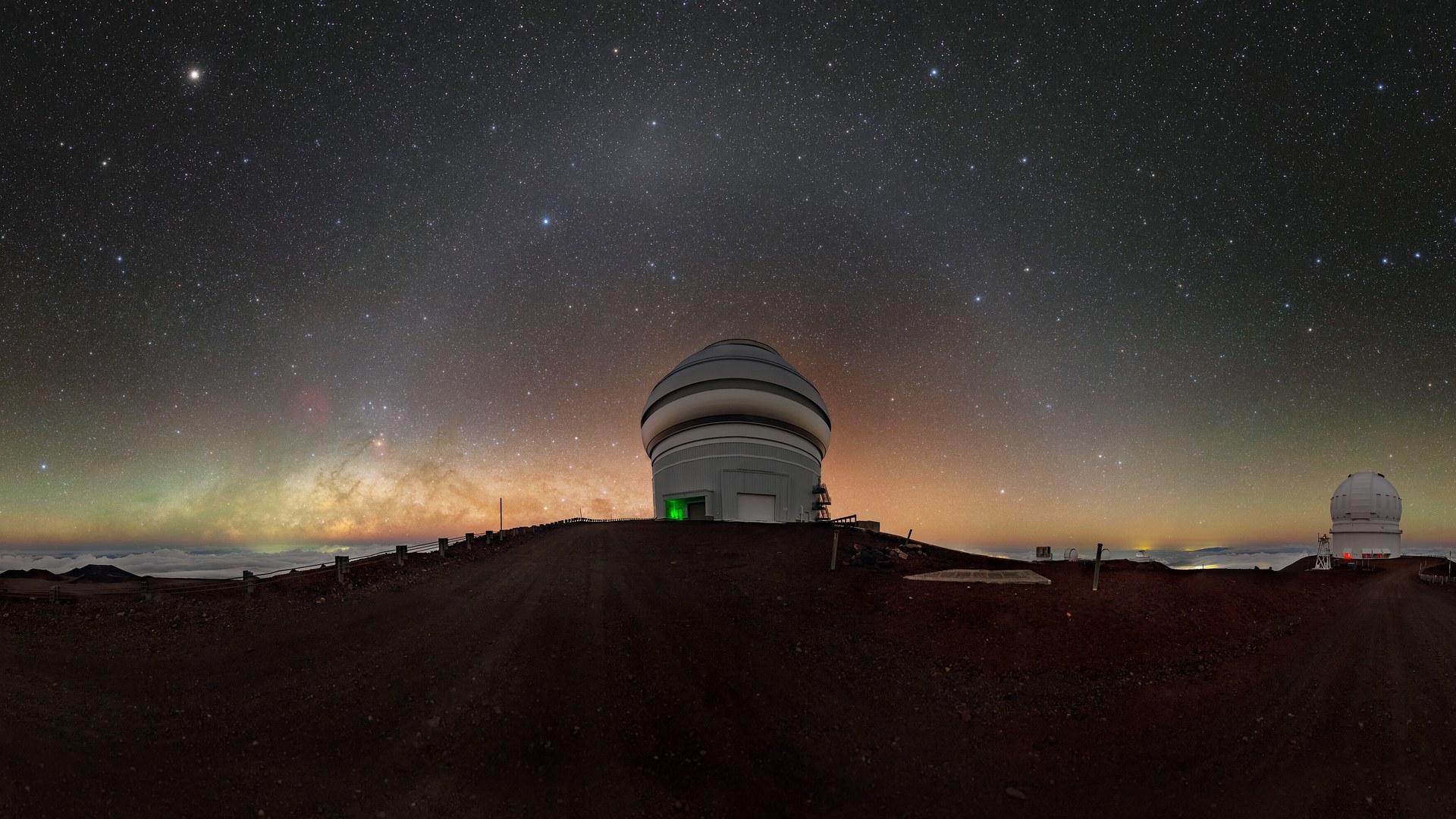
The discovery began as a routine exoplanet survey. Étienne Artigau of the Trottier Institute for Research on Exoplanets at Université de Montréal used the SPIRou spectropolarimeter on the Canada–France–Hawaii Telescope to monitor the red dwarf IRAS 21500+5903 (also catalogued as TYC 3980-1081-1) for the subtle wobbles that betray orbiting planets.
Instead, the star’s radial velocity swung by nearly 16 kilometres per second. The signal was thousands of times larger than any planet could produce.
“We were actually looking for planets,” Artigau said. “Instead, we found something much more surprising.”
The team initially suspected a brown dwarf, but the mass had to exceed 0.6 solar masses, ruling that out. Follow-up imaging with the ‘Alopeke instrument on Gemini North resolved a faint companion — a white dwarf. A second, more distant white dwarf was already known to share the system’s motion through space.
Masses and orbits that defy the standard script
Combining 4.8 years of radial-velocity data with direct imaging yielded a complete orbital solution. The inner pair — the M4 red dwarf (0.419 solar masses) and the newly found white dwarf (0.618 solar masses) — orbit each other every 9.83 years at a separation of 4.64 astronomical units. That is slightly closer than Jupiter is to the Sun. The outer white dwarf sits roughly 124 astronomical units away in projection.
Stellar-evolution models indicate the inner white dwarf’s progenitor was a star of about 1.4 times the Sun’s mass. When it expanded into a red giant, its envelope should have reached or exceeded the red dwarf’s orbit.
That would have triggered a common-envelope phase, dragging the pair into a tight orbit lasting days or merging them entirely. The nearest analogue, G 203-47, follows that script: its red dwarf and white dwarf circle each other in under 15 days. Welopōʻai’s ten-year orbit is more than two hundred times wider.
An ancient, metal-rich puzzle
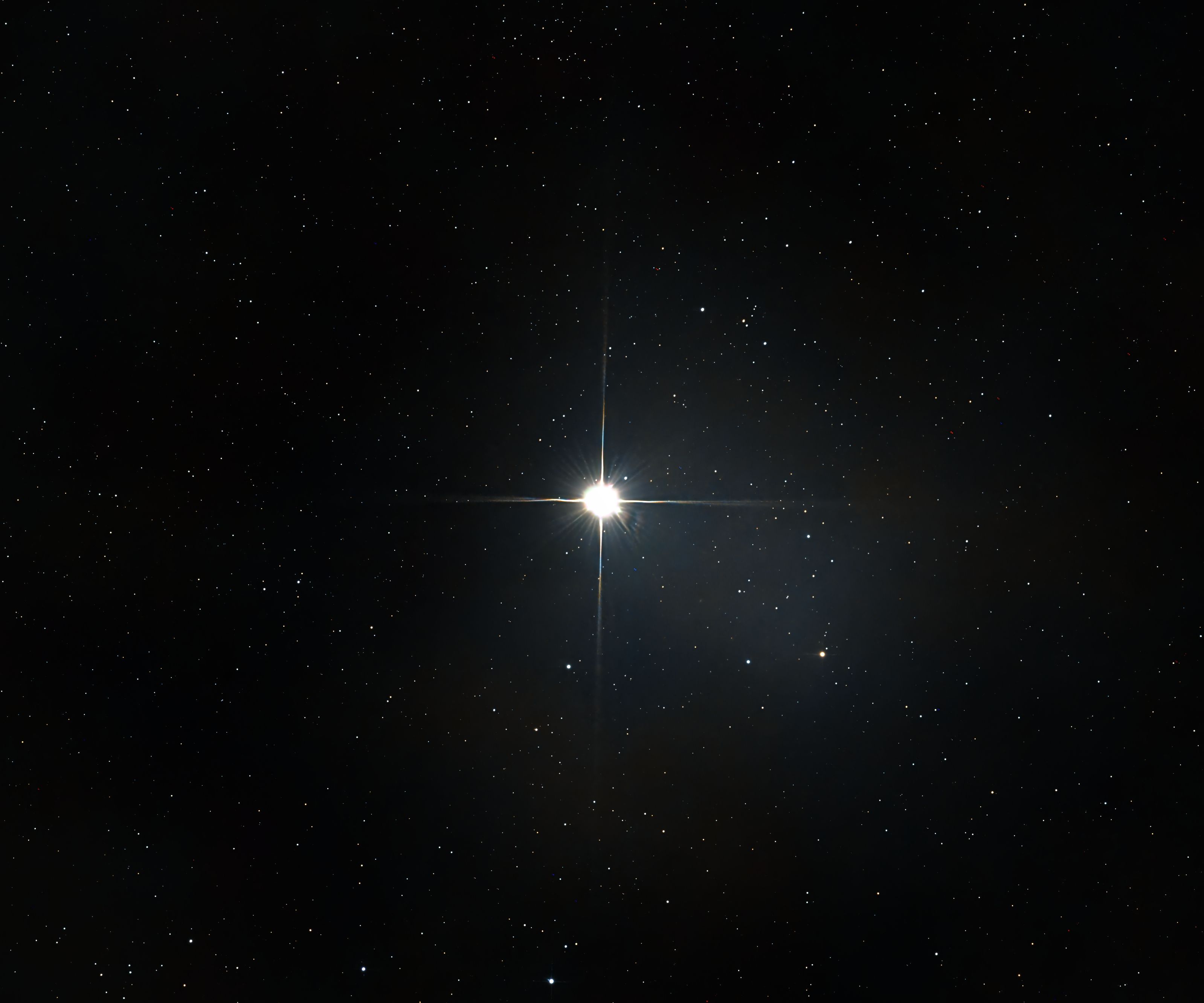
Both white dwarfs’ cooling ages point to a system age of 9 to 11 billion years, among the oldest stars in the galaxy. Yet the red dwarf is surprisingly metal-rich — a trait usually associated with younger stars. “It’s tantalizing, and we just don’t know if it means anything,” said Paul Delaney, professor emeritus of physics and astronomy at York University, who was not part of the discovery team.
Delaney suspects the outer white dwarf may have once been much closer, gravitationally stirring the inner pair. “I would bet that they were relatively proximate to each other and then they did engage in a bit of gravitational embracing, and the further white dwarf today was much, much closer in its heyday.” Such three-body interactions could have halted the common-envelope in-spiral. Detailed simulations have not yet been run.
Researchers rule out planetary cause for extreme wobble
The mid-M dwarf showed a near-constant acceleration of roughly 5 metres per second per day, equivalent to about 1,800 metres per second per year, the authors write. On a multi-year orbit around a 0.42-solar-mass star, even a Jupiter-mass planet would induce an acceleration of at most 40 to 130 metres per second per year.
Charles-Antoine Parent, an undergraduate student at Université Laval and a co-author of the study, explained that the unusual combination of high mass and very low brightness left only one plausible explanation: the remnant of a dead star. The unseen companion’s mass had to exceed half the Sun’s, far above any planetary threshold.
James Webb Telescope will test debris disk signal
A tentative infrared excess around the inner white dwarf hints at a possible debris disk, though the authors call the signal speculative. The team has applied for James Webb Space Telescope time to confirm the disk and to measure the system’s full three-dimensional architecture. “That is the question driving our next observations,” Dufour said.
Professor Patrick Dufour, a full professor at Université de Montréal, has built his career on detailed white-dwarf atmosphere modelling and the spectroscopic analysis of polluted white dwarfs.
His expertise in calculating model atmospheres and interpreting heavy-element abundances — developed over decades at the Département de physique and the Observatoire du Mont-Mégantic — allows him to derive the precise masses, temperatures and cooling ages that underpin the Welopōʻai study’s conclusion that the inner white dwarf’s progenitor should have engulfed its red-dwarf companion.
Dufour’s work on metal-polluted white dwarfs, which uses atmospheric contamination as a probe of planetary debris, directly informs the team’s plan to use James Webb Space Telescope observations to test whether an infrared excess around the inner white dwarf signals a debris disk.
“Discoveries like this remind us that our own cosmic neighborhood still contains remarkable surprises,” Artigau said. “Even when we’re searching for planets, our universe often has something completely unexpected waiting for us.”