Geologists studying ancient rock samples from around the world have identified a distinct chemical fingerprint that vanishes from the geological record about 2.5 billion years ago.
The research was supported by AuScope and the Australian Government’s National Collaborative Research Infrastructure Strategy. An Australian Research Council grant funded the instrument used.
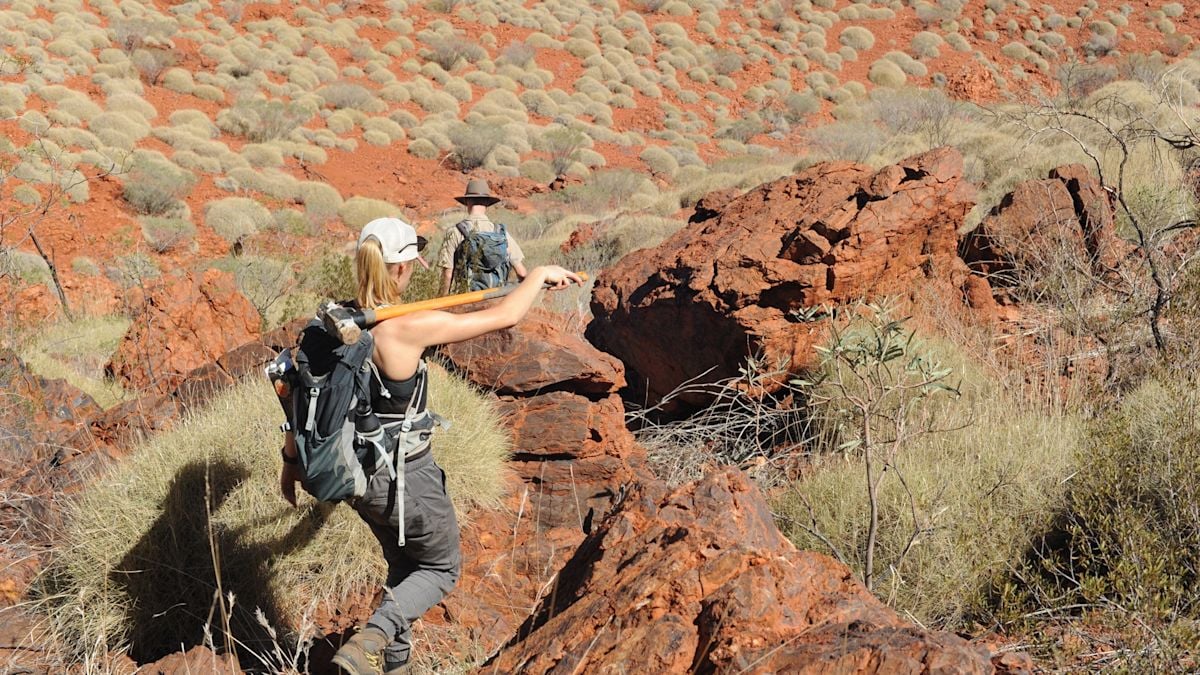
Lead acts as a clock. Uranium and thorium break down into lead at steady rates. Dr. Janne Liebmann collected rock samples in the Western Australian outback. She is a research fellow in Curtin’s Timescales of Mineral Systems Group within the Curtin Frontier Institute of Geoscience Solutions.
The team analyzed thousands of rocks. Mars and Venus do not possess active plate tectonic systems comparable to ours.
The same narrow window came up whether all samples were analyzed together, Australian feldspar alone, or non-Australian samples alone.

Rocks from around the world show that a chemical pattern in Earth’s crust, intact for over a billion years, vanished between 2.75 and 2.63 billion years ago. The results support evidence that Earth underwent a transformation late in the Archean Eon.
“That tells us something fundamental changed in the way Earth's crust was being formed and transformed, marking a transition towards the dynamic tectonic system we see today,” research fellow Janne Liebmann said.
We found it consistently in rocks older than 2.5 billion years, showing they were derived from a pool of ancient crust that formed about four billion years ago. But after 2.5 billion years ago, that fingerprint disappears from the geological record—and despite examining thousands of rocks, we never see it again.
Dr. Janne Liebmann, Research Fellow in Curtin’s Timescales of Mineral Systems Group
Before this transition, early continental material was melted and reworked repeatedly in place.
Professor Chris Kirkland said that this turning point distinguishes Earth from inactive neighbors. He works in Curtin University’s School of Earth and Planetary Sciences.
It marks the transition from an early Earth where ancient crust could be repeatedly melted and reworked in place, to a system capable of moving and recycling crust on a much larger scale. This gives us our clearest geological evidence yet for when the tectonic engine that drives the modern Earth ‘switched on’.
Professor Chris Kirkland, Curtin University
This shuffling altered what washed into ancient oceans. It aligned with shifts in processes that shaped continents, oceans, climate, and overall habitability.

Earlier coverage: Researchers Simulate 5 Billion Years of a Lifeless Earth Evolution