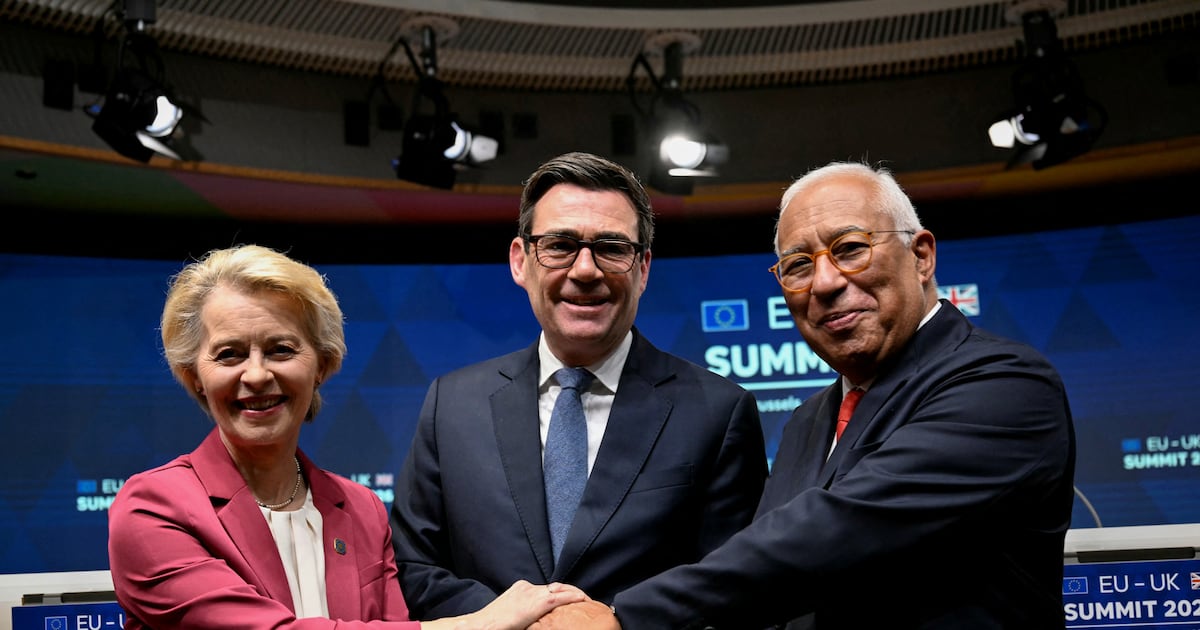
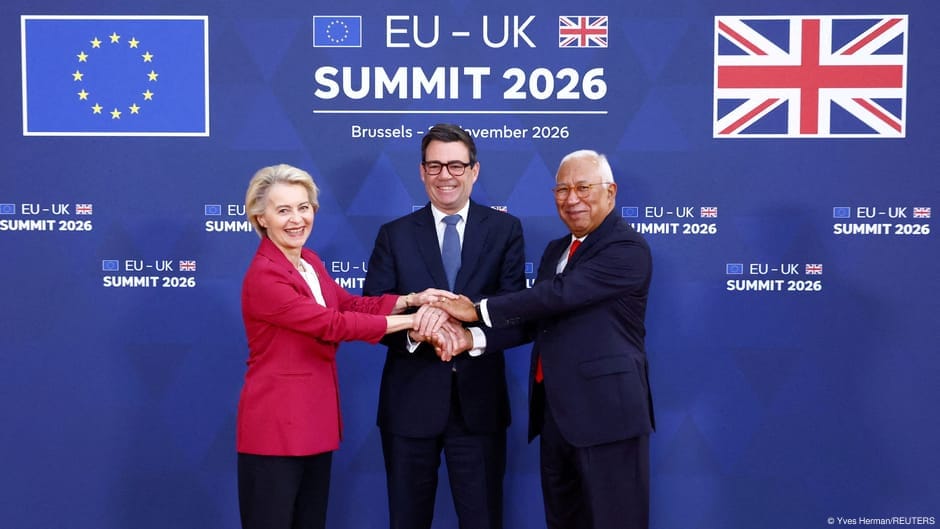
British Prime Minister Andy Burnham met top European Union officials in Brussels on Friday for a summit aimed at resetting relations a decade after the 2016 Brexit referendum.
“The Brexit we were given has not worked. We have lost more than we gained,” Burnham said ahead of the meetings.
Britain and European Union Agree on Trade and Youth Mobility
European Union and United Kingdom leaders finalized agreements covering food trade, youth mobility, and carbon market links during Friday’s summit. European Commission President Ursula von der Leyen called the package “a turning point” in cross-channel relations. European Council President Antonio Costa said that the bloc respected Britain’s original decision to leave while welcoming its current choice to build closer ties.
“a summit of ambition and concrete results. More opportunities for young people. Easier agrifood trade. And a stronger cooperation on economic security,” European Commission President Ursula von der Leyen said.
During the delegations’ meeting, Burnham called the deal a “landmark agreement.” Von der Leyen added that Britain would rejoin the Erasmus+ program, stating, “We miss them so much.”
The centerpiece of the trade package is an agreement to eliminate border checks and certification requirements for animal and plant products. The change is scheduled to take effect on March 1, 2028. Burnham said that the measures would add up to 0.5% to UK Gross Domestic Product, representing a £17 billion economic boost.

“The Chancellor of the Exchequer is here today and he has confirmed today that the UK Treasury has said that the deal struck here will add up to 0.5% to UK GDP. That is a £17 billion boost to the British economy. It is the single biggest growth measure that we could take in this Parliament,” Burnham said at the summit.
Tuition Fee Dispute Casts Doubt Over Ratification
The summit hit a last-minute barrier when the EU’s 27 member states stipulated that the core agreements would only be implemented if Britain agreed within six months to lower university tuition fees for European students to domestic levels. Complying with that request would cost the UK hundreds of millions of pounds annually.
Von der Leyen expressed confidence that negotiators would reach a solution on tuition fees. She said that the two sides have a track record of finding solutions and will work on the matter over the coming month.
While the UK has offered a discounted rate rather than full domestic parity, Burnham insisted that the core agreements were finalized despite the ongoing haggling over higher education costs. Legislation on the deal is expected to be laid before Parliament within a week.
Youth Mobility and Economic Security Agreements
The summit also established the Youth Experience Scheme. It allows 100,000 British citizens under 31 to live and work in the EU for up to three years. There is a reciprocal arrangement for 100,000 EU nationals under 30 in the UK.
The travel industry urged the government to work closely with industry partners so that young people do not have to wait until 2030 for implementation.
Leaders agreed to link their emissions trading systems to prevent carbon border levies on industrial goods like steel. Both sides also launched formal talks on economic security, supply chain cooperation, and structured dialogue on migration and maritime defense.
Critics Question Domestic Political Reactions and Future Prospects
Former Conservative Cabinet minister Michael Gove warned that closer alignment risked handing back control over British laws, borders, and money. Reform UK leader Nigel Farage argued that the agreement humiliated the UK by effectively tying it back into European regulatory structures.
Burnham maintained that the reset reflects public frustration with the status quo. He pointed to recent polling indicating changing attitudes toward Europe across all parts of the country.
Launching Discussions on Defense and Long-Term Relations
Friday marked an announcement by British Prime Minister Andy Burnham suggesting that the newly finalized EU reset agreement likely represents the maximum scope of progress achievable during the current legislative term. Following the conclusion of Friday’s summit, he pledged to initiate discussions with the EU concerning future long-term partnership possibilities.
Euronews.com reported that the documentation specifies that leaders aim to move further regarding defence industrial cooperation. They want to find methods to strengthen joint capabilities, bearing in mind the goal of fostering European supply chains and capabilities alongside tackling capability shortfalls, partly through the Capability Coalitions.
Welcoming Economic Measures and Border Changes
As reported by Irish The Independent, British Prime Minister Andy Burnham characterized the pacts as a positive milestone for both Britain and Europe. He mentioned prior to the summit that these accords would help reduce expenses, maintain lower prices, and create fresh prospects for youth.
The Journal highlighted Northern Ireland Secretary Chris Bryant’s praise for the fresh agreement. The publication pointed out that the UK administration remains determined to forge an increasingly tight bond with the EU to repair the harm caused to Northern Ireland via the establishment of an internal frontier within our nation along the Irish Sea.
Dw.com reported that leaders stated they will establish a structured dialogue on migration. Their joint summit statement noted this would include engagement with third countries and returns to third countries.

The Independent mentioned that the travel industry welcomed the UK-EU Youth Experience Scheme and offered to help deliver it quickly. Seasonal Businesses in Travel urged the government to work with industry so young people do not have to wait until 2030.
Leaders Commit to Defense Collaboration and Border Security Measures
Leaders at the summit also committed to enhancing exchanges on defense industrial issues and identifying ways to deepen capability collaboration. The text of the agreement highlights the objective of developing resilient European supply chains, addressing critical capability gaps through capability coalitions, countering hybrid threats, and providing support to Ukraine.
Brussels hosts the principal EU institutions — its administrative-legislative, executive-political, and legislative branches — making it the de facto capital of the European Union since the end of the Second World War. Because of this concentration, its name is used metonymically to describe the EU and its institutions, which is why major summits like the UK-EU reset are held there.
The framework incorporates data sharing initiatives to tackle criminal gangs involved in human trafficking and illegal migration across the Channel. These plans include provisions to enable the work of the EU border agency Frontex.