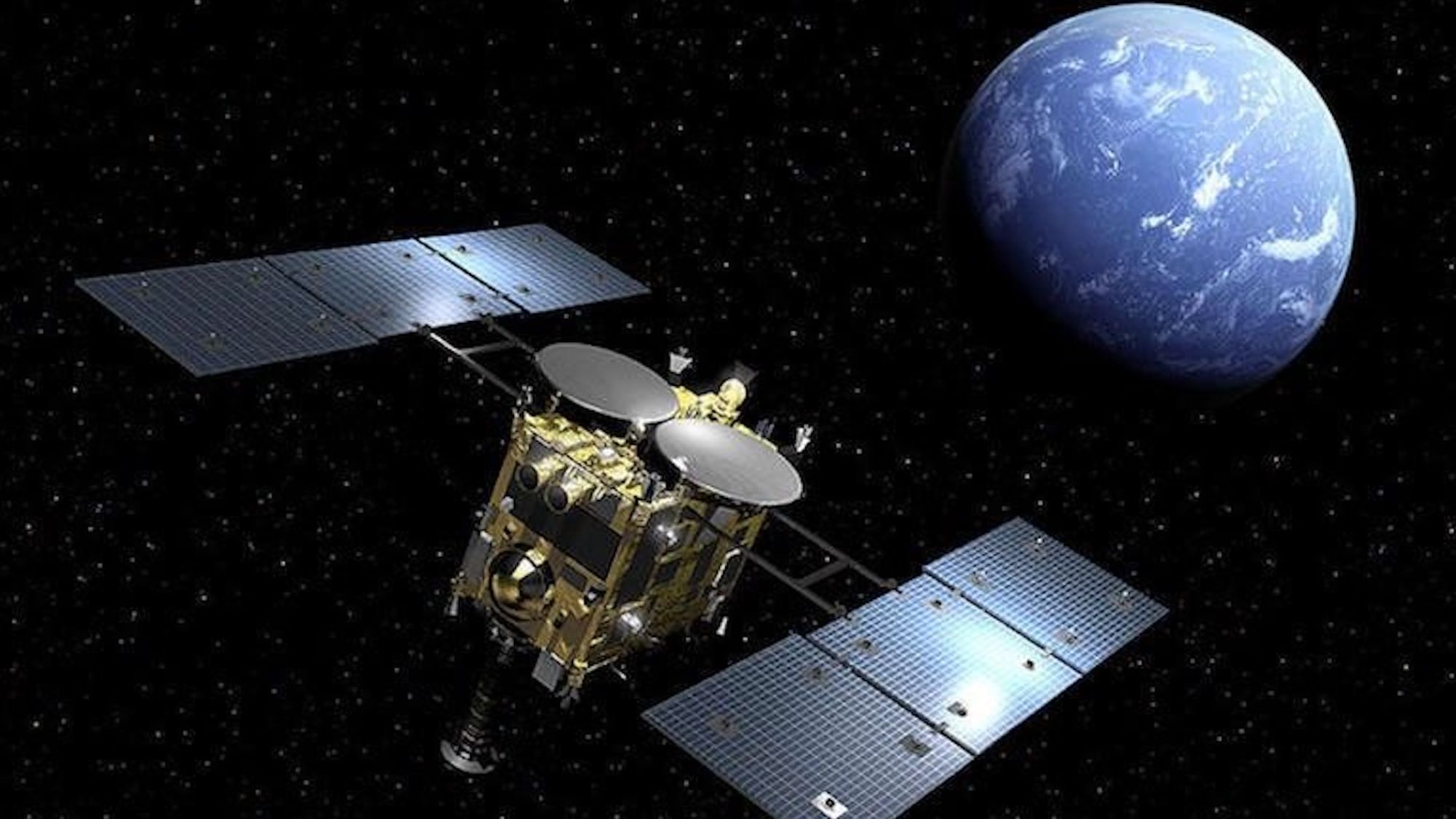
Japan’s space agency has scrapped plans for the Hayabusa2 spacecraft to rendezvous with near-Earth object 1998 KY26 in 2031, forcing scientists to abandon a planned landing after the probe’s ion engines suffered critical malfunctions.
Engine Failures Force Route Change
Launched in 2014 to collect material from the asteroid Ryugu, the veteran spacecraft delivered its samples to Earth in December 2020 via a reentry capsule. It then embarked on an extended mission of exploration, which included a super-close flyby of the two-headed asteroid Torifune in July.
Those extended adventures face a premature end. The Japan Aerospace Exploration Agency announced the decision during a press conference following a Cabinet Office space policy subcommittee meeting, reporting that the final functioning thruster out of Hayabusa2’s four main ion engines suffered a malfunction in mid-August.
The deterioration of the onboard equipment … is becoming increasingly evident.
Yuya Mimasu, team leader of the extended mission, via Japan Times and Space
JAXA officials explained that combining working parts from two damaged engines left the 12-year-old spacecraft without enough thrust to perform the orbital changes required to reach 1998 KY26. The probe will redirect toward a different small body known as 2015 BM510, aiming for a high-speed flyby in April 2028.
Debating Origins of 1998 KY26
The cancellation of the 2031 landing has generated scientific debate over whether the 36-foot-wide object is a natural space rock or something else. Harvard astrophysicist Avi Loeb and his colleagues have examined whether 1998 KY26 could be the long-lost Phobos 1, a Soviet spacecraft that stopped communicating while traveling to Mars in 1988.

Loeb said the object’s rapid rotation—about once every five minutes—and high reflectivity set it apart from ordinary rocks. “This object reflects roughly half the sunlight that strikes it, while a typical rock or iceberg reflects about 5%”, Loeb said, as reported by Internewscast, calling the brightness surprising.
Mainstream researchers and space officials have pushed back against the artificial-origin theory. NASA Administrator Jared Isaacman dismissed the speculation during an appearance on “Fox & Friends,” saying, “I’ve not seen any evidence to suggest this is … anything other than an asteroid.”
NASA pointed to an orbital study led by the agency’s Center for Near-Earth Object Studies. The study concluded that the object’s complex trajectory is driven by solar radiation forces—the natural push of sunlight and thermal emission on its non-spherical shape—rather than hidden comet-like activity or propulsion.
Additional research published by scientists at the Georgia Institute of Technology indicated that 1998 KY26 is likely too warm to sustain ice.

Distant Observations Replace Close-Up Exploration
With JAXA’s direct rendezvous scrapped, astronomers have lost what Loeb described as the only opportunity to capture high-resolution images of the surface and settle the debate.
“There is no way by which we can actually resolve the object, or get a high-resolution image of its surface, without coming close to it — without a flyby — because even with the Webb telescope or the biggest telescopes we have on Earth, the object is not close enough to be resolved into multiple pixels in an image,” Loeb told Fox News Digital.
Loeb said that NASA’s James Webb Space Telescope can detect the heat emitted by the object, offering a way to learn about its size, surface temperature, and composition. JAXA continues its exploration roadmap, with plans to launch its Destiny+ mission around the same time as Hayabusa2’s 2028 flyby.
JAXA Cancels 2031 Rendezvous After Thruster Failure
JAXA officials reported to the space policy subcommittee on November 16 regarding the cancellation of the 2031 rendezvous after the final operational ion thruster malfunctioned. Team leaders explained that repeated main engine trouble prompted them to revise the mission trajectory to a safe pathway.
The new target, object 2015 BM510, measures between 17 meters and 74 meters across and completes a rotation every 49 minutes. Operating as a dark and small target, investigators said the upcoming flyby will rank among the most difficult navigation feats attempted by the agency.
Researchers studying the celestial body point out that its D-type classification indicates an organic-rich, comet-like composition originating in the outer solar system.
Independent analyses continue to track potential interstellar intruders across the solar system, with experts anticipating that upcoming surveys from ground-based facilities will discover numerous similar items in the coming decade. JAXA’s separate mission lineup includes the Destiny+ probe, which will travel past asteroid 3200 Phaethon following its initial flyby sequences, building on decades of asteroid exploration.