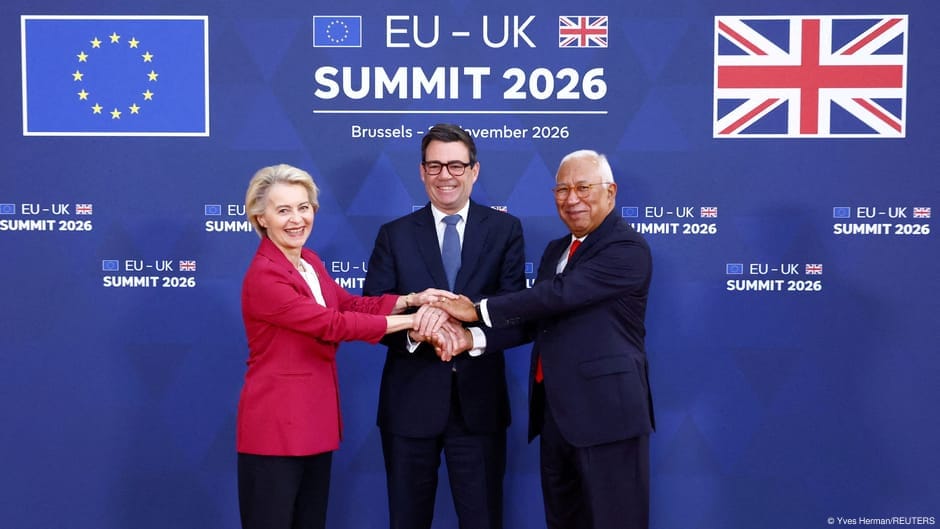
“Prime minister, you are always welcome in the European Union,” European Council President Antonio Costa told UK Prime Minister Andy Burnham as the two leaders convened in Brussels on Friday for a high-stakes summit aimed at rebuilding post-Brexit ties a decade after the United Kingdom voted to leave the bloc.
Brussels Summit Delivers SPS and ETS Agreements
The summit produced a suite of draft agreements designed to lower trade friction and economic barriers between the UK and its largest trading partner. British officials finalized deals covering sanitary and phytosanitary rules to ease border checks on food exports, alongside alignment on emissions trading systems for carbon-heavy goods.
“A strong partnership between the European Union and the United Kingdom is a strategic investment in Europe's security, but it is also an investment in our shared prosperity, in innovation, competitiveness and resilience because there can be no strong defence without a stronger economy, and together, we will be stronger on defence and stronger on the economy,” European Council President Antonio Costa said.
European Union top officials and UK Prime Minister Andy Burnham announced agreements on trade and youth mobility at the Friday Brussels summit. European Commission President Ursula von der Leyen called it a turning point in relations, while Burnham characterized the deal as a landmark agreement.
Von der Leyen said that the youth experience project would create lifelong friendships and open horizons, adding that the trade pact functions as a two-way street providing greater choice for customers. Regarding the carbon market agreement, von der Leyen stated it would generate investments in cleaner industries while cutting emissions. She also mentioned that Britain will rejoin the Erasmus+ program, expressing that they miss them greatly.

Tuition Fee Dispute Delays Implementation
Despite the initial breakthrough, the practical implementation of the summit package faces significant hurdles. London and Brussels remain divided over university tuition fees for European students attending British institutions. The EU pressed for EU nationals to pay the same domestic rates as British students—currently £9,790 per year—rather than international fees reaching up to £36,000, according to RTÉ and Yahoo News reports.
Von der Leyen expressed confidence that negotiators would resolve the fee question within the next six months. This resolution is required before the food export and carbon trading agreements can go live, a rollout RTÉ notes is targeted for March 1, 2028. Tied to these discussions is a youth mobility scheme designed to allow 100,000 young people from each side to study, work, or travel across the Channel.
The number of European Union students starting courses at British universities experienced a decline of 57 percent between the 2020/21 and 2023/24 academic years, according to data from the University of Oxford’s Migration Observatory. Meanwhile, Oliver Lewis, chairman of the Stay Out group, asserted that Burnham had been outmaneuvered by Brussels after observing how eagerly the prime minister sought an agreement.
Lewis argued that European officials decided British taxpayers should cover cheaper fees for EU students before signing any pact. Conversely, an EU official highlighted that such measures are vital for maintaining people-to-people contacts across both sides of the channel.
Economic Projections and Political Opposition
Prime Minister Burnham told Parliament that the package represents “the single biggest growth measure to be delivered in this parliament,” citing UK Treasury estimates that the deal will add up to 0.5 percent to gross domestic product—equivalent to a £17 billion economic boost, according to BBC News.
“This is a good day for Britain. This is a good day for Europe,” Burnham said.
Opposition figures launched immediate criticisms following the announcement. Conservative Party leader Kemi Badenoch questioned the Treasury’s modeling, accusing the government of plucking figures from the air while warning that British farmers would be forced to follow Brussels-made regulations. Reform UK leader Nigel Farage characterized the summit as an EU triumph, while former prime ministers Theresa May, Tony Blair, and Rishi Sunak raised separate objections over the direction of post-Brexit policy.
Polling firm YouGov maintains a regular tracker monitoring public sentiment on whether the United Kingdom was right or wrong to vote to quit the European Union. Since the middle of 2022, a survey majority consistently indicated that the departure was a mistake. By September, the share of respondents in the regret camp climbed to 60 percent, marking the highest recorded level in the tracker’s history.

Opposition Leaders Challenge Treasury Modeling
Conservative leader Kemi Badenoch targeted the Treasury analysis in her speech at the Confederation of British Industry annual conference, accusing Andy Burnham of deploying ambitious rhetoric with questionable figures and asserting that British farmers would now have to follow rules made by Brussels, as reported by BBC News.
Reform UK leader Nigel Farage argued on Friday that the great Brexit debate had just started again and maintained that the prime minister possessed no mandate for the package, according to The Independent and Deutsche Welle.
Former prime minister Tony Blair told The Sunday Times that Britain should only rejoin the European Union if it carries out reforms and allows greater innovation on technology, adding that Burnham should move on from Brexit.
Meanwhile, the Socialist Workers Party reported that US ambassador Warren Stephens had warned even before Burnham took office that closer ties with Brussels would be viewed unfavourably in the White House, with retaliation potentially taking the form of further tariffs, a frozen trade deal, and pressure on Britain’s dependence on American nuclear and intelligence systems.

Forecasting Future Alignment and Strategic Challenges
Politico reported that over 30 politicians, officials, and campaigners in the United Kingdom and Brussels questioned Andy Burnham’s grand strategy on Europe, noting that EU officials are making clear the future path will be all or nothing because the bloc expects Britain to either join the single market and customs union or stay where it is.
Anand Menon observed that once observers look carefully at the deals Norway and Switzerland have, they realize those arrangements are awful, while a Cabinet minister laughed when asked if they knew the Europe strategy and said that nobody tells them anything, according to Politico.
Joël Reland, senior researcher at the UK in a Changing Europe think tank, suggested that the economic relationship could culminate in Labour’s next election manifesto abandoning the party’s famous red lines and proposing an application for European Union membership, while Euronews reported that an unnamed EU official emphasized the youth mobility package is important for maintaining people-to-people contacts on both sides of the channel.
Long-Term Relationship Talks and Next Steps
As the government deals with domestic pushback, Burnham acknowledged that the Brussels agreement marks the practical limit of what can be secured during the current parliamentary term. Both sides agreed to initiate informal brainstorming talks to map options for a broader, long-term relationship to inform future parliaments, while economic security and migration dialogues are formally established.