Western intelligence agencies believe Russia could launch a nuclear-armed satellite into orbit as early as December, a timeline that would violate the 1967 Outer Space Treaty and risk disabling a third of all low-Earth orbit satellites within hours, according to a joint investigation by German broadcasters WDR and NDR and the newspaper Süddeutsche Zeitung published Monday.
The satellite, designated Sputnik-S, has reportedly been stored near Moscow for years and could be launched within 60 days of early-November warnings shared among NATO members. Germany’s military briefed Defence Minister Boris Pistorius and other officials in recent weeks. The U.S. Defense Intelligence Agency’s October report, “Challenges to Security in Space 2026,” explicitly states Russia is developing a satellite designed to carry a nuclear weapon.
What a Detonation Would Do
A nuclear explosion in low-Earth orbit would generate an electromagnetic pulse and artificial radiation belts capable of crippling satellites across multiple orbital regimes. Low-Earth orbit hosts commercial constellations like Starlink. Medium-Earth orbit carries navigation satellites. Geostationary orbit holds critical communications.
U.S. Space Command chief General Stephen Whiting estimated roughly one-third of low-orbit satellites could fail within the first hours or days, with additional losses accumulating over months. The radiation would also endanger astronauts on the International Space Station and persist for years.
Western militaries rely far more heavily on space-based assets for targeting, communications, navigation and drone operations than Russia does. A mass satellite failure would hand Moscow a temporary warfighting advantage, the German investigation noted.

The Kosmos-2553 Precursor
Intelligence analysts have tracked a likely precursor since February 2022, when Russia launched Kosmos-2553 into an unusual 2,000-kilometer orbit with elevated radiation levels. Moscow claimed the satellite was conducting radiation-hardening experiments, but Western services assess its real purpose may differ. The DIA report links this activity to the current nuclear satellite program.
Germany’s Readiness Gaps
The German investigation also exposed shortcomings in national preparedness. Of 27 planned space-security procurements or upgrades, 19 remain in development through the end of the decade and are not expected to reach operational status for another ten years, according to Süddeutsche Zeitung, NDR and WDR. The Defence Ministry declined to comment on the specific Russian plans, citing the confidentiality of internal deliberations.
DIA Report Details Expanding Counterspace Threats
The report catalogs a broad spectrum of Chinese and Russian counterspace capabilities, including direct-ascent anti-satellite missiles, cyberattacks on ground stations, electronic jamming and directed-energy weapons, while also noting Iran and North Korea are strengthening their own space capabilities, as reported by Reporter and ENIKOS.
NEW: Western intelligence agencies believe Russia could launch a nuclear-armed satellite into space before the end of 2026. The satellite, reportedly named Sputnik-S, has allegedly been stored near Moscow for years and could be launched as early as December. Germany’s military… pic.twitter.com/ctGpUhziwE
Peter Garretson, a space strategy specialist, assessed that China’s expanding space ecosystem — from reusable launches and new propulsion to on-orbit servicing and commercial satellite exploitation — is tied to wider economic and strategic ambitions, according to Reporter.
German Officials Briefed on Imminent Launch Risk
The joint investigation by WDR, NDR and Süddeutsche Zeitung states that several NATO allies were informed in early November, while the German military’s intelligence branch warned of severe limitations on communications, navigation and possible power-grid disruptions from an orbital detonation, as reported by Flash.

Major General Armin Fleischmann of the German Cyber and Information Domain Command emphasized that Western armed forces show greater dependence on satellite services compared to Russia, meaning an extended outage would offer Moscow a temporary military advantage in any conflict.
Kremlin Rejects Allegations as Propaganda
BREAKING: Western intelligence agencies believe Russia could launch a nuclear-armed satellite into orbit as early as December 2026, potentially threatening thousands of satellites worldwide, according to a new investigation by German broadcaster Tagesschau. The satellite named… pic.twitter.com/ShyTj5ClFl
U.S. officials have warned since 2022 that Moscow might place a nuclear weapon in space, initially focusing on Kosmos-2553, launched in February 2022 into an unusual 2,000-kilometer orbit with elevated radiation levels, which Western intelligence assesses may serve a different purpose than Moscow’s stated radiation-hardening experiments, according to Source 2 and Source 6.
Broader Anti-Satellite Arsenal
The DIA report catalogs a full spectrum of Chinese and Russian counterspace capabilities: direct-ascent anti-satellite missiles that create long-lived debris fields, cyberattacks on ground stations and satellite control networks, electronic jamming, and directed-energy weapons. China aims to establish a permanent lunar-space economy by 2045 and has conducted sustained operations on the Moon’s far side, with the report noting Chinese officials have referenced potential military applications.
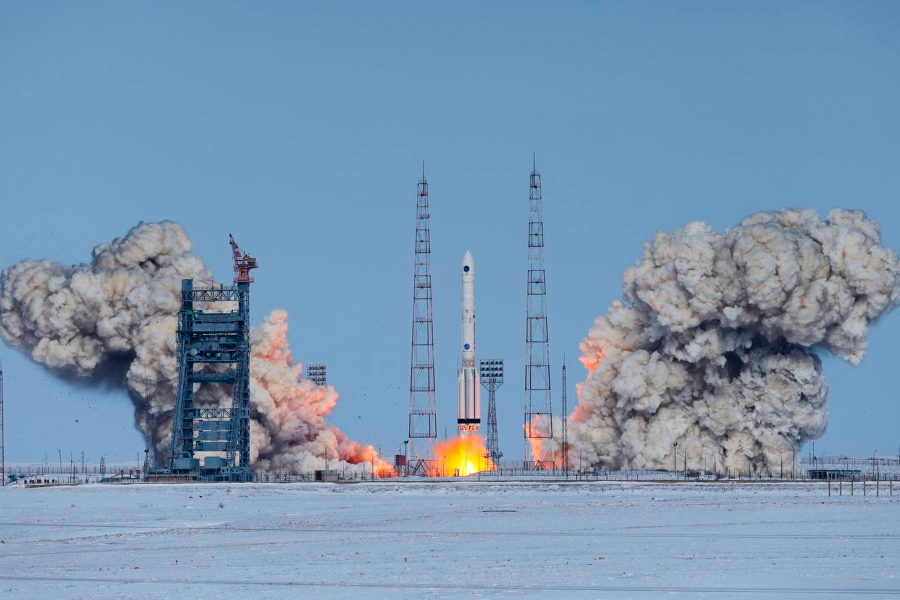
The 1967 Outer Space Treaty prohibits placing nuclear weapons or other weapons of mass destruction in orbit around Earth. A Russian launch of Sputnik-S would constitute a direct violation, with few effective countermeasures once the weapon reaches orbit, the DIA warned.